

Research shows that older job seekers often face age discrimination. What can you do to reduce ageist bias in hiring? And are there regulations that give older employees a fairer chance?
This guide covers how age bias shows up in applications and interviews, the preparation that pays off from your 40s onward, and how to present seniority as an asset on your resume and in the room.
You will also find U.S. and UK legal reference points, job boards for retirees and 55+ workers, and practical ways to keep your search active — including training, career switches, volunteering, freelance work, and networking. Pair the advice with a modern resume builder so your experience reads clearly to both people and screening software.
Age is just a number
“Age is just a number” sounds fine in romance. In the labor market, people over 40 know that birthdays can change how employers read the same skills. As an applicant, your age is a factor — and not “just a number.”
Statistical insight
Career surveys have found that about half of people over 40 sensed age discrimination during the application process. That feeling was most common when applying by email or telephone at another company (54%), or during a job interview at another company (48%). They were less likely to suspect age discrimination during an internal job application or promotion (28%).
Research by WerkLabs and The Mom Project found that 75% of 700 over-40s in their survey experienced being labeled “old” when applying for a job at some point. Ageism shows up across the hiring funnel:
- 67% do not feel welcome because of phrases such as “starter,” “young team,” or “great dynamics.” Those kinds of terms appear especially often in digital marketing (81%), advertising (84%), and finance (85%). Many surveys show that age requirements are still imposed on candidates, directly or indirectly.
- In interviews, recruiters and employers often downplay deep work history and over-emphasize modern technology — even when candidates prove they are tech-savvy.
- After applying, people are sometimes rejected for a lack of “cultural fit.” According to Pam Cohen, lead author of the study, saying “you don't fit in the team” can be a way to mask ageism.
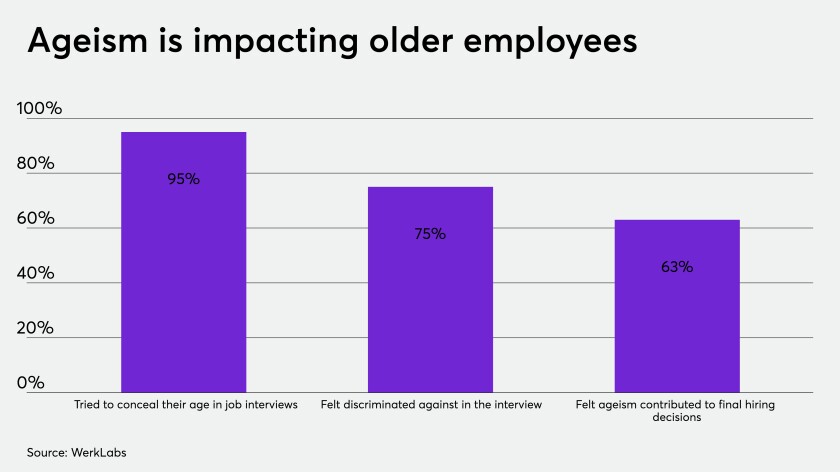
Age discrimination is common — and often unjustified. Over the years, research has found that older employees often perform as well as or better than younger colleagues. People over 55 can use the same technologies as colleagues between 18 and 35. They also tend to show more stable performance and lower absenteeism.
Being good at your job still does not automatically stop bias. Postdoc researcher Jelle Lössbroek of Utrecht University advises mixed selection committees; his research found that managers over 50 themselves discriminate less on age than younger managers.
Like other forms of discrimination, age discrimination in the UK is prohibited — the Equality Act 2010 guidance covers age, and cases have been won, yet proof remains difficult. If you are a professional over 50, what can you do yourself to reduce the bias you face? The sections below focus on preparation, resume strategy, interviews, and active job-hunt tactics.
Job searching over 50: do your homework
Those studies make one point clear: as an older applicant, you rarely get an automatic advantage. Strong preparation matters even more after 50 — and that preparation should start while you still have a job.
Careers change with little warning. You will not always know months ahead that you need another role. Build habits now so “later” does not become an emergency scramble.
Homework from your 40th birthday
Treat your mid-career years as continuous readiness, not a scramble after a layoff. These habits compound:
- If you do not have a solid LinkedIn presence, build one. Visibility, network maintenance, vacancy discovery, and Easy Apply all start there — and a current profile is easier to update than a blank one. Strengthen how you present expertise with skills to add to LinkedIn.
- Maintain and grow your network. The larger and warmer your circle, the more likely someone can open a door when you need it.
- Keep taking courses, training, and further education. That helps your current job and shows lifelong learning on your resume. When you update materials, a clean layout from MakeResume's resume templates or the free resume builder keeps new credentials easy to scan.
- Keep learning new skills — especially technology employers expect in your field. Stale tools are one of the fastest ways age stereotypes stick.
- Replace outdated email providers with a modern address (for example Gmail or Outlook). An ancient Hotmail-style address can signal that you are not keeping up, fair or not.
Homework from the moment you look for a new job
Once the search is live, turn quiet readiness into visible momentum:
- If you skipped the mid-career homework above, start today — LinkedIn, courses, email, and network refresh all still count.
- Tell your network you are looking and describe the kind of employer and role you want. Clear enthusiasm makes it easier for contacts to spot a fit.
- Set LinkedIn to Open to Work and respond thoughtfully to relevant posts so you stay visible without sounding desperate.
- Collect references and recommendations. They strengthen your LinkedIn profile, support applications, and quietly announce that you are open to a new challenge. When an offer lands, knowing how to announce a new job on LinkedIn helps you close the loop professionally.
- Message interesting employers on LinkedIn. Lead with what you can do for them and the ideas you would bring — not a long history dump.
If you want role ideas that fit encore careers and flexible schedules, see our guide to the best jobs for seniors — with dozens of examples beyond the usual stereotypes.
What can you do to prevent age discrimination?
When you are actively searching, the instinct is to hide anything that reveals age. Some candidates omit date of birth, graduation years, and early career roles, and keep only the last 15–20 years of experience so age never appears on paper.
That approach has trade-offs. Understanding both sides helps you choose a strategy you can defend in an interview.
Benefits of leaving out your age on your resume
- Age feeds a recruiter's mental picture of you. Without it, they may need an interview to “complete the puzzle.” If your skills match the vacancy, curiosity can get you in the door.
- When age is missing, reviewers lean harder on experience, education, and skills. That can help in roles where depth and judgment matter most.
Disadvantages of leaving out your age on your resume
- Omitting age can backfire. A recruiter may guess high — or set your resume aside because they dislike playing detective.
- If your resume implies a younger candidate and a much older person walks into the interview, the mismatch becomes a negative first impression you could have avoided.
Hiding your age is rarely an ideal long-term solution. Screening systems and humans both notice gaps and odd date patterns, and surprise rarely helps once you are in the room.
The best solution to fight age discrimination successfully
Be open about seniority. Embrace the experience you have earned, and pair it with a resume that shows energy, curiosity, involvement, and results — not defensiveness about your age.
Own the story: you are experienced and still learning. That framing beats vague attempts to look 30 on paper.
The older employee's resume
If it has been years since your last application, your resume needs a deliberate refresh. Use these updates to look current without erasing the value of a long career:
- Refresh job titles and update outdated labels to modern equivalents. A “chief” may now read as team leader or manager; a “vendor” may map to sales manager or key account coordinator.
- You may include a date of birth if you choose, but avoid awkward age commentary — phrases like “despite my respectable age,” “young at heart,” or “active senior” invite the bias you are trying to defuse.
- Optimize for applicant tracking systems (ATS). Many employers filter resumes by keywords and qualifications before a human reads them. Mirror language from the job posting and use a clean, ATS-friendly format. For a full walkthrough, see how to make an ATS-friendly resume.
- Strengthen your resume summary. A few sharp sentences at the top should show who you are, what you deliver, and how that matches the role — achievements, ambition, and eagerness to keep learning.
- Add relevant hobbies and interests when they prove energy, skills, or culture fit. An active life outside work can counter stereotypes without sounding defensive.
- In work experience, emphasize the last 10–15 years. Earlier roles matter less unless they prove a rare credential; employers want recent knowledge and skills you can bring now.
- Align skills and personal qualities with the posting. Read the description carefully and surface the capabilities the employer actually needs — then prioritize those in your skills section.
Expert tip
A polished, keyword-aware resume from MakeResume's resume builder helps decades of experience fit on one or two pages without looking dated — so recruiters see impact first, not a timeline dump.
Profiling yourself as over 50 in the job interview
A strong resume that wins an interview is only half the job. Expect questions that touch age directly or indirectly — salary expectations, learning agility, software comfort, stamina — and prepare answers that turn extra years into proof.
Address concerns head-on. Explain why experience is an advantage, and neutralize stereotypes about curiosity, cost, tech fluency, and pace. Anchor your story on these strengths:
- Experience. You have watched office trends come and go. You know what works, you are harder to mislead, and you work with quiet confidence.
- Involvement. You have a clearer picture of the organizations and tasks that suit you. You commit for a purpose, not just a paycheck.
- Stability. Many people over 50 have a steadier home rhythm than twenty years earlier, more self-knowledge, and less chaos from early family years — a stabilizing presence on a younger team.
- Productivity. Depth makes familiar tasks faster and new tasks easier to absorb. You have solved unforeseen problems before; that raises output.
- Loyalty. Where some early-career candidates job-hop quickly, you are less likely to leave for small frictions — and more likely to stay and improve a role when things get hard.
- Broad employability. Multiple roles across a career usually mean wider process knowledge. You can cover for colleagues, step in during absences, and connect dots younger specialists may miss.
If interviews keep ending in silence or soft noes, revisit how you handle outcomes with guidance on how to reject and be rejected during job interviews — then adjust your pitch, not just your volume of applications.
Regulations and assistance for older jobseekers
In the United States, the Equal Employment Opportunity Commission (EEOC) oversees equal employment opportunity for older workers.
The Age Discrimination in Employment Act of 1967 (ADEA) forbids discrimination against workers aged 40 and over, while the Older Workers Benefit Protection Act (OWBPA) prohibits employers from denying benefits to older workers. Any employment decision or practice that is age-related and not based on a reasonable factor other than age (RFOA) can be a basis for complaint.
A 2018 report by Victoria A. Lipnic, then chair of the EEOC, examines the state of age discrimination in U.S. employment as the workforce ages. The EEOC's fact sheet on age discrimination is a clear starting point for rights and definitions.
Rules do not make bias disappear overnight — but knowing ADEA, OWBPA, and RFOA helps you recognize when a practice may cross a legal line and where to seek help.
Working after retirement
More people keep working well into traditional retirement years. They want daily rhythm, social contact, a chance to share knowledge, and a sense of usefulness.
Many stay with a long-time employer after pension age, combining wages with retirement benefits and any additional employee pension — and some can postpone extra pension payments. Others return after a break through part-time, consulting, or encore roles.
If you are of pensionable age and want to work again, specialized job boards and resource hubs can help:
- National Older Worker Career Center (NOWCC)
- Workforce50
- CareerOneStop (55+ workers)
- Retired Brains
- AARP Work
For concrete role ideas once you are browsing those boards, cross-check options in best jobs for seniors.
Actively get started with your job hunt at 50-plus
If applications have stalled, widen the playbook. Employers often weigh what you have done in the last three years heavily — long gaps without learning, volunteering, or project work are harder to explain. Stay busy in ways that produce proof.
- Take a course, training, or formal education. New knowledge is always useful, and recent learning signals energy. If you are unsure which direction fits, a career aptitude test can narrow the field before you invest months of study.
- Explore a career switch that combines learning and earning. Healthcare, education, IT, and technology still show notable shortages; one or two years of focused study is often enough to enter a new path. See how to change careers for a structured approach.
- Consider an internship. An internship lets you prove value up close and often dissolves age assumptions. Many people convert strong internships into permanent roles — search boards for “internship” plus your target profession.
- Volunteer with intention. Volunteer work can spotlight reliability and skills, and it still belongs on a resume even if it does not become a paid offer.
- Attend company open days — including online events — to sample culture and meet hiring contacts without a full formal process.
- Try freelancing if rejections keep stacking up. Contracting lets clients choose your seniority on purpose, and it keeps your recent experience current while you hunt for a longer-term role.
Finally, keep networking. Many senior openings never appear on public career pages; they move through referrals and internal channels. Make sure your network knows you are looking, and profile yourself as an active candidate — not a passive applicant waiting for luck.
Age bias is real, but preparation, a modern resume, and a clear interview story still move the odds. Build materials that show what you can deliver next — then use MakeResume's resume builder to keep that story tight, current, and easy to tailor for every application.
Tools & guides mentioned in this article
- AI Resume Builder
Build an ATS-ready resume with AI writing help and live preview.
- Resume Templates
Browse ATS-friendly layouts for every industry and career stage.
- Free ATS Checker
Upload your resume and get an instant ATS compatibility score.
- Free Resume Checker
Grade your resume's overall quality, bullet impact, and clarity for free.
- Career Advice Blog
More resume, ATS, and job-search guides from MakeResume.
Land 3x more interviews with AI.
Don't let your resume get stuck in an ATS. Build an optimized resume in minutes, then validate it with our free checker.