

Should you send that application in January or August? Monday morning or Friday afternoon? Timing is not everything, but it can change whether a recruiter actually reads you.
A strong resume and cover letter still do the heavy lifting. Knowing when hiring teams are most likely to look at new files can still give you an edge — especially when you are competing with a pile of similar candidates.
If you need work immediately, you will not wait for a perfect month. You can still pick a better day and hour to hit send. This guide covers why timing matters, the best and worst times of year, week, and day to apply, and how to use the rest of a job hunt when you are not filling out forms. Pair it with a current resume you can tailor per posting.
Why does when you apply for a job matter?
When you apply matters because hiring volume, vacation calendars, and inbox habits change how fast — and how carefully — someone reviews your file. A dream role still deserves an application the day you find it; a discretionary search can wait for a busier hiring window.
If you already have a job and want a better one, it helps to hunt when employers are opening roles and prioritizing interviews. Otherwise your resume can sit in a growing stack. If you lose a job or you are entering the market for the first time, you will not wait months — you can still aim for a receptive day and hour so HR is more likely to be at a desk, not on leave.
The exception is obvious: if you see a role that is clearly the right fit, apply. Do not let a calendar theory talk you out of a posting you would regret missing. For borderline listings, decide whether the posting is worth the form before you optimize the clock.
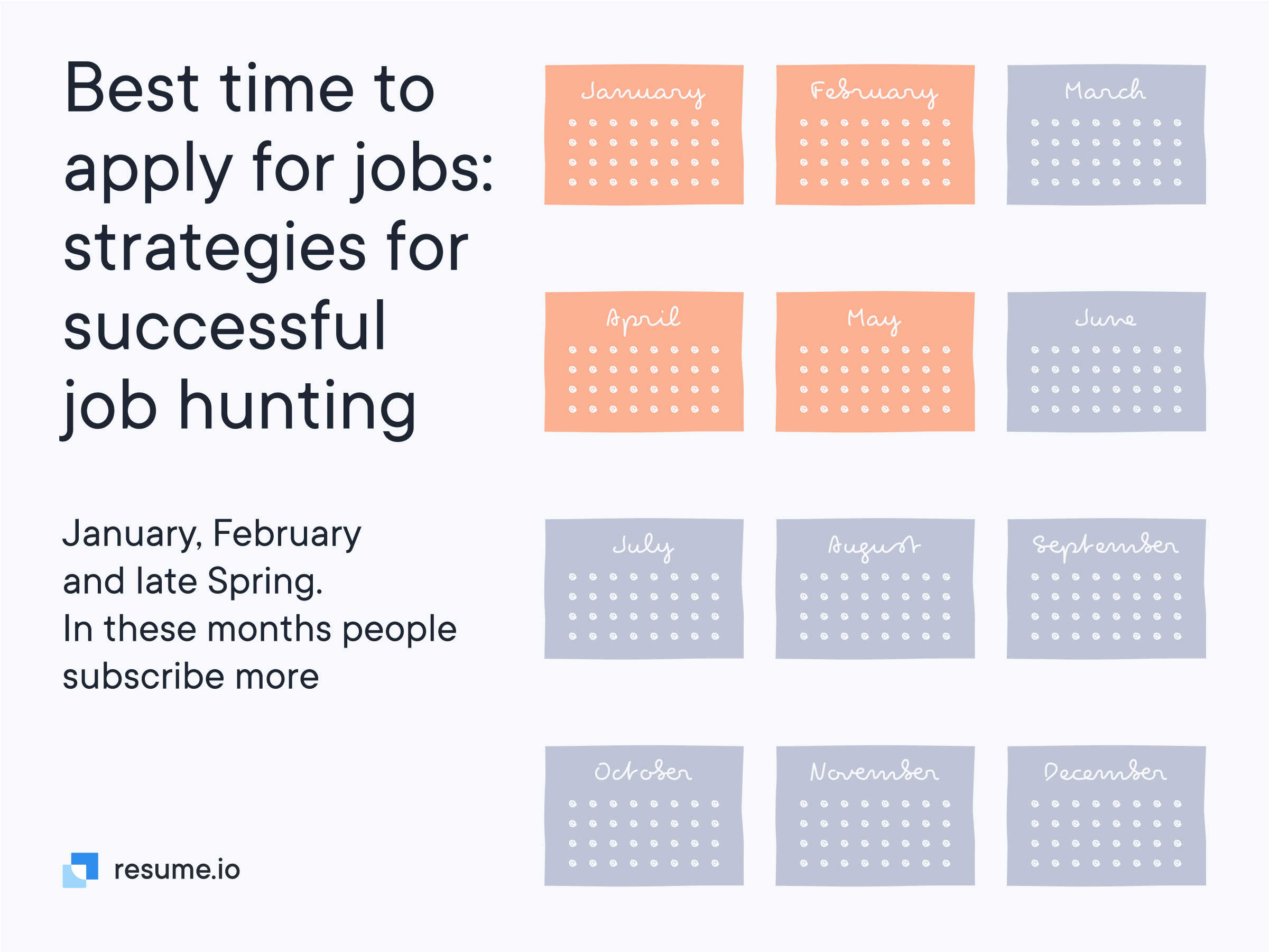
When is the best time of year to apply for a job?
The strongest window for most office and professional roles is the start of the year and late spring; the weakest stretches are late December and late summer, when vacations slow hiring — unless you work in retail or travel, where the calendar is reversed.
New Year plans are not only personal. Many companies restart initiatives after winter holidays, including roles that were approved before Thanksgiving but not posted or filled while offices were thin. Those jobs may appear in December; interviews often wait until January.
Which months are best for a job search?
January and February are strong months if you want the widest range of openings. Many budget cycles reset near year-end, so new headcount that sat through holiday closures often goes live in the new year.
New Year resolutions also move people who are unhappy in their current roles. Those departures create vacancies you can fill.
The run-up to school graduations is another useful stretch. Employers know students want first jobs, so they post in March, April, and May. Fewer HR people tend to be on vacation then, so processes often move faster.
Which months are worst for sending applications?
Late December and August are usually the slowest, because that is when many workers take time off and office life thins out.
December is the most popular vacation month, followed closely by July and August. Retail and travel are the clear exceptions: their busy seasons sit opposite the typical corporate calendar, so hiring can spike when everyone else is at the beach.
What is the best day of the week to apply for a job?
Monday (or late Sunday evening) is the better bet for many applicants; Friday — especially Friday afternoon — and Saturday are weaker, because recruiters are winding down or not in the inbox at all.
A January resolution to look for work is shared by a lot of other people. Day-of-week timing will not invent a job, but it can keep you out of the densest Tuesday pile.
Why is Monday the best day to apply?
Monday is a strong send day because many workers treat it as their most productive day, and late-Sunday applicants have shown a higher interview rate than the Tuesday crowd in cited studies.
LinkedIn reports that studies have found most people apply on Tuesdays. You do not have to join that cluster. Although 37 percent of resumes arrive on a Tuesday, those applicants have only a 20 percent success rate. Polish the resume and cover letter over the weekend and send on Monday — the most productive day of the week for 28 percent of workers — or late Sunday evening, when 30 percent of applicants moved on to the interview process.
Why is Friday a bad day to apply?
Friday is a weak day because attention drops as the week ends, and Saturday applications often land under a weekend of spam before anyone is hiring again.
Every HR team has its own rhythm, so no weekday is a guarantee. You can still bet that Friday afternoon is not when people concentrate hardest on new applicants. Completing forms on Saturday is fine; queue the send for Sunday night or Monday morning so you are not buried at the bottom of an inbox.
Expert tip
What about Wednesday or Thursday? If a posting is a genuine fit, send the package. The highest volume of responses to job ads comes within 2–5 days of posting. Being an outlier later in the week can still get a read — but if a recruiter already has a pile of qualified people, they may stop looking.
Do not hit send minutes after the job goes live, either. That often signals a generic resume, not enthusiasm. Take time to match skills to the posting and research the company so the file looks like it belongs to this role.
What time of day should you send a job application?
Aim for mid-morning — around 10:30 a.m. in the employer's time zone — if a person will see the file soon. Avoid 3 a.m. sends unless you have already proofread, because errors and a buried overnight inbox both hurt you.
If you cannot sleep and you are scanning job sites again, two checks matter. First: are you awake enough not to send an application with typos? Second: when will a human look? Many responses pass through an applicant tracking system before a recruiter's inbox, which can make clock time less important. If you are emailing a person directly, time of day still counts.
The average worker is most productive at about 11 a.m., according to a data analysis by Quartz (via Redbooth). If you think your application may be opened soon, try to have it there by about 10:30 a.m. so the recruiter can batch what they want to read in depth. After lunch, productivity falls; by 4 p.m. many people are watching the clock more than the inbox.
How should you spend time during a job hunt besides applying?
You cannot apply all day. Use leftover hours to inventory skills, refresh the resume, talk to people in the field, and tidy professional profiles so callbacks have somewhere solid to land.
- Take an honest skills inventory. Build a master list of job-related knowledge and skills. If postings keep asking for something you lack, close the gap with a class or a credential instead of sending the same file again. Lead future versions with skills hiring managers actually screen for.
- Review the resume, not just the latest job title. Keywords still have to match what an ATS will parse. Adding one new role on top of an outdated document is often why interviews stall. A full rewrite in the resume builder is usually faster than another cosmetic pass.
- Do research that is not a job board. Informational conversations with recruiters or people a level above you in the field can show what impresses them. Some will even critique a resume or cover letter if you ask cleanly.
- Update LinkedIn and other professional profiles. Many recruiters look there for a broader picture than a one-page PDF.
Keep applications moving
Timing helps, but a messy tracker wastes the Monday send. Keep a simple list of postings, dates, and follow-ups, and run each file through an ATS check before you submit so the clock is not the only thing working in your favor.
Frequently asked questions
What is the best month to apply for jobs?
For most professional roles, January through May is the strongest stretch: new budgets, New Year moves, and spring graduate hiring. Late December and August are usually slower because of vacations. Retail and travel often hire on the opposite calendar.
What is the best day of the week to apply for a job?
Monday, or late Sunday evening, is a better default than Tuesday (when 37 percent of resumes arrive but success is only about 20 percent) or Friday afternoon. If a posting is a clear fit midweek, still apply within 2–5 days of it going live.
What time of day should I send a job application?
If a person may open it soon, aim for about 10:30 a.m. in their time zone, ahead of an 11 a.m. productivity peak. Proofread first. Overnight sends are fine if the file is clean and you are not counting on an immediate human read.
Should I wait to apply if I need a job now?
No. Optimize day and hour; do not delay weeks for a theoretically better month. A tailored, error-free application still beats a perfectly timed generic one.
Is it bad to apply the minute a job is posted?
Yes, if that speed means a generic resume. Recruiters often read a rushed file as a lack of research. Take enough time to match the posting, then send — preferably still inside the first few days.
Tools & guides mentioned in this article
- AI Resume Builder
Build an ATS-ready resume with AI writing help and live preview.
- Resume Templates
Browse ATS-friendly layouts for every industry and career stage.
- Free ATS Checker
Upload your resume and get an instant ATS compatibility score.
- Free Resume Checker
Grade your resume's overall quality, bullet impact, and clarity for free.
- Career Advice Blog
More resume, ATS, and job-search guides from MakeResume.
Land 3x more interviews with AI.
Don't let your resume get stuck in an ATS. Build an optimized resume in minutes, then validate it with our free checker.