
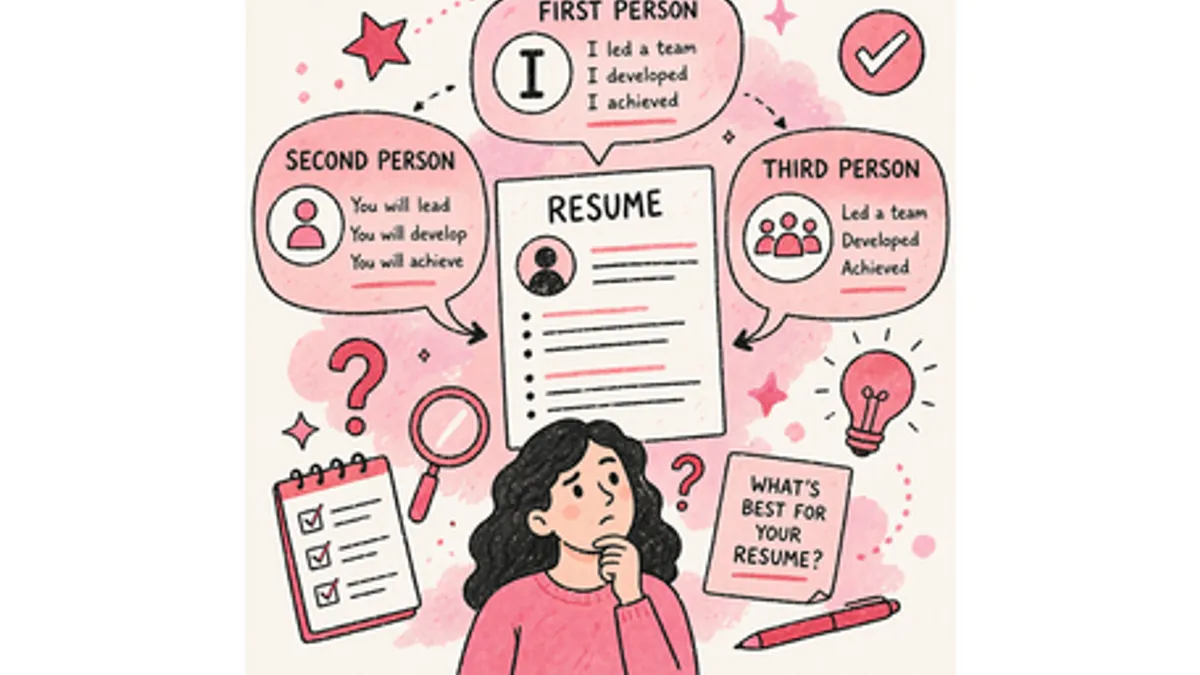
Should your resume say “I managed a team of five” or just “Managed a team of five”? The answer affects tone, length, and how quickly a recruiter can scan your experience — yet most guides only say “don’t use I” without explaining why.
Standard U.S. resume convention is implied first person: the document is obviously about you, so pronouns are dropped and bullets open with action verbs. This guide covers when explicit “I” language hurts, how implied voice works in each section, before-and-after examples, and the few cases where full sentences are acceptable.
Should you use first person on a resume?
No — avoid first-person pronouns such as “I,” “me,” and “my” in resume bullet points and most summary lines. Use implied first person instead: start with a strong verb and let the subject be understood.
That keeps the document concise, professional, and easier for recruiters and applicant tracking systems to parse. Every line already refers to you; repeating “I” adds words without adding information.
Is first person okay in a resume?
First person is acceptable only in its implied form — meaning you write as if you are speaking about yourself but never name the pronoun. This is the default across industries because it keeps writing focused on actions and results rather than the subject.
Recruiters expect a consistent, streamlined style. Since each bullet under your name describes your work, “I managed” and “I created” read as redundant. Opening with strong action verbs makes experience easier to scan and more impactful.
Full first-person phrasing (“I managed,” “I created”) can feel slightly informal next to a clean, action-led resume format. It is rarely an automatic rejection, but it weakens the polished impression compared to implied voice.
Should I avoid using “I” in my resume?
Yes. Modern resume writing treats the subject as understood. Removing “I” saves space and eliminates repetition.
- Instead of: “I managed a team of five”
- Use: “Managed a team of five”
The shift is small, but the second version reads more competent and aligned with what hiring managers expect.
What are the best practices for pronoun usage in resumes?
The best practice is to avoid all personal pronouns and write in implied first person — direct, action-focused lines without “I,” “me,” or “my.” That keeps the resume scannable and aligned with recruiter expectations.
Pronoun usage comparison: what to use and avoid
| Writing style | Example | Use it? | Why |
|---|---|---|---|
| First person (explicit) | “I managed a team of 10” | Avoid | Adds unnecessary words; reads less professional |
| First person (implied) | “Managed a team of 10” | Recommended | Concise, results-focused, recruiter-friendly |
| Second person | “You will manage projects” | Avoid | Not appropriate for resumes |
| Third person | “He managed a team of 10” | Avoid | Feels detached and unnatural |
Best practices to follow
- Start bullet points with strong action verbs (managed, developed, led, improved)
- Remove pronouns in all sections, including your professional summary
- Focus on results, not narration
- Keep structure consistent across every role
- Write short, direct lines suited to quick scanning — see our resume length guide for how much fits on one page
Hiring managers already know the resume is about you. Dropping pronouns avoids repetition and helps ATS parsers index clear keywords and actions.
How do you write a resume in first-person implied?
Remove pronouns and start each bullet with a strong action verb. Describe what you did, how you did it, and the result — without filler or full-sentence narration.
1. Start with an action verb
Use verbs like managed, developed, led, or improved to open each line. The verb immediately signals contribution and keeps writing direct.
2. Add what you did
State the responsibility or task clearly so the reader understands your role without extra context.
3. Include measurable results where possible
Add numbers, percentages, or outcomes to show impact. The XYZ bullet format (outcome, measurement, method) works well here when you have honest metrics.
4. Keep wording concise
Cut filler and avoid complete sentences where a tight phrase will do. Recruiters spend seconds per entry — density beats prose.
Examples: explicit vs implied first person
- Weak: “I managed a team of five employees and improved performance.”
- Strong: “Managed a team of five employees, improving performance by 20%.”
- Weak: “I was responsible for customer service and handling complaints.”
- Strong: “Handled customer service inquiries and resolved complaints, improving satisfaction scores.”
Before you submit, scan every bullet for stray “I,” “my,” or “me” and confirm each line opens with a verb.
When can you use pronouns in a resume?
In most cases, you should not use pronouns on a resume. They may appear in limited contexts — a short summary, a career-change note, or informal supporting materials — but implied first person remains the safer default for consistency and tone.
Where pronouns might appear (and what to do instead)
- Professional summary: Tempting: “I am a marketing manager with five years of experience.” Better: “Marketing manager with five years of experience…”
- Career change explanations: A full sentence may feel natural when explaining a pivot. Still prefer dropping pronouns when you can.
- Cover letters (not resumes): First person is expected in cover letters, where a conversational tone is appropriate.
Mixing styles — “I” in one section and implied voice in another — makes the document feel uneven. Keeping everything in implied first person produces a cleaner, sharper file.
What does a first-person implied resume look like?
An implied-voice resume removes pronouns and leads each line with an action verb. Bullets stay short and outcome-focused; structure stays consistent from summary through work history.
Example: experience section (first-person implied)
Sample experience block
Sales Representative | Markham Wholesaler Group

Managed relationships with 10+ retail clients, facilitating product returns and purchases
Monitored customer feedback and logged insights into internal systems
Reviewed client accounts monthly, identifying up to $50,000 in outstanding balances
Negotiated pricing and discounts, contributing to 95%+ customer retention
Example: before vs after
| Before (explicit first person) | After (implied first person) |
|---|---|
| I managed a team of five sales associates | Managed a team of five sales associates |
| I was responsible for handling customer complaints | Resolved customer complaints and improved satisfaction scores |
| I created marketing campaigns for new products | Developed marketing campaigns for new products |
Removing pronouns tightens each line and shifts focus to action and outcomes — what recruiters look for during a quick skim.
Common mistakes to avoid when using first person in a resume
The most common error is using full first-person pronouns instead of implied voice. Other issues include mixing styles, writing complete sentences instead of scannable bullets, and listing duties without results.
Common mistakes and how to fix them
| Mistake | Example | Fix |
|---|---|---|
| Using “I” in bullet points | I managed a team of five | Remove pronoun → Managed a team of five |
| Mixing styles | Managed projects… then I created reports | Keep implied voice throughout |
| Writing full sentences | I was responsible for overseeing operations | Concise phrasing → Oversaw operations |
| Tasks only, no impact | Managed customer service | Add outcome → Managed customer service, improving satisfaction by 15% |
| Weak verbs | Helped with marketing campaigns | Strong verb → Developed marketing campaigns |
Small inconsistencies make a resume harder to read. For more rejection triggers, see resume mistakes that get you rejected.
Expert tip
Run a pronoun search before you upload
Use your editor’s find function for “ I ”, “ my ”, and “ me ” (with spaces). One pass catches most explicit first-person slips in summaries and bullets.
Frequently asked questions
What should I say instead of “I” in a resume?
Start each bullet with a strong action verb — managed, developed, led, improved — and drop the pronoun entirely. The subject is already understood. This removes filler and keeps focus on actions and results.
Is third person best on a resume?
No. Third person (“He managed,” “She led”) sounds formal and detached, as if someone else wrote your experience. Implied first person is direct, lean, and what U.S. recruiters expect.
What is the 1-2-3 rule in pronouns?
In general grammar, the 1-2-3 rule refers to first-, second-, and third-person pronouns (“I,” “you,” “they”). On resumes, those are typically avoided for concision. This is separate from gender pronouns (she/her, they/them), which may appear in a header or contact block if you choose to include them.
Can AI resume tools write in implied first person?
Most professional builders default to verb-led bullets without pronouns. If a draft includes “I,” strip it manually or regenerate the section — see our comparison of AI resume builders vs ChatGPT for formatting consistency tips.
Need bullet points in the right voice? The MakeResume AI builder formats experience lines in implied first person by default — action verb first, no pronouns, ready for ATS screening.
Implied first-person checklist
Before you submit, confirm your resume follows standard pronoun conventions.
0 of 6 done
Tools & guides mentioned in this article
- AI Resume Builder
Build an ATS-ready resume with AI writing help and live preview.
- Bullet Point Formula
Action-verb structure for implied first person.
- Resume Summary Examples
Write summaries without I or my.
- ATS-Friendly Resume Guide
Formatting rules that pair with tight bullet phrasing.
- Resume Mistakes to Avoid
Voice and wording errors that cost interviews.
- Free ATS Checker
Upload your resume and get an instant ATS compatibility score.
Land 3x more interviews with AI.
Don't let your resume get stuck in an ATS. Build an optimized resume in minutes, then validate it with our free checker.