

Job search fatigue is the mental, emotional, and physical exhaustion that builds during a long, discouraging job hunt. It is a normal response to unpaid effort without predictable reward — not a personal failure.
You overcome it by treating the search as a part-time job with fixed hours, protecting your health and routine, measuring inputs you control, and recognizing that slow results often reflect a tight market rather than your ability.
This guide defines job search fatigue, explains why it hits so hard, and walks through prevention, motivation, stress resets, and when to seek extra help. When you are ready to cut wasted applications, use MakeResume's resume builder and resume templates so each tailored submission costs less energy — and read should you apply for that job before you click Apply.
What is job search fatigue?
Job search fatigue is a burnout-like state that develops when a job hunt drags on without results. It combines physical tiredness with emotional symptoms: lost motivation, self-doubt, irritability, trouble concentrating, and the urge to avoid applications altogether.
It is a normal response to prolonged effort, and it can affect anyone whose search runs long. Researchers who applied the clinical model of burnout to long-term job seekers found that searching for work can produce the same three markers seen in overworked employees: exhaustion, cynicism, and a sense of ineffectiveness (Job Seekers' Burnout and Engagement study, 2023). Naming it as burnout helps, because it frames the exhaustion as a normal reaction to a hard, drawn-out process.
Common signs of job search fatigue include:
- Applying feels harder than the task itself should warrant
- Motivation drops even for roles you genuinely want
- Small setbacks trigger disproportionate self-doubt
- Sleep, focus, or appetite start to slip
- You begin avoiding job boards and applications entirely
Spotting these signs early gives you the chance to adjust your routine before the exhaustion turns into a longer stall.
Why do people feel exhausted after searching for jobs?
People feel exhausted after searching for jobs because the search is unpaid work that offers effort without predictable reward. You tailor applications, track roles, and prepare for interviews, then wait in silence. Add a tighter market and constant rejection, and the process keeps your nervous system on alert for weeks or months.
The market itself explains part of the drain. In the United States there are now 1.2 jobs available per job seeker, down from two-to-one in April 2022. Searches have lengthened to match: the average period of unemployment reached 24.9 weeks, close to six months (Bureau of Labor Statistics U.S. employment situation).
Several psychological forces then stack on top of the numbers:
- Decision fatigue from evaluating roles and customizing every application
- The black-hole effect of applications that vanish without any reply
- Postings that are never truly filled, which waste effort and time you cannot get back
- Financial pressure that raises the stakes of every outcome
When months pass with little to show, exhaustion is a rational response to those odds, and understanding that is the ground you build your recovery on.
How can I prevent burnout during a long job hunt?
Prevent burnout during a long job hunt by running the search like a part-time job with firm limits. Set fixed hours, work in focused blocks, apply to fewer but better-matched roles, and safeguard your sleep, meals, movement, and downtime. Structure turns an open-ended grind into a routine you can sustain for months.
Use a simple daily process:
- Set office hours: Choose a window, for example 9:00 a.m. to 12:30 p.m., and close the laptop when it ends.
- Batch your tasks: Group searching, tailoring, and outreach into focused blocks instead of switching all day.
- Apply selectively: Focus on roles where you meet around 70 to 80 percent of the requirements instead of applying to everything — our guide on whether you should apply helps you decide faster.
- Build a reusable toolkit: Keep master resume versions and reusable messages so each application costs less energy. MakeResume's resume templates and resume builder make spinning up a clean base document faster.
- Treat your health as fixed: Keep sleep, daily movement, and time offline in the schedule, the same as any appointment.
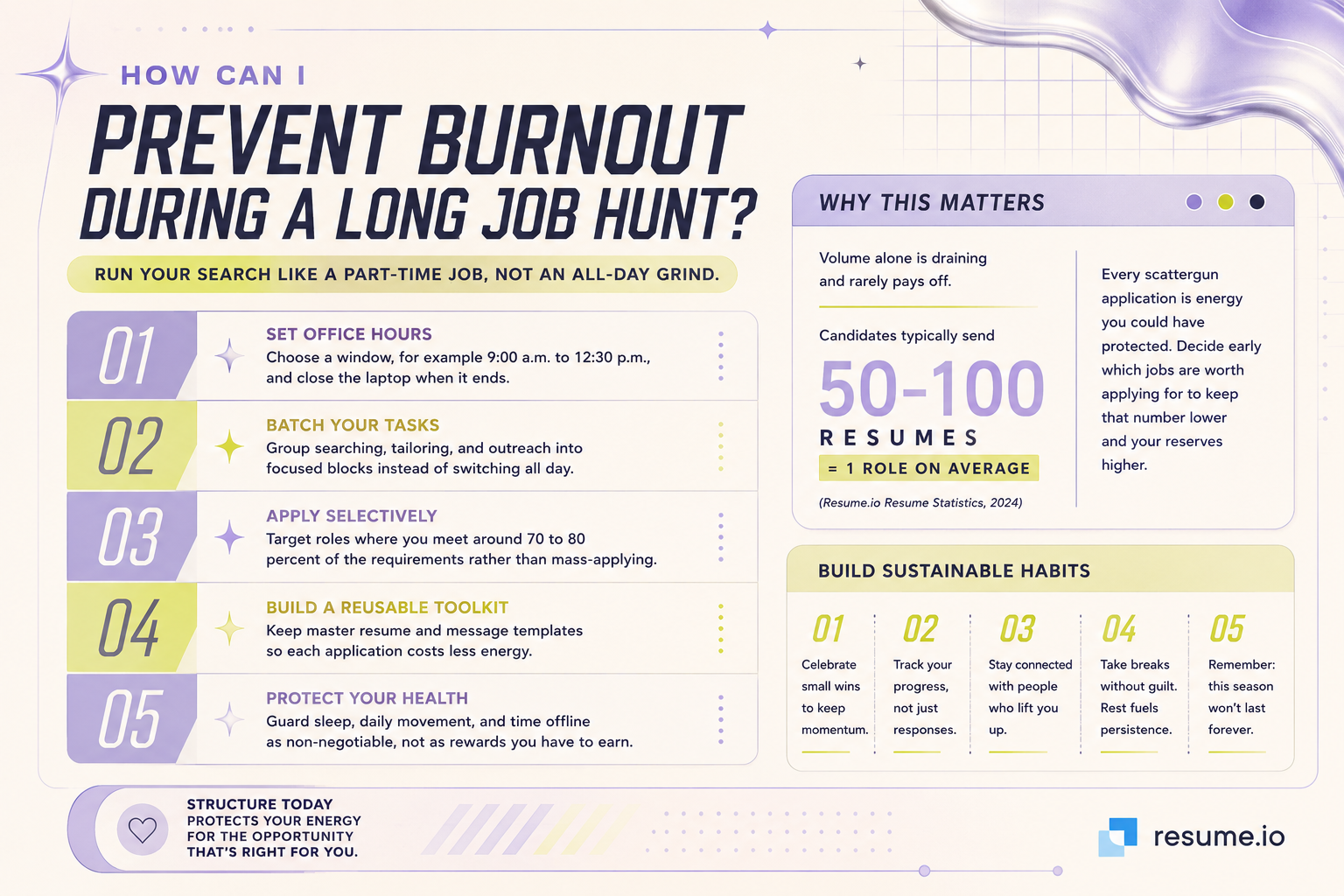
This selective approach matters because volume alone is draining and rarely pays off. Candidates typically send 50 to 100 resumes to secure a single role, so every scattergun application drains energy you will want later. Deciding early which jobs are worth applying for keeps that number lower and your reserves higher, which is the simplest way to keep fatigue from setting in.
How do you stay motivated while job searching?
Stay motivated while job searching by measuring what you control rather than what you cannot. You cannot force a callback, but you can track applications sent, skills learned, and people reached. Logging those inputs and treating them as the real measure of a productive day keeps your momentum steady when results are slow to arrive.
A small shift in what you count changes how the search feels:
| Instead of fixating on | Focus on |
|---|---|
| A job offer | Two tailored applications sent |
| An interview callback | Thirty minutes spent building a skill |
| A reply to your last application | One message to a former colleague |
Silence is the fastest way to lose motivation, so it helps to know the odds. Only about 2% of resumes lead to an interview, which makes a quiet inbox a normal feature of a crowded market. Understanding how many applications it typically takes keeps a single rejection in proportion.
A simple tracking sheet does double duty here: it turns invisible effort into a record you can look back on when confidence dips, and it surfaces patterns worth adjusting. Keeping one person you can talk to about anything other than the search stops the process from consuming your whole week.
What should you do if you feel overwhelmed by job search stress?
When job search stress feels overwhelming, step back before you push harder. A short, deliberate pause resets your judgment far faster than forcing another round of applications through a fried brain. The real skill is knowing when a break helps and when stepping away too long costs you momentum you will struggle to rebuild.
Start with a 24 to 48 hour application fast. Close the job boards, ignore your inbox, and do something unrelated. Missing two days of postings will not change your prospects, but a full mental crash will stall them for weeks.
Picture someone three months into a search, applying every evening and sleeping badly: two days off followed by a lighter, planned restart usually restores more output than grinding on would.
For the decision between resting and continuing, use a simple guide:
- Take a short break when fatigue is affecting your sleep, focus, or mood but your routine is still intact.
- Take a longer, planned pause when applications feel pointless and your quality has dropped for a week or more.
- Keep going with lighter goals when motivation dips but you are still functioning and hitting small targets.
When a deliberate reset does not lift the weight, the exhaustion may be more than fatigue, and that deserves to be taken seriously.
When is it more than job search fatigue, and where can you get help?
Job search fatigue usually eases with rest and a steadier routine. When low mood, loss of interest, or difficulty functioning lasts two weeks or longer, it may have moved beyond fatigue into depression, which needs proper support. Reaching out to a professional is a sensible, common step, and free resources exist.
The difference is duration and reach: fatigue eases once you rest, while a low mood that touches sleep, appetite, and daily life tends to persist and calls for help. A licensed therapist or career counselor can help you separate the search from your sense of self-worth.
Several free services are available in the United States:
- 988 Suicide and Crisis Lifeline: Call or text 988 for confidential support at any time of day.
- National Alliance on Mental Illness (NAMI): Call 1-800-950-6264 for information, guidance, and peer support groups.
- CareerOneStop: Sponsored by the U.S. Department of Labor, it offers free job-search tools and local, in-person career counseling.
Caring for your mental health is part of a search you can actually sustain, and your career is only one part of who you are. If you later return to applications with clearer judgment, a focused pass through MakeResume's homepage tools can help you rebuild materials without starting from a blank page.
Frequently asked questions
A few common questions about job search fatigue and how to manage it.
How long does job search fatigue last?
Job search fatigue has no fixed timeline, but it tends to ease once you add fixed hours, rest, and realistic goals to the search. Most people feel some relief within days of setting a schedule and taking a short break. If the exhaustion persists for weeks despite those changes, consider speaking with a professional.
Is it okay to take a break from job searching?
Yes. A short, planned break of one to two days often restores more focus and output than pushing through exhaustion. The key is to keep it deliberate and time-limited, so a brief reset does not drift into a long stall.
Is job search fatigue the same as depression?
No. Job search fatigue is temporary exhaustion tied to the hunt, and it usually lifts with rest and a lighter routine. Depression is more persistent, affecting mood, sleep, and daily functioning for two weeks or more, and it warrants professional support. If you are in crisis, contact the 988 Lifeline or a local emergency resource right away.
Tools & guides mentioned in this article
- AI Resume Builder
Build an ATS-ready resume with AI writing help and live preview.
- Resume Templates
Browse ATS-friendly layouts for every industry and career stage.
- Free ATS Checker
Upload your resume and get an instant ATS compatibility score.
- Free Resume Checker
Grade your resume's overall quality, bullet impact, and clarity for free.
- Career Advice Blog
More resume, ATS, and job-search guides from MakeResume.
Land 3x more interviews with AI.
Don't let your resume get stuck in an ATS. Build an optimized resume in minutes, then validate it with our free checker.