

When job satisfaction drops past a certain point, leaving starts to feel inevitable. The harder question is timing: do you stay until another offer is signed, or do you quit first and search from the outside?
Rage-quit videos get views because plenty of people fantasize about walking out. Quitting without another role lined up is still a high-stakes move. It is not automatically a career disaster — if you leave with relationships intact and you have actually run the numbers. Cookie-cutter advice says never quit until the next job is locked. Real lives are messier than that.
This article walks through how emotion can hijack the decision, nine reasons people resign before they finish a search, three practical risks you cannot wish away, and how to weigh both sides before you send notice. If you have only been in the role a short time, also read how to quit a job you just started so a short stint does not look like a pattern. Then keep a current resume ready so the search can start the day you leave.
How do you keep emotions from deciding when you quit?
Once your head is already at the next job, a bad week at work can make sending notice feel like relief — so pause, write down the logic, and only quit if the plan still holds when you are calm.
You replay better versions of your life. Then another disaster lands at the office and your finger hovers over a resignation email. Your brain shouts that you will find something else. That feeling is information, not a strategy.
Ask the unromantic questions. Why do you need to leave before you have an offer? Can you afford it? Have you prepared enough to start applying immediately? Will the outcome actually be better than staying through a search? If the only honest answer is “I cannot stand another Monday,” you may still be right to go — but you should know that is the reason.
What are good reasons to quit before you have another job?
People resign first when they need search time, mental space, a planned break, life logistics, a head start before layoffs, study, a business, or personal reset — and when they have prepared enough that employability is not a guess.
If you have slept on it more than once and you still think leaving without a landing pad is the right call, you are not uniquely reckless. If your skills are in demand, the gap is a project with a deadline, not a void. Mitigate the risks below, then treat these nine reasons as a checklist, not permission to storm out.
1. More time for job hunting
A serious search takes hours most full-time jobs will not give you. Quitting can free you to apply, network, and interview without hiding calendar blocks from your manager.
Doing both at once can also hurt the job you still have. If interviews leak into sick days and your employer notices, relationships can sour fast. A clean, professional exit is sometimes better for both sides than months of half-attention. Use the extra hours on targeted applications, not an unstructured scroll — decide which postings are worth the form before you burn a day on portals.
2. Improved mental health
Searching while you are still in a grinding or toxic role often produces worse decisions and a thinner interview presence. Walking out can restore energy you will need for a long hunt.
If you can afford the risks, that bounce in mood is not a luxury. Job searches are already hard. Extra mental capacity can be the difference between sending five average applications and running a real process. Quiet checking-out at work is a different pattern — if that is what you have been doing, read what quiet quitting actually is before you confuse withdrawal with a plan.
3. You want to take a break
Sabbaticals and career pauses are more common than they used to be, and many hiring managers will accept a planned break if your last decade is not already full of unexplained gaps.
Give yourself breathing room, then pick timing that does the least damage to the team you are leaving. Leave on good terms. A break you can explain beats a smear of short jobs you cannot.
4. External commitments
Life can change faster than a search: relocation for a partner, caregiving, health, or a visa clock. Decent employers understand that people sometimes have to go before the next role exists.
Being a victim of circumstance is not a character flaw on a resume. Explain the constraint clearly when you interview. You are not required to overshare medical or family detail — only enough that the gap makes sense.
5. You have prepared meticulously
Sometimes the thinking, targeting, and materials are already done, and the remaining bottleneck is time. If demand for your skills is real, a short, intense search after notice can work.
The brave version looks like this: finish preparation, work a professional notice (with interviews scheduled in the open if your employer allows it), and land something in six to eight weeks. Pressure jumps the moment notice is in. Mental preparation matters as much as a polished ATS-friendly resume.
6. Get ahead of the mass exodus
If the business is failing and you can see the writing on the wall, leaving early can put you in front of recruiters before a wave of laid-off peers hits the same market.
There are no medals for being last off a sinking ship. Your industry may be shrinking at the same time. Resigning before redundancy can mean giving up some severance — it can also mean a head start. Talk to a recruiter about demand before you trade pay for speed.
7. Studying for a career change
Some switches need coursework you cannot stack on a full-time job. Quitting to study, then job-hunting with new credentials, can signal commitment rather than flakiness.
Learning on the job is valuable. So is uninterrupted study when the target field requires it. Pair the pause with a career-change plan and, when you apply, a career-change cover letter that connects old strengths to the new path.
8. You are thinking of starting a new business
Side hustles have limits. Many contracts restrict competing work, and the first months of a company usually need more attention than evenings can provide.
If you believe in the idea, those early months matter. Staying employed “just in case” can keep you from doing the work the business actually needs. That is a financial and legal decision — read the contract and talk to an advisor before you burn the bridge.
9. Personal reasons — enough said
Sometimes the reset is about a relationship, health, or a line you will not cross at work. You may never discuss the full story in an interview, and you still may need a clean break.
Preserving relationships and resetting the work/life blend is occasionally only possible if you leave now. You put yourself and the people you care about first. You will find another job. You may not get another window to repair what the current job is costing you.
What are the real risks of resigning without a job lined up?
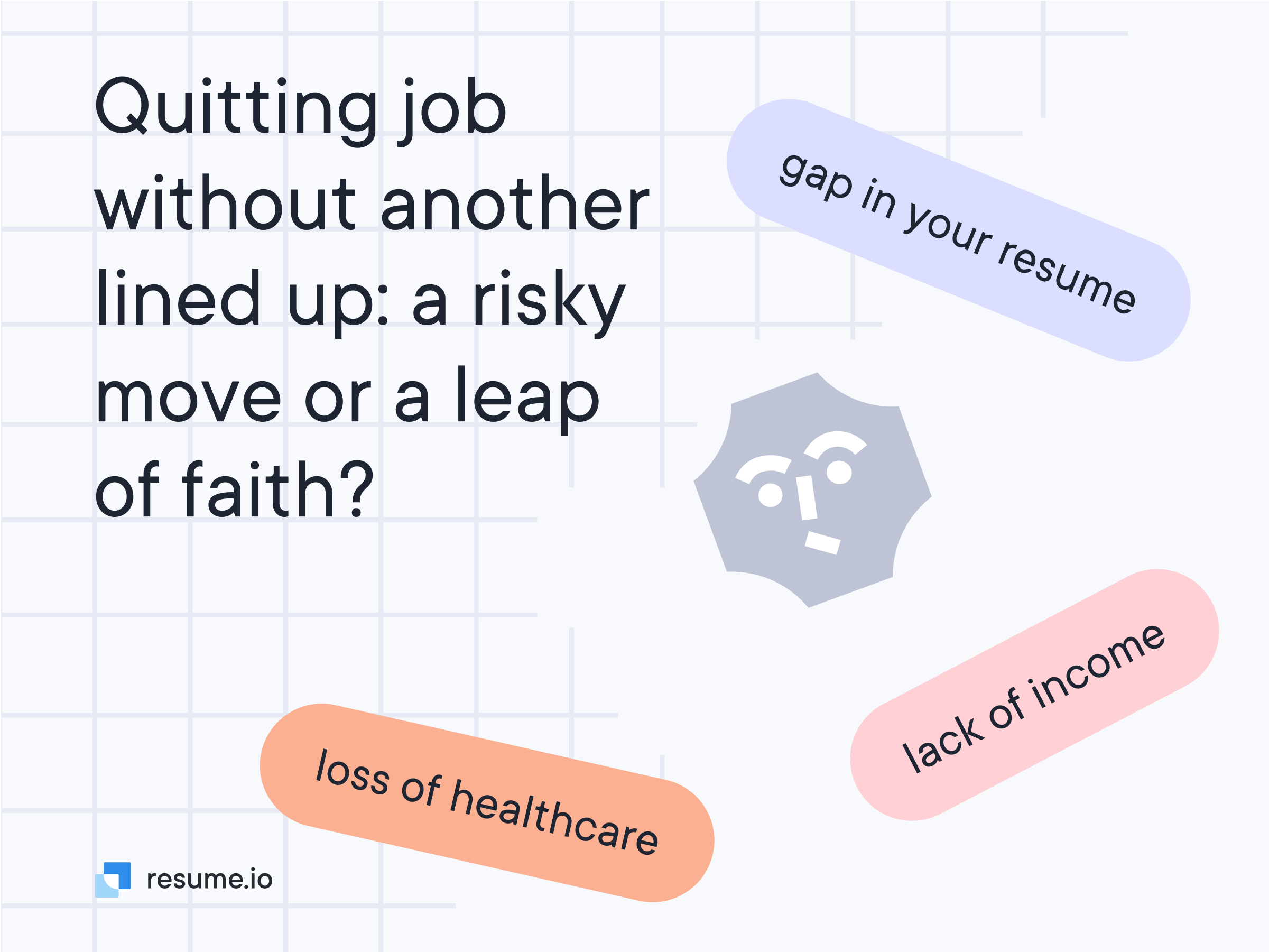
The three risks that do not yield to optimism are lost income, lost employer healthcare and benefits, and a growing resume gap you will have to explain later.
The emotional strain is real too. Offers fall through. Supportive colleagues disappear from your weekday. You will lean on friends, family, and self-belief. None of that replaces a budget, insurance plan, or a story for the gap. Staring into a career void is frightening; pretending it is not does not make the search shorter.
1. Lack of income
You need a realistic runway — typically on the order of six months of expenses plus a plan for what you will cut — so you do not take the first paycheck out of panic.
Severance evaporates faster than people expect. If cash pressure forces a bad job, you have undone the point of leaving. Write the number. Include rent, food, debt, and job-search costs. Then write the emergency version if the search runs long.
2. Loss of healthcare
In countries where health insurance is tied to the job, resigning can end coverage quickly. In the U.S. that risk alone keeps many people in roles they would otherwise leave.
Some contracts continue benefits for a short period after your last day; many do not. Company cars, allowances, and other perks vanish on the same timeline. Picture the whole household, not only your salary line, before you quit without another lined up.
3. Gap in your resume
Four or five months between jobs is long enough that a future hiring manager will notice. Senior candidates get more slack; early-career candidates get more questions.
Some managers carry bias about hopping or gaps. If you are unemployed for any stretch, you need a clear, truthful explanation — study, caregiving, a planned break, a failed company, a search that took longer than the market suggested. Practice it the way you would practice any other interview answer in a structured interview prep list.
How do you balance risk and reward if you quit without a next job?
Write the gains and the worst-case plan on paper, do it more than once, and do not quit on a story that “it will work out” without a budget, a search plan, and a healthcare fallback.
You cannot predict force majeure. You can refuse to gaslight yourself. Sit down at least three times before you press send. What do you gain from leaving now? If the worst case hits, how do you eat, stay insured, and explain the gap? If those answers are still solid when you are not angry, you are closer to a decision than a mood.
Frequently asked questions
Is it ever smart to quit a job without another lined up?
Yes, when staying is actively harming you, your skills are in demand, and you have money, healthcare, and a search plan that survive several months. It is a calculated risk, not a personality flex.
How much savings should I have before I resign?
Plan for about six months of essential expenses, plus a cut-back plan if the search runs longer. The right number is the one that keeps you from accepting a bad job out of fear.
Will a gap on my resume ruin interviews?
A few months is explainable if you can say what you did and why you left. A string of unexplained gaps is harder. Prepare a short, honest line and then steer to what you offer next.
Should I tell interviewers I quit without an offer?
Tell the truth without a rant. “I left to search full-time / care for family / complete a course, and I exited professionally” is enough. Do not trash the last employer.
What if my industry is shrinking?
Leaving before a mass layoff can help you reach recruiters first, but you may give up severance. Check demand with people who hire in your field before you trade pay for a head start.
Tools & guides mentioned in this article
- AI Resume Builder
Build an ATS-ready resume with AI writing help and live preview.
- Resume Templates
Browse ATS-friendly layouts for every industry and career stage.
- Free ATS Checker
Upload your resume and get an instant ATS compatibility score.
- Free Resume Checker
Grade your resume's overall quality, bullet impact, and clarity for free.
- Career Advice Blog
More resume, ATS, and job-search guides from MakeResume.
Land 3x more interviews with AI.
Don't let your resume get stuck in an ATS. Build an optimized resume in minutes, then validate it with our free checker.