
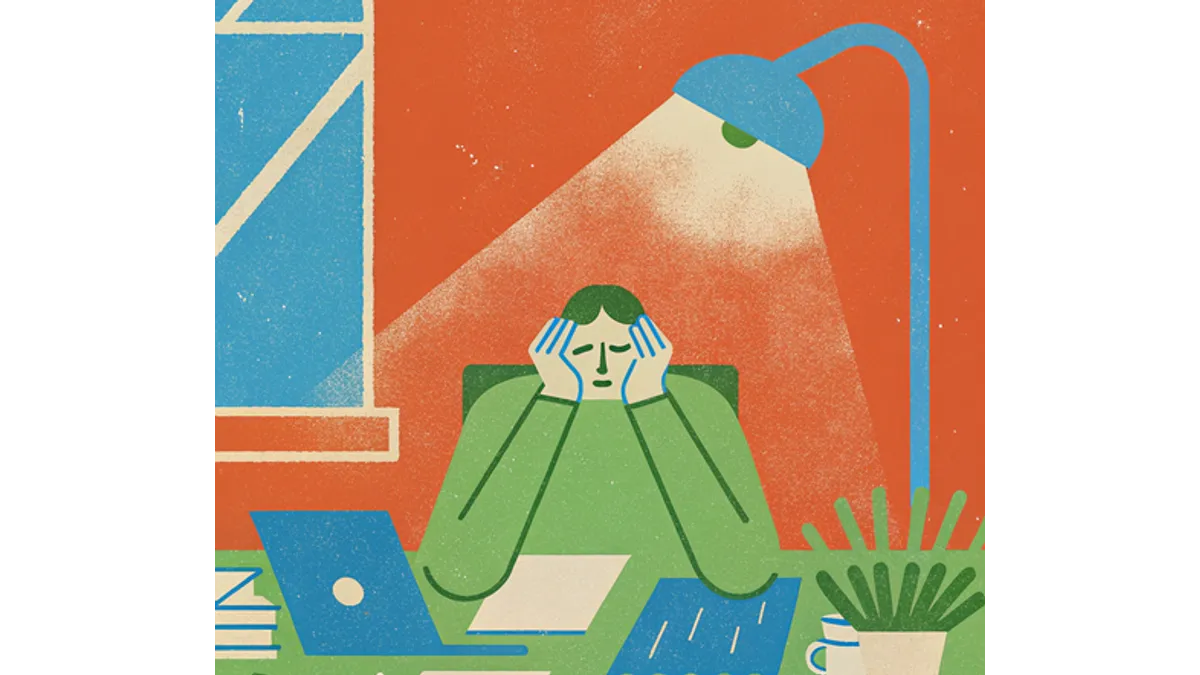
Sunday evening used to mean finishing a show, prepping lunch, and winding down. For a growing share of American workers, it now means dread — a creeping anxiety about Monday that can start as early as Saturday and follow you into the workweek.
Return-to-office mandates, blurred boundaries between home and work, and heavier workloads have made “Sunday Scaries” a mainstream phrase. But the feeling is not uniform: who experiences it, how severely, and whether they act on it varies sharply by gender, generation, and seniority.
We surveyed 1,000 full-time U.S. employees about Sunday anxiety — how often it hits, what triggers it, and whether it has changed their career decisions. Here is what the data shows, who is most affected, and what both workers and employers should take from it.
What are the Sunday Scaries?
According to Merriam-Webster, the “Sunday Scaries” refers to the feeling of anxiety or dread that people experience as the weekend ends and the work week approaches. It often stems from looming responsibilities, unfinished tasks, or the loss of personal time — making it hard to fully relax on Sundays.
Research by the Journal of Clinical Sleep Medicine found that anxiety about the upcoming week can significantly disrupt sleep patterns, estimating that up to 76% of people experience some form of sleep disruption on Sunday nights.
What did the Sunday Scaries survey measure?
We surveyed 1,000 American employees about their experience with Sunday anxiety: how often they feel it, what triggers it, and whether it has influenced their mental health or career choices. Responses were broken down by age, gender, and job seniority to reveal deeper trends.
What were the key survey findings?
- 1 in 7 U.S. professionals experience Sunday anxiety every single week
- Over a third (36.6%) have considered quitting a job because of it, and 11.7% already have
- Gen Z professionals are the most likely to quit their job over Sunday Scaries
- Men are more likely to experience anxiety over work, but women are more likely to accept it as a “normal” part of work
- Entry-level workers are the most vulnerable to Sunday stress
How common is Sunday night anxiety among workers?
Over one-third (31.2%) of American professionals say they experience anxiety on some Sundays, and nearly 13% report feeling it every Sunday. For some, the stress starts long before Sunday evening — 7% say the anxiety kicks in as early as Saturday.

The top causes for anxiety before the working week were:
- Workload and deadlines (33.1%)
- Burnout and exhaustion (23.6%)
- Unrealistic expectations (15.7%)
The emotional toll is clear. More than one in three professionals have considered quitting their job due to Sunday anxiety, and 11.7% already have. Meanwhile, over two-fifths (42.2%) say their job negatively affects their mental health, and more than one in six (15.5%) describe that impact as significant.
Despite this, many still accept Sunday stress as unavoidable. A third of professionals (34.2%) believe this anxiety is just part of working life, regardless of their role or employer — a mindset that can keep people in roles that are slowly eroding their well-being, similar to patterns described in our guide to quiet quitting.
Do men or women experience Sunday Scaries more?
Men are slightly more likely to report Sunday anxiety than women (14.6% vs. 11%), and more likely to experience it on Sunday evenings (35.3% vs. 30.7%).
But while women report fewer symptoms, they are more likely to normalize them. Over two-fifths (40.4%) of women say Sunday anxiety is just part of working life, compared to 28.7% of men.
In terms of root causes, women are more likely to attribute their anxiety to burnout and exhaustion, while men cite upcoming meetings more often. Workload and deadlines top the list for both genders.
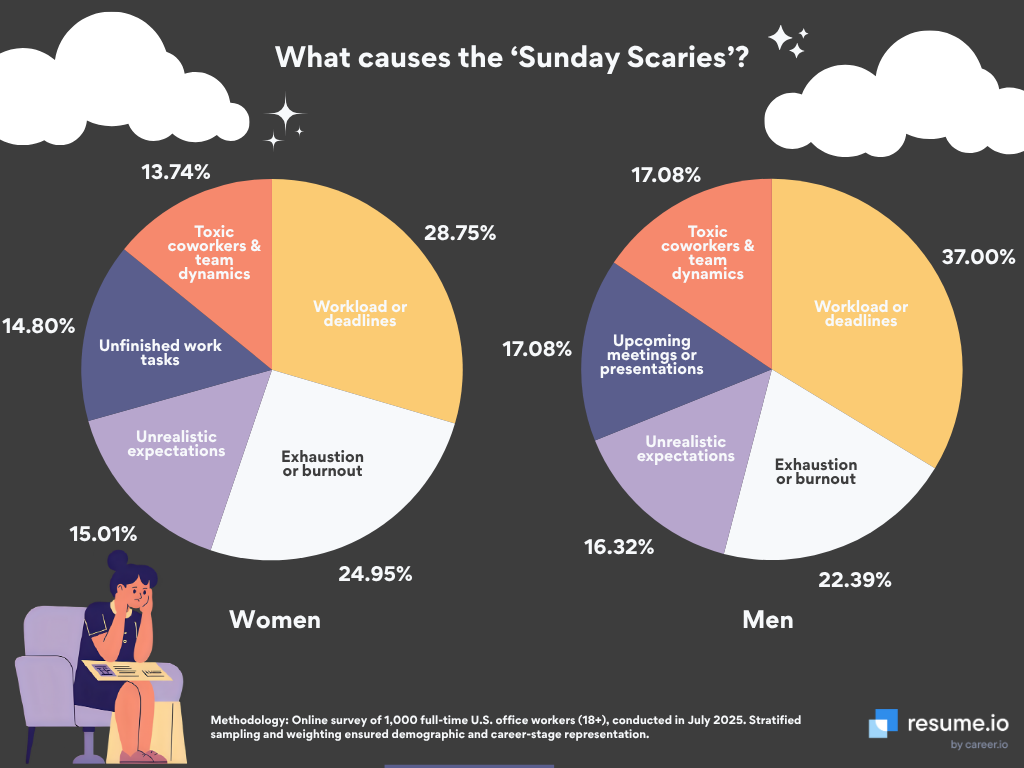
When it comes to career decisions, men are slightly more likely to leave a role due to Sunday Scaries (12.5% vs. 10.8%), but both genders are affected.
Why is Gen Z most likely to quit over Sunday Scaries?
Gen Z workers are at the forefront of changing attitudes toward mental health and job satisfaction. Compared to older generations, they are more open about their struggles and more willing to take action.
- Nearly 1 in 5 Gen Z professionals (18.4%) experience Sunday anxiety every week
- 45.9% have considered quitting their job due to Sunday stress
- 1 in 5 (20.2%) already have
Younger professionals also feel the stress sooner. As many as 15.6% say the anxiety kicks in as soon as the weekend starts — compared to just 7% of Gen X and 2% of Boomers.
Gen Z is also more likely to report that their job negatively impacts their mental health: 71.6% say their job has at least a somewhat negative effect on their well-being, versus 44.6% of Millennials, 37.8% of Gen X, and 27.3% of Boomers.
Fewer Gen Z workers accept workplace anxiety as normal — just 34.2% believe stress is a given part of working life, compared to nearly half (48.5%) of Boomers.
Why are entry-level workers most at risk?
Entry-level professionals are the most vulnerable to Sunday anxiety, with nearly one in five (19.6%) saying they feel it every Sunday. As many as 12.5% report that the stress begins as early as Saturday. Almost one in five (18.8%) of entry-level workers say their job has a significant negative impact on their mental health.
Here is what drives the stress by career level:
- Entry-level: Burnout (25.9%), poor management (20.5%), workload (22.3%)
- Mid-level: Workload (27.8%), burnout (26.5%), unrealistic expectations (17.2%)
- Senior-level: Workload (41.6%), burnout (23.9%), upcoming meetings (18.1%)
Despite their stress, 37.5% of entry-level workers have stayed in a job they wanted to quit because of Sunday anxiety — slightly higher than senior professionals (38.1%) and mid-level employees (35.1%). If you are in that group and ready to move, having an updated resume template ready removes one barrier to acting on the clarity the feeling provides.
What should workers and employers do about Sunday Scaries?
The data reveals a shifting mindset across the American workforce: stress and anxiety are no longer being dismissed as just “part of the job,” especially among younger and entry-level workers.
As return-to-office policies increase and the boundaries between work and home blur, employees are paying closer attention to how work impacts their mental health — and they are not afraid to take action. For those looking for a fresh start, a polished resume helps you stand out when you are ready to leave. The vacation quit survey found similar patterns: time away often clarifies dissatisfaction that Sunday dread hints at all year.
For employers, the signal is clear. If businesses want to retain top talent, mental wellbeing cannot be a checkbox — it has to be part of the culture. Flexible schedules, mental health support, and clear workload boundaries are expectations now, not perks.
If Sunday anxiety is pushing you toward an exit, plan the transition deliberately. Read how to quit a job you just started (or any role) without burning bridges, then use the MakeResume AI builder to prepare materials before you need them.
Survey methodology
Online survey of 1,000 full-time U.S. office workers aged 18+, conducted in July 2025. Respondents represented diverse demographics across age, gender, location, and career stage. Stratified sampling and post-stratification weighting were used to ensure a balanced, representative sample.
Data recorded: July 2025
Frequently asked questions
Are Sunday Scaries a real mental health issue?
Sunday Scaries are a widely recognized form of anticipatory anxiety about the workweek. They are not a clinical diagnosis on their own, but research links Sunday-night anxiety to measurable sleep disruption — and this survey connects the feeling to job dissatisfaction and quit decisions for a significant share of workers.
Should I quit my job if I have Sunday Scaries every week?
Not automatically. Weekly dread is a signal worth investigating — workload, management, fit, or burnout — but acting impulsively can create new problems. Try addressing root causes first; if nothing changes after a reasonable effort, treating the feeling as data about fit is reasonable.
What is the fastest way to prepare for a job search triggered by work stress?
Start with an updated resume tailored to roles you actually want, not just any escape hatch. Our guide to tailoring your resume per job walks through how to do that efficiently once you begin applying.
Tools & guides mentioned in this article
- AI Resume Builder
Build an ATS-ready resume with AI writing help and live preview.
- Resume Templates
Browse ATS-friendly layouts for every industry and career stage.
- Free ATS Checker
Upload your resume and get an instant ATS compatibility score.
- Free Resume Checker
Grade your resume's overall quality, bullet impact, and clarity for free.
- Career Advice Blog
More resume, ATS, and job-search guides from MakeResume.
Land 3x more interviews with AI.
Don't let your resume get stuck in an ATS. Build an optimized resume in minutes, then validate it with our free checker.