
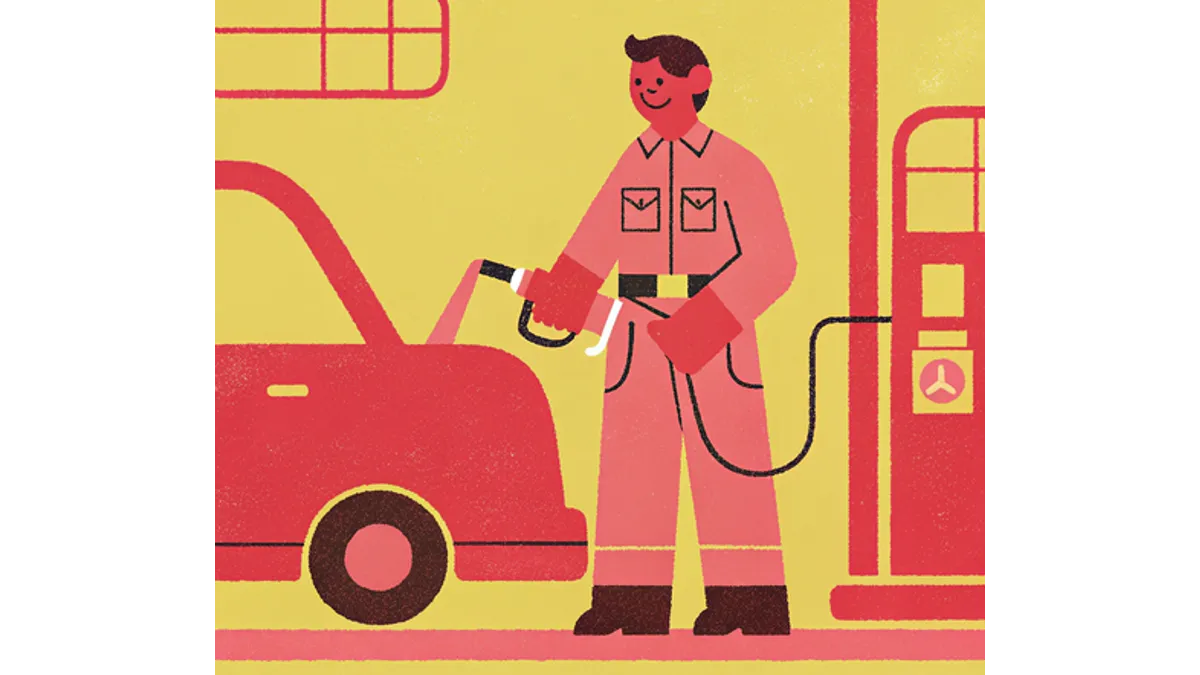
Automation, self-service kiosks, and smartphone apps have eliminated thousands of jobs that once structured daily life in America. Full-service gas stations, paper routes, film developing counters, and video rental clerks are largely gone — replaced by faster, cheaper, often impersonal alternatives.
When we asked more than 3,000 Americans aged 45 and older which vanished jobs they miss most, the answers were not about prestige or pay. They were about people: the attendant who remembered your car, the clerk who recommended a movie, the paperboy who knew your doorstep.
The survey reveals a country quietly nostalgic for slower routines and face-to-face service — and it offers a useful lens for thinking about which human skills still matter in a workforce reshaped by AI and automation.
Which lost jobs do Americans miss most?
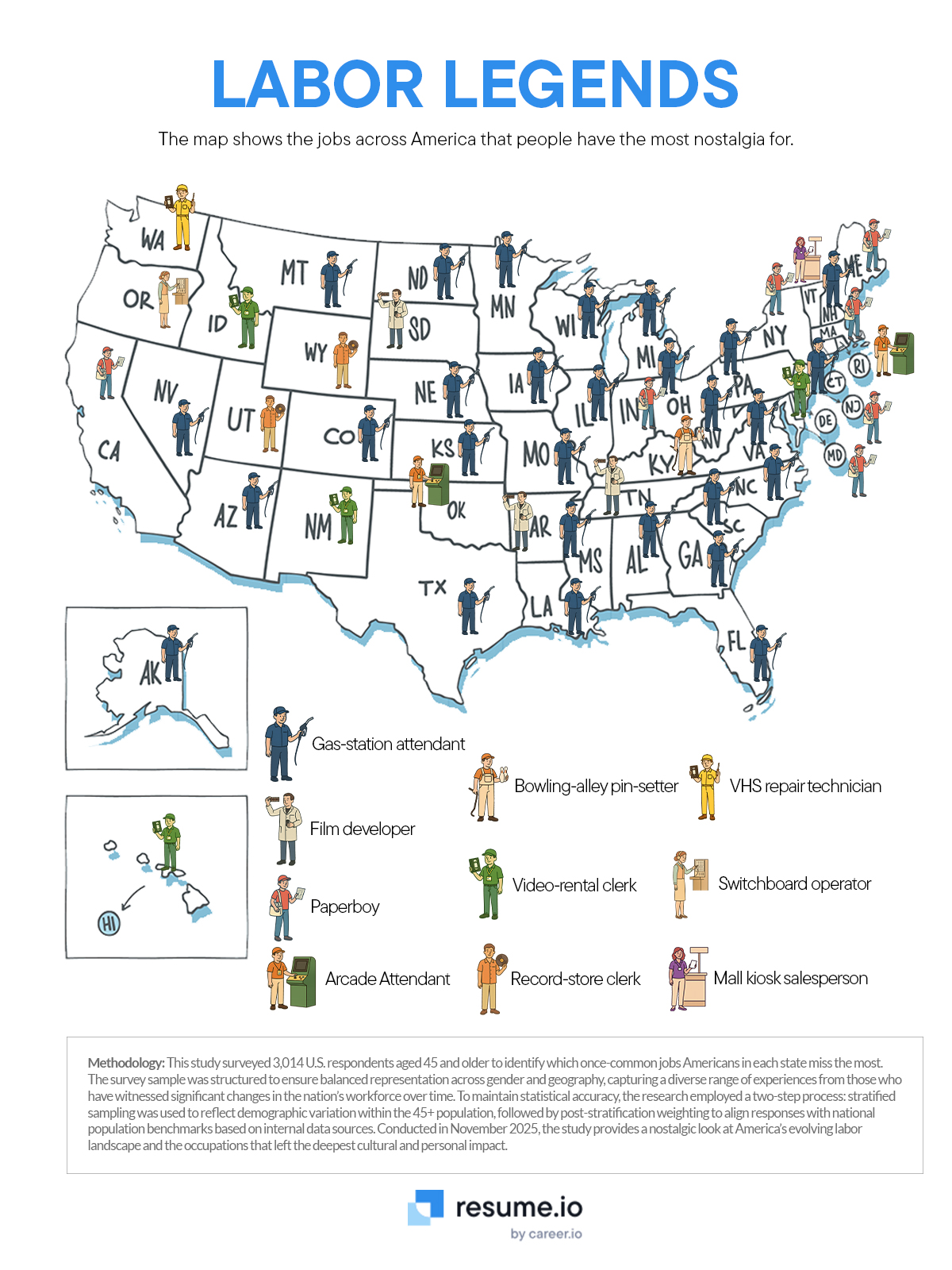
Service-oriented roles led the rankings nationwide, with regional patterns reflecting local culture, density, and memory. Below are the headline findings from the survey — every percentage and state list preserved from the original research.
Why are gas-station attendants the most missed job?
From Alabama to Alaska, the gas-station attendant is the job Americans miss most. Thirty-plus states picked it as their top vanished profession — a clear sign that many people are nostalgic for customer service that involved eye contact instead of a card reader.
For many respondents, it was not just about topping off the tank. It was about someone remembering your name, your car, and maybe your preferred brand of gum. That kind of repeatable personal connection is exactly what customer-facing skills on a resume still signal to employers, even as the jobs themselves disappear.
Where do people miss paperboys most?
The paperboy ranked first in states including California, Indiana, Maryland, Massachusetts, New Jersey, and New York — places where dense neighborhoods once relied on a daily doorstep ritual.
The paper route was many people's first lesson in responsibility and early entrepreneurship, long before gig apps replaced neighborhood jobs. If you had a route like that on your first resume, it still counts as evidence of reliability and time management — worth listing when you are building a resume with no formal experience.
Why do small towns miss film developers?
Film developers were the most missed role in Arkansas, Tennessee, and South Dakota — reminders that some regions still value tangible memories over instant digital uploads.
The slow wait for photos to develop, the smell of chemicals, the thrill of seeing what turned out — all point to a craving for patience in a world that now delivers everything instantly. That same preference shows up in hiring: employers still reward attention to detail and quality control, especially in creative and technical fields.
Which states miss video-rental clerks?
Video-rental clerks were most missed in states such as Delaware, Hawaii, Idaho, and New Mexico — a tribute to the Blockbuster era when browsing the shelves was half the fun.
Those clerks combined product knowledge with conversation — skills that map cleanly onto retail, hospitality, and media roles today. Browse our resume examples by industry if you are translating older service experience into a modern application.
What do regional patterns reveal?
Service-oriented jobs dominate the South and Midwest — regions often associated with friendliness and in-person conversation. Creative and entertainment-driven roles cluster more in the West, where culture and individuality tend to take center stage.
The survey also captured nostalgia for office life before everything went digital:
Which office relics do people remember most?
When people think back to office life before the internet, small sensory details come up first: the clatter of a typewriter, the warm chemical smell of fresh photocopies, even the stubborn whine of a fax machine. These scored far higher than you might expect — not just as tools, but as rhythms that structured a workday in ways modern apps do not replicate.
Which retro office gadgets would people bring back?
A large share of respondents said they would happily revisit some old equipment for a week, just for the novelty. Typewriters and pagers were the standout favorites — partly for nostalgia, partly for simplicity. Others picked the overhead projector or the classic in-tray/out-tray setup, both reminders of a time when meetings and workloads felt more tactile and less cluttered.
Which office era do Americans miss most?
When asked which decade of working life they would most want to return to, the 1980s were the clear winner. Respondents spoke fondly of the energy and ambition of that era — big ideas, big hair, and even bigger briefcases. The 1950s, 70s, and 90s also had loyalists, each remembered for its own flavor of structure, solidarity, or early tech curiosity.
What does nostalgia for lost jobs mean for your career?
The disappeared jobs Americans miss most — from gas-station attendants to video-rental clerks — are missed for everyday human exchange: the quick chat, the personal touch, the sense that someone cared enough to ask how your day was.
In an economy now obsessed with automation and AI productivity, the survey makes clear that people still value connection. For job seekers, that is a reminder to highlight interpersonal skills, reliability, and service orientation on your resume — qualities no algorithm fully replaces. When you are ready to refresh yours, the MakeResume AI builder helps you frame those strengths in language recruiters recognize today.
Frequently asked questions
What is the most missed job in America?
According to the survey of 3,000+ Americans aged 45 and older, gas-station attendants were the most missed profession in more than 30 states — chosen for the personal service and human interaction that self-serve pumps eliminated.
Are any of these lost jobs coming back?
Some niches have revived in premium form — full-service fuel at select stations, vinyl and film processing in specialty shops — but mass-market versions of these roles are unlikely to return at scale. The skills they required, however, remain relevant in customer-facing careers.
How should I list outdated jobs on my resume?
Focus on transferable skills — reliability, cash handling, customer service, route management — rather than the obsolete title alone. See our guide on how many jobs to list on a resume for how far back to go.
Tools & guides mentioned in this article
- AI Resume Builder
Build an ATS-ready resume with AI writing help and live preview.
- Resume Templates
Browse ATS-friendly layouts for every industry and career stage.
- Free ATS Checker
Upload your resume and get an instant ATS compatibility score.
- Free Resume Checker
Grade your resume's overall quality, bullet impact, and clarity for free.
- Career Advice Blog
More resume, ATS, and job-search guides from MakeResume.
Land 3x more interviews with AI.
Don't let your resume get stuck in an ATS. Build an optimized resume in minutes, then validate it with our free checker.