

When an interviewer asks “Tell me about a time you failed,” they are not looking for perfection — they want to see how you handle setbacks, take responsibility, and grow from mistakes.
Every professional has missteps along the way. What separates strong candidates is whether they corrected course or got stuck repeating the same errors. This behavioral interview question is designed to reveal exactly that.
The best answers come from preparation. Below you will find four sample responses for different failure types, plus a clear set of do's and don'ts to help you craft an answer that leaves the right impression.
What are sample answers to “Tell me about a time you failed”?
Strong sample answers describe a real setback, explain how you resolved it, and highlight what you learned — without blaming others or dwelling on the word “failure.” The four examples below cover communication, detail, organizational, and planning mistakes.
1. A communication failure
A communication failure answer works best when you show how you adapted your approach to connect with a colleague whose style clashed with yours — without placing blame.
- “I had a colleague in the finance department who I just could not connect to. We were working on a budget proposal and, while we were not arguing, we could not communicate our ideas to one another. We both wanted to do our best and were getting very frustrated, especially as our deadline for making recommendations to senior staff approached.
- “One night, I went home ready to admit defeat and report the trouble to my boss, when I struck upon the idea to create a graphic story of how I thought we should allocate funds and why. Not just pie charts, but almost like a graphic novel. I am no artist, but the visual representation got through to him and we could proceed from there.”
This answer works because it was not a huge failure, but became a success because of the problem-solving skills of the candidate. It also did not blame the colleague for the difficulties and expressed that both were equally invested in doing a good job.
2. A detail failure
A detail failure answer demonstrates that you caught a mistake quickly, fixed it, and built a system to prevent it from happening again.
- “In a previous job in home construction, I was ordering material for a kitchen remodel. It was a complete redesign with lots of detail and hurry. I hit the send button to place the order before double-checking everything because it was a rush job and I felt a lot of pressure to keep the process moving.
- “Later that day, I went back to check and, it turns out, I had ordered 500 boxes of flooring instead of 50. I immediately picked up the phone to change the amount. It had gone through the company credit card, but we got a credit and 50 boxes of tile.
- “That taught me that rushing ends up taking more time in the long run and leads to errors. Now, I double-check all my work before I finalize it and have someone else take a look when possible.”
Yes, this one includes an actual mistake, but it was not egregious and did not cause any long-lasting problems. Plus, the end of the story points out the candidate's increased attention to detail.
3. An organizational failure
An organizational failure answer shows that you owned a scheduling mistake, leaned on your team, and implemented a lasting fix for the whole group.
Soft skills can be more important to hiring managers than hard skills. Organizational skills help you manage your time and make deadlines. Yes, the hiring manager wants to know you can do the job, but they want to know you can do it on time so others are not impeded by your disorderliness. Have you made improvements in this area because of a past failure? You have got your answer to this question.
- “I was in a team meeting for a product launch campaign for a customer. We were going over the schedule when I realized that I was supposed to have the preliminary images for one of the proposed landing pages completed by that afternoon. Somehow, I had put it on my calendar for the following week.
- “I froze for a moment because I could not decide whether I should try to rush it through or let everyone know. I decided that we were a team and I should not let everyone down by doing last-minute work on an important project. I trusted the team and spoke up. A colleague a bit ahead of me on her deadline offered her assistance and we were able to get it done on time.”
- “Then, I went back to figure out where I had gone wrong. I never did find the exact cause of my mixup, but I suggested to the team that we use project management software from then on. I researched them and proposed Monday to our director and we have not had that problem since.”
This candidate felt a responsibility to the team and project and was able to trust their response to his error. They completed the work with the collaboration of the team. Then, they suggested a long-term solution that benefited the entire company.
4. A planning failure
A planning failure answer highlights creative problem-solving under pressure and shows you learned a concrete lesson about lead times and contingency planning.
Interviewers will not always ask “Tell me about a time you failed” in those exact words. Instead, they might phrase it as, “Tell me about a time something did not go as planned.” This more narrowly focused question gets to the heart of your analytical thinking and problem-solving abilities as well as whether you tend to figure things out on your own or seek the assistance of colleagues.
- “I am an event planner, so, I know that it is rare that everything goes as planned! I do not want to make light of blunders, but it is almost impossible to plan a conference and have nothing go wrong. The worst that ever happened was due to my lack of forethought.
- “When I first started, I did not leave enough lead time for the caterers to arrive, set up, and have lunch ready for 500 hungry, restless IT professionals. First, I had a few of the vendors start playing with any of the toy-like swag they had to keep everyone happy.
Then, I had the caterers shift gears and announced that we were having a special upside-down lunch. We served dessert first since it was cakes and cookies which were easy to get going, and worked our way back to salad. It worked!
- “Since then, I have planned dozens of conferences and every time I ask the caterer how much time they need to set up. Then I plan for them to be there three hours earlier.”
This candidate uses a light tone to describe a stressful situation, giving the impression of grace under pressure. It also highlights that she has a whimsical side to her personality. In a job where something is bound to go wrong, these are great qualities to highlight.
Expert tip
Know your audience
You have done your homework while you were preparing your resume and cover letter application package, so you understand the company culture and what they are looking for. Tailor your answer to the “tell me about a failure” question to that style. Answer 4, above, may be perfect for a more casual workplace, but may not be the right approach for a conservative environment.
What are the do's and don'ts for answering “Tell me about a time you failed”?
Do describe a real mistake with a clear resolution and lesson learned; do not repeat the word “failure,” blame others, or choose a story where your error caused serious harm. These rules help you craft a response that makes the interviewer sit up and take notice.
The answers above have several points in common. They all:
- Avoid the word “failure.” Yes, the interviewer used the word failure, but there is no need to repeat it. You certainly do not need to repeat it more than once. The stories you should be relating are temporary missteps, not true failures. Referring to them as failures may make the hiring manager think you are too hard on yourself or, perhaps worse, they will associate your name and face with the word failure. It is not the impression you want to leave.
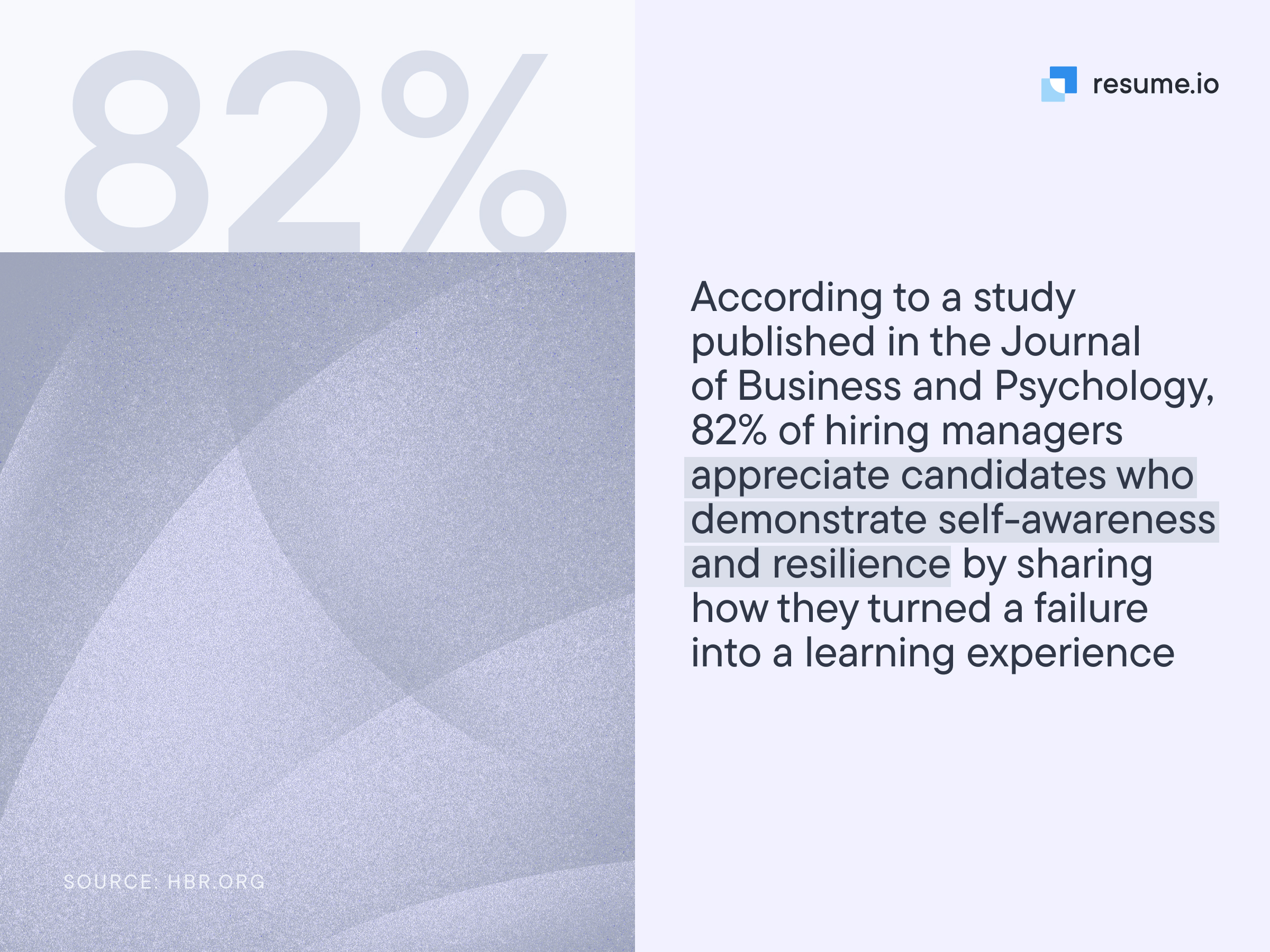
- Describe the solution you used to correct the failure. Emphasize the self-awareness and learning that came from the experience. Never choose an anecdote that does not end with you growing as a professional.
- Focus on a failure that did not cause damage to the employer or colleagues. Leaving the hiring manager with the impression that your team had to clean up after a mess you made is not going to win you the job. Even if it all turned out fine in the end, the burden to your company and colleagues is not a selling point.
- Do not highlight skill failures that are core competencies of the job. For example, you are in HR and you failed to code someone's pay raise correctly; you are a waiter who gets diners' orders wrong; or a teacher whose students all failed the AP exam. These are not the stories to tell to your interviewer (unless you are telling them why you are switching careers)
- Choose a real failure. No one buys that your biggest failure is trying too hard unless it means you missed the forest for the trees. You are going to have to fess up to a mistake and take responsibility for it.
- Do not get defensive. Adopt a tone of humility. Do not spread the blame or explain away why you did what you did. Simply state what happened and how you corrected it.
- Describe your solution
- Highlight skills outside the job's core competencies
- Relate a real failure.
- Use the word “failure”
- Focus on a failure that caused the company harm
- Try to explain away your error
Frequently asked questions about failure interview questions
Still unsure how to frame your answer? These quick responses address the most common concerns candidates have about this prompt.
What is the interviewer really asking?
They want to know whether you take accountability, recover from setbacks, and apply lessons going forward. The specific mistake matters less than your response to it and the growth that followed.
Should I admit to a major failure?
Choose a genuine mistake that was manageable — not a catastrophe that harmed the company or your team. The story should end with a clear lesson and a positive change in your behavior or process.
How long should my answer be?
Aim for 60 to 90 seconds using the STAR method: Situation, Task, Action, Result. Keep the setup brief and spend most of your time on what you did to fix the problem and what you learned.
Can I use the same answer for different interviews?
You can reuse a core story, but tailor the emphasis to each role and company culture. A creative, lighthearted anecdote may work at a startup but feel out of place at a conservative financial firm.
What if I cannot think of a failure?
Think smaller — a missed deadline, a miscommunication, or a process oversight all qualify. Interviewers expect honest reflection, not perfection. Review our weaknesses for job interview guide for related framing strategies.
MakeResume.pro offers resume templates, occupation-specific examples, and behavioral interview guides to help you prepare for every stage of the hiring process.
Tools & guides mentioned in this article
- AI Resume Builder
Build an ATS-ready resume with AI writing help and live preview.
- Resume Templates
Browse ATS-friendly layouts for every industry and career stage.
- Free ATS Checker
Upload your resume and get an instant ATS compatibility score.
- Career Advice Blog
More resume, ATS, and job-search guides from MakeResume.
Land 3x more interviews with AI.
Don't let your resume get stuck in an ATS. Build an optimized resume in minutes, then validate it with our free checker.