
A career fair is a live networking event where employers set up booths and job seekers meet recruiters face to face — and showing up prepared with the right materials can turn a brief conversation into a real interview opportunity.
Whether you are launching your first career or exploring your next role, a job fair puts you in the same room as hiring managers and company representatives who are actively looking for talent. You cannot afford to arrive empty-handed.
This guide covers exactly what to bring to a career fair, from resumes and business cards to the less obvious items that separate prepared candidates from everyone else — plus practical tips to help you make lasting connections.
What is a career fair?
A career fair — also called a job fair — is an organized event where employers and businesses host stalls and meet job seekers in one shared space, often on a university campus or in an exhibition hall.
Job fairs vary widely in size and focus. Colleges often host annual fairs to connect students with prospective employers, while industry-specific events target fields such as healthcare, marketing, or technology.
Do not underestimate these events. If you are job hunting, attending a career fair is one of the most efficient ways to network with decision-makers, learn about companies firsthand, and practice your interview skills in a lower-pressure setting.
Expert tip
The rise of virtual career fairs
This guide focuses on what to bring to an in-person career fair. However, that is not the only type of job fair you will encounter. Since the COVID-19 pandemic, virtual career fairs have seen a surge.
Of course, there are benefits of virtual career fairs. The main one is that you do not have to travel. You can meet and greet potential employers from the comfort of your own home.
If you are planning to attend a virtual career fair, you still need to prepare. It is important to make sure that you dress to impress and have your introductory statement at the ready.
Looking for more inspiration? Read our phone and video interview tips to prepare for remote hiring conversations.
What should you bring to a career fair?
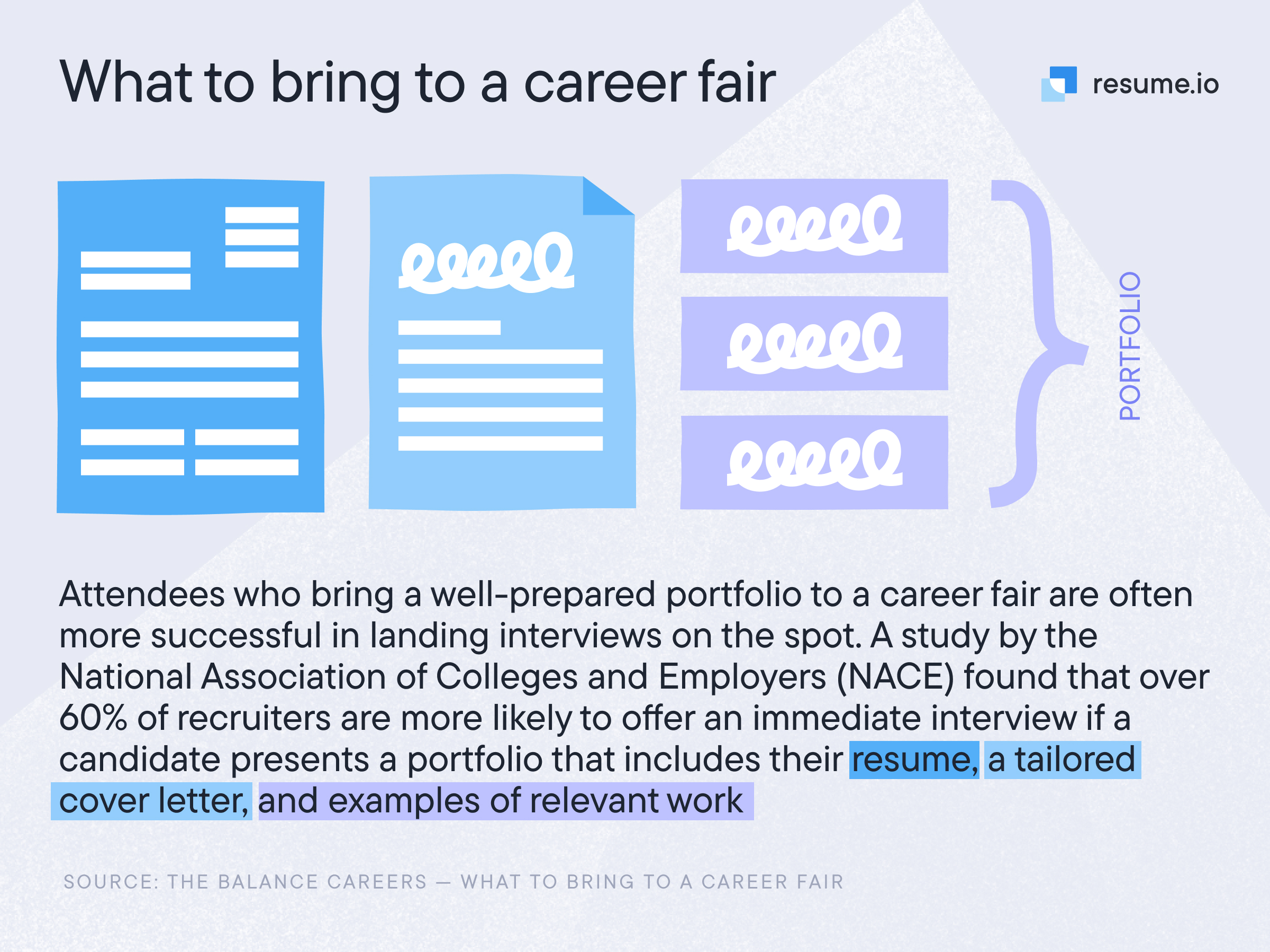
Bring printed resumes, business cards, a smartphone, an elevator pitch, and a notebook — at minimum. Arriving without these essentials wastes the opportunity to make a strong first impression on prospective employers.
Before you attend the job fair, run through this checklist to make sure you have everything you need:
1. Business cards
Business cards give recruiters a quick way to reach you after the event ends. When a conversation goes well, handing over a card keeps the connection alive.
Include the following on your card:
- Your name. Start off by including your first and last name.
- Job title. What role are you aiming for? Include it on the card now.
- Location. Employers need to know where you are based. If you are willing to relocate for the right job, you might want to add this detail to your business card.
- Phone number. List a number where you can be reached. Make sure that your answer phone message is suitable for work, too.
- Email address. Include a work-worthy email address. If in doubt, you can use one that features your first and last name or your initials.
- Socials. In some cases, you might want to include your social media handles. Should you choose to include these, you need to make sure that they are professional.
Do not scrimp when it comes to printing. Your business card represents you on a professional level. You want to get every part of this process right from the start. Remember it is better to get a small run of high-end cards than it is to get hundreds of low-quality ones.
2. Resume copies
Printed resumes are non-negotiable at a career fair. Start with a general — not tailored — version that gives a brief overview of your experience, education, and skills.
Most of the time, we recommend using a tailored resume when applying for jobs. However, since you do not know what employers you could meet, this is a rare occasion when you can use a one-size-fits-all document. Ensure that you have lots of copies of your resume.
Need a starting point? Browse our expert-backed resume examples and writing guides for over 500 professions. When you are ready to build, use our resume builder to create your document in just a few clicks.
3. Tailored resumes
If a specific company at the fair is your top target, bring a resume customized for that employer. Researching attending businesses ahead of time pays off significantly.
Often enough, you can find a list of vendors and stallholders on the career fair site. Check out the employers that will be there and then start researching the ones that pique your interest.
You can customize your resume by looking at the company's website, social media channels, and any news about them. Pay close attention to the business' values and vision. You can tweak your general resume to meet their needs and align well with their company culture.
4. Smartphone
Your smartphone is a practical tool at a career fair — as long as you keep it on silent throughout the event. The last thing you want is to be interrupted when you are talking to a prospective employer.
Here are several ways to use your phone productively during the fair:
- Google brands and companies. If you come across a business you have not seen before, you might want to sneak off to Google it. Knowing your stuff could help you make the right first impression on the person who is running the stall.
- Save important numbers and details. Spoiler: you will be collecting a whole load of business cards when you are at the event. However, having your smartphone is useful if someone tells you their phone number or email address.
- Follow businesses on social media. You might find that stallholders ask you to give the company a quick follow on social media. One tap, and you are in.
Of course, you do not want to be glued to your phone the entire time. The whole point of a job fair is to make the right first impression on other professionals. So, when you are not using your smartphone, make sure that you keep it in your bag or pocket.
5. Portfolio
Creative professionals should bring a portfolio to showcase their best work. Photographers, graphic designers, and writers all benefit from having samples ready to share on the spot.
Pick out your top work and display it well. The aim of the game is to make it as easy as possible for people to flick through your work and see your value quickly.
6. Elevator pitch
An elevator pitch is a 30-second introduction covering who you are, your unique selling proposition, and a call to action or question — and you need it memorized before you walk in.
When you introduce yourself to prospective employers, you cannot afford to be lost for words. Your pitch should be clear, concise, and memorable from the first sentence. Before you head to the career fair, practice until it feels natural.
7. Application materials
Bring any documents you would need to complete an on-the-spot application, including referee contact details and past employer information.
While it is rare, you may be asked to share this information with employers at the career fair. You never want to be caught off guard. That is why it is important to have everything ready. Above all else, this simple move will show you have a high level of organization.
8. Notebook and pen
A notebook helps you track every conversation so follow-ups do not fall through the cracks. Career fairs are networking marathons — you will talk to many people in a short window.
After you have made a new connection, step aside and make a few notes about it. You should include details of what the next steps are (e.g. if they told you to add them on LinkedIn) and when you plan to follow up with them. When we talk about what to bring to a career fair, this is one of the main things that most candidates forget. Do not make that mistake.
9. Change of clothes
A spare outfit protects your confidence if something goes wrong — a coffee spill or unexpected rain can derail an otherwise strong first impression.
Accidents happen. Maybe you spill coffee on your fresh, white shirt. Perhaps there is an unexpected downpour of rain, and you end up soaked. Whatever the case, you want to walk into the career fair feeling confident. Pack a spare change of clothes in your bag to ensure that is the case. That way, if the worst should happen, you can deal with it quickly and easily.
Expert tip
What to wear to a career fair, explained
Attending a career fair is all about making the right first impression. When it comes to your outfit, you should wear what you would to an interview. That way, you show prospective employers that you are serious about establishing your career.
Read more about what to bring and wear to an interview to complete your preparation.
What are the best tips for attending a career fair?
Research attending companies beforehand, stay curious during conversations, and manage your nerves so you come across as confident and engaged. Preparation extends beyond what is in your bag.
Before you attend a job fair, keep these final tips in mind to help you make real connections with the right people:
- Give yourself a confidence boost. You may be feeling nervous ahead of the event. However, you want to come across as cool, calm, and collected. Take the time to steady your nerves before you go to the event. You can try meditation or deep breathing.
- Do your research first. As mentioned here, you can learn a lot about the job fair online. Do some research and find out which companies will be at the event.
- Be curious. One of the best ways to make a good impression on prospective employers is to appear curious. Be genuinely interested in what they say and ask plenty of questions. It might make all of the difference!
Frequently asked questions about career fairs
Still preparing for your next job fair? These quick answers cover the most common questions candidates ask.
How many resumes should I bring to a career fair?
Bring at least 20 to 30 printed copies — more if the event is large. You may speak with more employers than you expect, and running out mid-event means missing opportunities to leave a tangible reminder of your candidacy.
Do I need business cards at a career fair?
Yes, business cards are worth bringing even as a student or early-career job seeker. They give recruiters a professional, easy way to contact you after the event and signal that you take networking seriously.
What should I wear to a career fair?
Dress at the same level you would for a job interview — business casual at minimum, with full professional attire for corporate or formal industries. Your outfit is part of the first impression employers form before you even speak.
Can I use the same resume for every employer at a career fair?
A general resume works for most booth conversations, but bring tailored versions for your top-priority companies. Researching employers ahead of time and customizing your resume shows genuine interest and preparation.
How do I follow up after a career fair?
Send a brief, personalized message within 24 to 48 hours referencing your conversation and restating your interest. Use the notes you took during the event to make each follow-up specific — a generic template will not stand out.
MakeResume.pro offers resume templates, occupation-specific examples, and interview guides to support every step of your job search.
Tools & guides mentioned in this article
- AI Resume Builder
Build an ATS-ready resume with AI writing help and live preview.
- Resume Templates
Browse ATS-friendly layouts for every industry and career stage.
- Free ATS Checker
Upload your resume and get an instant ATS compatibility score.
- Free Resume Checker
Grade your resume's overall quality, bullet impact, and clarity for free.
- Career Advice Blog
More resume, ATS, and job-search guides from MakeResume.
Land 3x more interviews with AI.
Don't let your resume get stuck in an ATS. Build an optimized resume in minutes, then validate it with our free checker.