

Return-to-office policies are reshaping what American workers expect from employers — and the perks that mattered in 2019 are not the same ones employees call non-negotiable today.
We surveyed 1,000 U.S. professionals to uncover which workplace benefits they now consider must-haves when evaluating job offers — from paid overtime and sick leave to compressed workweeks, pet-friendly offices, and DEI training.
The results show a workforce prioritizing financial fairness, health coverage, and flexibility over ping-pong tables. Below are the headline statistics, generational splits, gender differences, and full methodology.
What did the employee perks survey measure?
For this study, we surveyed 1,000 American employees, capturing insights across participants' age, gender, and location. Participants were asked to identify which workplace perks they considered to be absolute must-haves when evaluating job opportunities.
The survey responses were then analyzed to uncover key trends, generational differences, and the shifting priorities of today's corporate America.
What were the key findings on office perks?
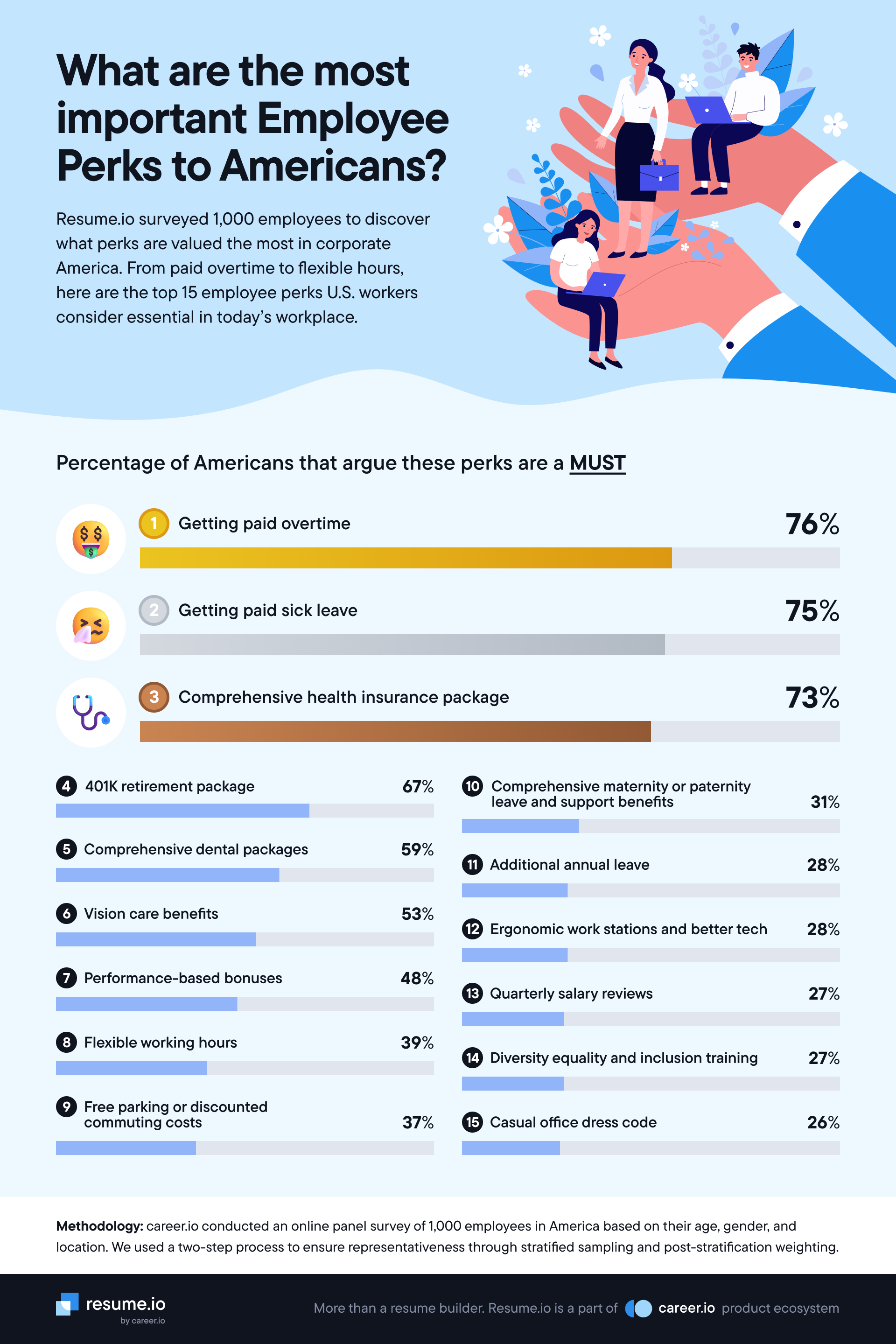
- Paid overtime was revealed as the most in-demand employee perk in America, with 76% of professionals saying it is a must-have
- A third of Gen-Z workers argue that a compressed workweek should be a non-negotiable perk, more than any other generation
- Female professionals prioritize inclusive and supportive benefits, such as maternity/paternity leave and DEI training, more than their male colleagues, who prefer financial benefits such as stock and investment options
Why is paid overtime the top office perk in 2025?
Paid overtime stands out as the most sought-after perk in 2025. The results reveal that 76% of American workers say paid overtime is a non-negotiable benefit, making it the top demand among employees.
This is closely followed by:
- Paid sick leave (75% consider it a must-have)
- Comprehensive health insurance packages — 73%
- 401(k) retirement package — 67%
- Comprehensive dental packages — 59%
The study highlights a clear preference for health benefits and financial security over traditional “fun” perks in the workplace.
What perks does Gen Z want most?
Younger generations are driving a major shift in workplace culture, prioritizing flexibility, mental health, and inclusivity over traditional perks. Our research found that Gen-Z, in particular, is setting a new standard for what the future of work should look like.
One in three Gen-Z professionals (30%) argue that a compressed, four-day workweek should be a non-negotiable perk. This highlights a strong desire for a better work-life balance from the younger generation. In contrast, only 19% of Gen-X and 13% of Baby Boomers agree, signalling a clear generational divide in expectations around traditional work hours.
Fun rooms, such as spaces with games like ping-pong and other recreational activities, are popular amongst Gen-Z, with 18% saying that they're a must-have in the workplace. This compares to 14% of Millennials, 6% of Gen-X and only 1% of Baby Boomers. Similarly, nap rooms are popular amongst Millennial workers, with 17% considering them essential, and 13% of Gen-Z agreed.
Pet-friendly offices have also risen in popularity, especially among Gen-Z (20%) and Millennials (14%), who increasingly view the ability to bring pets to work as a quality-of-life benefit that fosters a more relaxed and supportive office atmosphere.
Beyond the more superficial perks, 27% of Gen-Z professionals say that support for neurodiverse employees is a non-negotiable perk. This is nearly double the 14% of Gen-X workers who feel the same, and considerably higher than millennials (21%) and Baby Boomers (7%). This strong advocacy for inclusivity among younger workers signals a future where equity, accessibility, and wellness will be at the heart of workplace expectations.
Do men and women prioritize different workplace perks?
Our analysis uncovered a significant gender gap in what professionals consider to be essential workplace perks, reflecting deeper differences in how men and women approach career satisfaction and support structures.
Financial security is a top priority for male professionals:
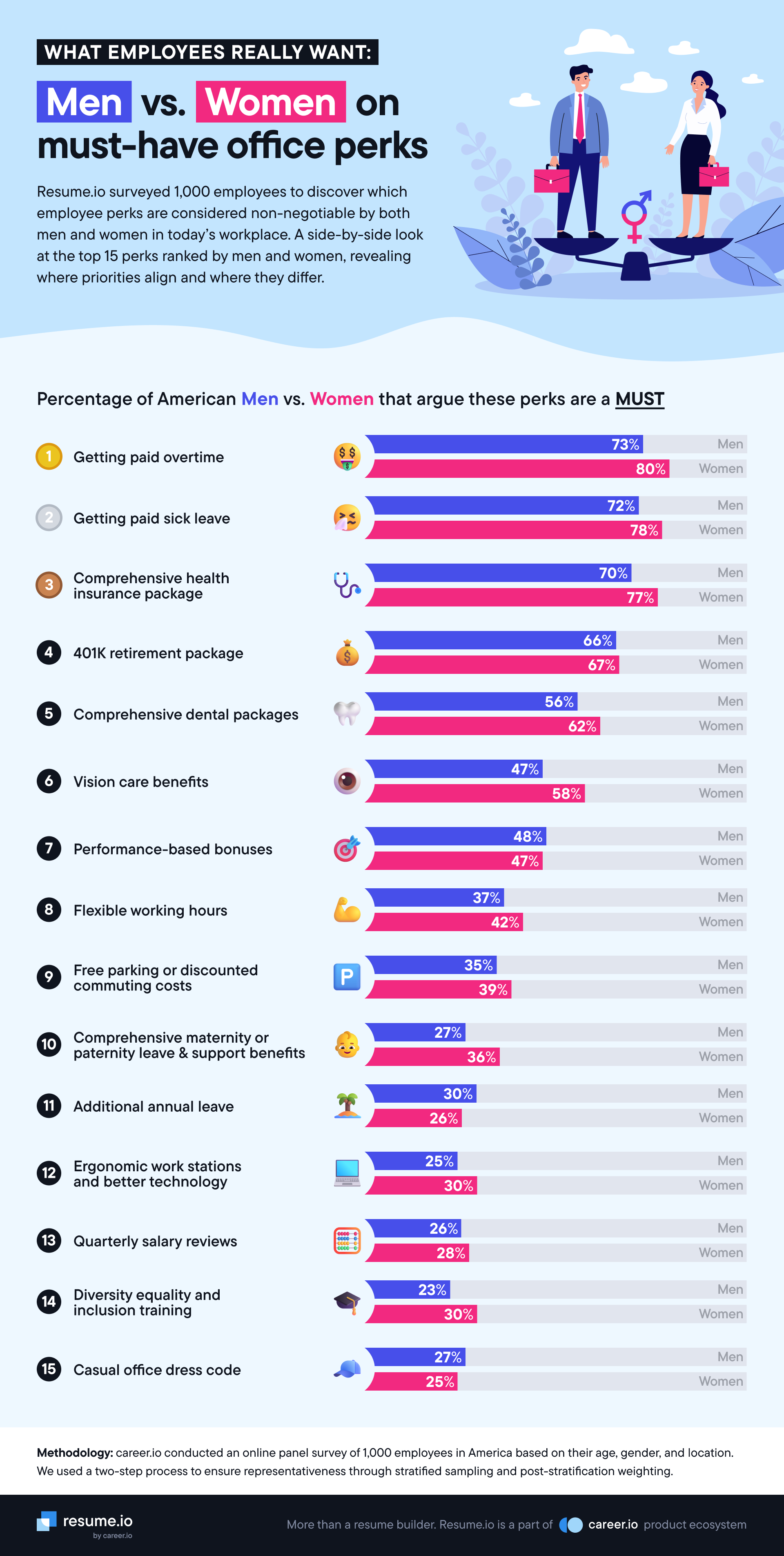
- 28% of men consider stock and investment options to be essential in the workplace, compared to 22% of women
- Similarly, 20% of men say that financial planning and counseling is a must-have benefit, versus only 15% of women
In contrast, women prioritize supportive, inclusive benefits that address both family needs and workplace culture:
- 36% of women say that comprehensive maternity and paternity leave, along with associated healthcare support, are non-negotiable perks. This compares to 27% of men who agree
- 30% of women rate Diversity, Equity, and Inclusion (DEI) training as an essential workplace feature, compared to 23% of men
- 25% of women emphasize the importance of mental wellbeing support services, slightly more than the 22% of men who prioritize it
The findings suggest that women are more likely to seek long-term, stability-focused benefits that promote wellness, inclusion, and family support, while men place a slightly greater emphasis on immediate financial gain.
How should job seekers use perk data in their search?
Our study highlights that employees want more than flashy perks. They are seeking environments that prioritize financial fairness, health and wellness, inclusivity, and flexibility.
As companies plan for the future in light of the increase in RTO (return to office) mandates, understanding these evolving needs will be crucial for attracting and retaining employees — a theme that also shows up in our return-to-office etiquette survey and Sunday Scaries research.
For professionals aiming to find roles aligned with their values, communicate priorities during the job search process. Update your resume and cover letter to highlight the environments where you thrive. Our cover letter templates and resume templates help you present that fit clearly — and the vacation quit survey shows how time off often clarifies what perks actually matter.
Survey methodology
Online panel survey of 1,000 American employees aged 18+. Respondents were selected to represent diverse demographics across age, gender, and location. A stratified sampling approach and post-stratification weighting were used to ensure a balanced and representative dataset.
Data recorded: April 2025
Frequently asked questions
What is the most wanted employee perk in America?
Paid overtime ranked first, with 76% of surveyed professionals calling it a must-have. Paid sick leave (75%) and comprehensive health insurance (73%) followed closely.
Do Gen Z workers want a four-day workweek?
Yes — 30% of Gen-Z respondents said a compressed four-day workweek should be non-negotiable, compared with 19% of Gen-X and 13% of Baby Boomers.
How do perk priorities differ by gender?
Men in the survey prioritized stock options (28%) and financial planning (20%) more often than women. Women ranked maternity/paternity leave (36%), DEI training (30%), and mental wellbeing support (25%) higher.
Tools & guides mentioned in this article
- AI Resume Builder
Build an ATS-ready resume with AI writing help and live preview.
- Resume Templates
Browse ATS-friendly layouts for every industry and career stage.
- Free ATS Checker
Upload your resume and get an instant ATS compatibility score.
- Free Resume Checker
Grade your resume's overall quality, bullet impact, and clarity for free.
- Career Advice Blog
More resume, ATS, and job-search guides from MakeResume.
Land 3x more interviews with AI.
Don't let your resume get stuck in an ATS. Build an optimized resume in minutes, then validate it with our free checker.