

Disgruntled employees sometimes vent through scathing — and occasionally funny — resignation letters. A scorched-earth exit is still the exception. As a fantasy, it can be useful: a heat scale that matches tone to how angry you feel, as long as the hottest drafts never leave your laptop.
O Canada — what is going on with those scorched-earth resignation schemes, eh? And a related joke: why did the Canadian go to anger management? Because he apologized to a door after bumping into it.
You do not need to be Canadian, or in on the self-deprecating humour, to follow along. Wherever you are, this article treats resignation rage as a real feeling with a dangerous send button. We cover what a scorched-earth letter is, how a Scoville-style heat scale works, survey numbers from 1,000 Canadians, copy-and-paste templates from sweet to scorching, why unsent drafts can help, and how to write the professional letter you should actually deliver. If you are leaving without another job, also read quitting without another role lined up before you torch the bridge you still need.
What is a scorched earth resignation letter?
A scorched earth resignation letter is a hostile, often exaggerated goodbye that tries to avenge the writer by attacking bosses, colleagues, or the whole organisation — the workplace version of burning bridges.
Scorched earth started as a military metaphor: destroy resources so the enemy cannot use them. At work it means leaving in a way that damages relationships on purpose. The letter (and sometimes other aggressive behaviour) is meant to get even. The cost is usually yours: a tarnished reputation, lost references, and a harder next search.
Typical ingredients include general complaints, pointed criticism, anger, bitterness, mockery, insults, accusations, threats, and cartoonish exaggeration. The templates later in this article remix situation and tone the way a professional tool would mix a calm resignation — except the hot versions are for private venting, not HR. A level-headed notice still belongs in business-letter form, which we cover after the heat scale.
How do we rate scorched earth resignation letters?
Each template is matched to a heat level, from mild to inferno, modeled on the Scoville Scale used for chili peppers: Sweet, Salty, Peppery, Spicy, Fiery, and Scorching.
In descending order of fierceness:
- Scorching
- Fiery
- Spicy
- Peppery
- Salty
- Sweet
The Scoville Scale — tasting the burn
The urge to taste chili heat is relative on a 1-to-10 scale, and has been for more than a century. American pharmacist Wilbur Scoville created the method in 1912. Human tasters judged how many dilutions of sugar water it took before the burn disappeared. Each pepper got a Scoville Heat Unit (SHU) score. The scale became the standard way to compare capsaicin, the compound in chili oil and seeds that makes mouths burn.
Why create a heat scale for resignation letters?
We built a jokey heat scale because a survey of 1,000 Canadians showed most people dream of an aggressive resignation letter — and most still think actually sending one is “unCanadian.”
The idea landed next to a research project on workforce discontent. “Resignation rage” was the theme for a survey of 1,000 random Canadians. We wanted to know whether an unusually blunt quit would fly in Canada, or whether it would be written off as culturally off-key.
Statistical insight
- A majority of survey respondents across Canada — 64.8% — dream about quitting their jobs with an aggressive resignation letter.
- At the same time, 68.2% of Canadians think it is “unCanadian” to actually do so.
- When asked about the most aggressive element in any resignation letter they had ever written, participants cited:
- 19.6% — General criticism of management
- 18.8% — Toxic workplace issues
- 13.6% — General criticisms of coworkers' performance
- 12.8% — Specific criticisms of management
What does unCanadian mean in this survey?
Here, “unCanadian” means a scorched-earth quit that clashes with a national reputation for politeness — whether that reputation is earned or just a “sorry” stereotype.
The foot-stepping joke never dies as an inside or outside gag. The image of Canadians as respectful, friendly, and peaceful is still part of the national story in media and pop culture. The survey numbers say people want the fantasy and still reject the send.
Should you ever send a scorched earth resignation letter?
Almost never. Treat the hot templates as fiction. We do not expect much real-world uptake, and we would never encourage anyone who wants to stay employable to mail a scorched-earth goodbye.
Pepper Joe's, which sells pepper seeds, plants, and ingredients, warns customers: “Hot peppers are a lot of fun, this is why we love what we do. But, please take them seriously and handle with care.”
In the same spirit, this scale is a light take on a serious problem. The useful version is an unsent draft that helps you write a calmer exit — or to raise workplace issues through proper channels instead of a public roast. If the job is new and already wrong, how to quit a job you just started is the practical guide; this page is the fantasy layer on top.
What do scorched earth resignation letter templates look like?
Six templates run from Sweet (a normal, grateful notice) to Scorching (a comic-rage dump). Copy them for private use. Except for Sweet and, with care, Salty, do not send them at work.
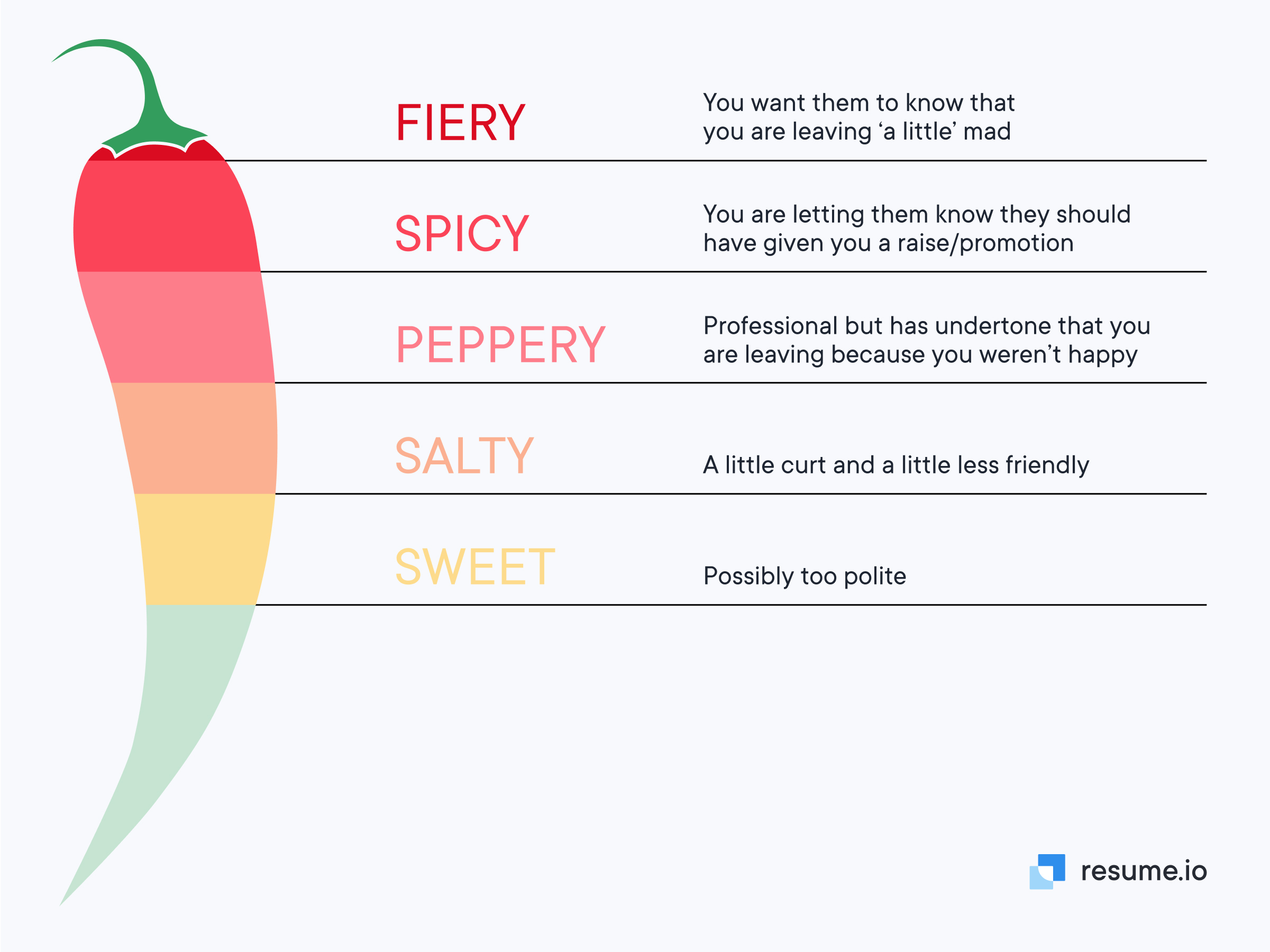
Disclaimer: Forget “do not try this at home.” Home may be the only safe place to test these. Except for sweet No. 1 and salty No. 2, do not try this at work.

Sweet — professional resignation letter
[Your name] Resignation

[Your Address]
[Your Phone Number & Email]
[Supervisor’s Name]
[Supervisor’s Title]
[Company Name]
[Company Address]
[Date of Letter]

Dear [Supervisor’s Name],

Please accept this letter of resignation as formal notice of my intentions to resign from my position as [Your Position] at [Company Name]. My last day will be [XXX XX, XXX]

The environment at [company name] was supportive and I learned a great deal from my peers. I’m grateful for the many positive experiences and friendships formed during my time here.

I want to express my gratitude for the opportunity to develop my skills and thrive in this role.

During the next two weeks, Please let me know if I can assist with recruiting or training a replacement, or anything else that would help during this transition.

I look forward to staying in touch. Thanks again and best wishes for the future.

Sincerely,

[Your Name]

Salty — brief, cool resignation letter
[Your name] Resignation

[Your Address]
[Your Phone Number & Email]
[Supervisor’s Name]
[Supervisor’s Title]
[Company Name]
[Company Address]
[Date of Letter]

Dear [Supervisor’s Name],

The purpose of this letter is to inform you that I will be leaving my job as [Job Title] at [Company Name], and my last working day will be XX, XX 2023.

I will be relocating to [New Location] in the near future. Any written correspondence can be mailed to me at [Relocation Address] until further notice.

Sincerely,

[Your Name]

Peppery — better-fit next job (use with care)
[Your name] Resignation

[Your Address]
[Your Phone Number & Email]
[Supervisor’s Name]
[Supervisor’s Title]
[Company Name]
[Company Address]
[Date of Letter]

Dear [Supervisor’s Name],

The purpose of this letter is to inform you that I will be leaving my job as [Job Title] at [Company Name].

I have accepted a position at a company that I feel is a better fit for my career moving forward, and my last working day will be [XX XX, 2023.]

Sincerely,

[Your Name]

Spicy — pay and promotion (fantasy or private draft)
[Your name] Resignation

[Your Address]
[Your Phone Number & Email]
[Supervisor’s Name]
[Supervisor’s Title]
[Company Name]
[Company Address]
[Date of Letter]

Dear [Supervisor’s Name],

The purpose of this letter is to inform you that I will be leaving my job as [Job Title] at [Company Name], and my last working day will be [XX, XXX 2023.]

The reason for my resignation is that I have decided my consistent hard work over the past [number of years in position] deserves a reasonable chance of promotion and pay increase which I do not believe is the case at [current company name.] I have accepted a position that grants me both at a company that I can continue to advance at.

My last working day will be [XX XX, 2023.]

Sincerely,

[Your Name]

Fiery — toxic workplace (unsent only)
[Your name] Resignation

[Your Address]
[Your Phone Number & Email]
[Supervisor’s Name]
[Supervisor’s Title]
[Company Name]
[Company Address]
[Date of Letter]

Dear [Supervisor’s Name],

The purpose of this letter is to inform you that I will be leaving my job as [Job Title] at [Company Name], and my last working day will be [XX, XXX 2023.]

The reason for my resignation is that I can no longer accept working in what I consider to be a toxic working environment. This is something that I am sure you are aware of, being in management and interacting with staff every day. I have accepted a position at a company that will make my workday far more pleasant with a management team that listens to the very real concerns of their staff.

My last working day will be XX XX, 2023.

Sincerely,

[Your Name]

Scorching — comic rage dump (never send)
[Your name] Resignation

[Your Address]
[Your Phone Number & Email]
[Supervisor’s Name]
[Supervisor’s Title]
[Company Name]
[Company Address]
[Date of Letter]

Dear [Supervisor’s Name],

The purpose of this letter is to inform you that I will be leaving my job as [Job Title] at [Company Name], and my last working day will be [XX, XXX 2023.]

The reason for my resignation is that I truly can’t spend one more day in the [insert from options below]

- Toxic hellscape.
- Seventh layer of hell.
- Radioactively toxic wasteland
- Dystopian fascist regime.
- Destroyer of talent hopes and dreams.
- Nightmare-inducing Thunder Dome.
- Soul crushing and conformist beige box.
- Horrific generator of mediocrity.
- Sucking wound of a thousand micro cuts by stupidity, mismanagement, and incompetence.
- Endless audition of Canada’s Got Talent (with absolutely no talent)
- Joyless grey Borg cube of repetitive tasks and monotony
- Space and time fogging vortex of sadness
- Optical migraine-inducing commercial assembly line of sheer boredom
- Customer facing endless negotiation to placate completely unreasonable humans
- Groundhog Day movie (without the charm)
- All night restaurant serving gruel and misery

that [company name] has become (and possibly always has been.) I do, in fact, have many grievances that I’d like to share here since management (yourself included) have never let me express them in any meaningful way.

For one, [possible grievance #1.] Secondly, [possible grievance #2.] in addition, [possible grievance # 3] and finally, [possible grievance #4.]

Possible grievances:

- I have been paid well by 2010 standards (unfortunately, it’s 2023)
- 2-3 people would have to leave or be hit by a bus for me to get a promotion.
- I was promised a parking space in the good lot.
- My co-workers do nothing and force me to do everything to keep this out-of-control freight train running; sometimes I think they are sleeping with their eyes open and staring at a monitor.
- Have you ever actually tried the coffee here?
- You won’t let us work from home so we can be more ‘productive’ really, it just adds 2 hours to my commute, makes me more tired and less likely to care about anything by the time I get to work.
- It’s insane that you make us pay for our own office supplies.
- I can never book off the days I want for my well-earned vacation.
- We have many empty offices, but for some reason, I still must work at a ‘hot desk’ like an intern.
- It’s always cold in the summer and hot in the winter here, just as I suspect Rikers Island prison would be.
- The sound of my co-workers' laughter and phone conversations in this open-concept hellish landscape is enough to drive anyone to question their life choices and how they brought them here.
- You may decorate this place with a used foosball table and toys so clients can believe it's a ‘fun’ and creative place to work … but the staff aren’t fooled.
- You force me to have countless never-ending meetings that are about as productive as explaining how crypto currency works to my elderly parents.
- The break room fridge is a black hole where food goes to die. I swear I saw a sandwich in there from 2017.
- The office bathrooms are like a scene from a horror movie. I'm pretty sure there's a family of raccoons living in there.
- My job title is so convoluted that I don't even know what I do anymore. When you hire my replacement, simplify it to something that doesn't require a dictionary to understand.
- The office chairs are so uncomfortable that I think they were designed by medieval torturers.
- The office lighting is so harsh that I feel like I'm being interrogated by the FBI. For the sanity of your remaining workers, Sweetdim the lights a little.
- The company social events are so awkward that I'd rather be stranded on a desert island with only a volleyball for company.
- The office smells like a combination of burnt popcorn and stale coffee. Be a hero and invest in some air fresheners or candles.

I have gladly tunnelled a way out of this ongoing nightmare of a job by accepting a position at a company that will make my workday far more pleasant with a management team that listens to the concerns of their staff. If that sounds good to you too, please don’t ask me to write you a letter of recommendation or give you an introduction to my new company. In fact, I’d love it if you were to always stay 100 yards from them (and me).

My last working day will be [XX XX, 2023.] Before you ask, I have no interest in an exit interview. I am very much looking forward to walking through the doors of [company name] and never returning (or thinking) about my past [number of years] ever again.

Gleefully,

[Your name]
Can writing an unsent resignation letter help with rage?
Yes — if it stays unsent. Comic relief on the heat scale can vent “resignation rage,” or it can be the draft that helps you write a respectful notice and use better channels for real complaints.
That is the therapeutic case for scorched-earth letters: they work as a detox only when they never become a personnel-file document.
Is it useful to write a resignation letter you never send?
It can be, as a private “blaze of glory” draft, as long as you cannot accidentally hit Send and you never share it at work.
You may be stuck with a boss you cannot stand, colleagues who drain you, and no safe exit this month. Daydreaming a dramatic departure in a document that never leaves your machine is usually harmless. Sharing it with anyone on the team is one of the fastest ways to damage relationships and future prospects.
How can an unsent letter help you reclaim control?
The value is reflection, emotional release, and self-care: you put anger on a page so you do not have to carry all of it into the next meeting.
Catharsis in a controlled file can feel like reclaiming a bit of agency. Wit, exaggeration, and sarcasm can lighten the load if you can laugh at the draft later. According to Karen Dempsey at Davanti Counselling, unsent letters of any kind can help you let go of hurt or rage before it hardens into resentment. As the feeling loses power, it loses meaning. “The page or screen now holds your anger so you don't have to,” Dempsey explains. “So, you may have to press ‘save’ on the email, but you don't need to press ‘save’ on your anger.”
Expert tip
Save the file somewhere that is not your work laptop. Do not put the recipient on the To line, even as a joke. Draft in a notes app, then delete or archive once you have written the real, short, polite notice.
What should you do instead of sending a scorched letter?
Use HR or management channels when they are safe, talk to trusted people or a counselor, and put the energy into a job search — starting with a resume that shows recent work, not a rant.
An unsent letter is not a substitute for those steps. If a toxic manager blocks every official path, colleagues, friends, or a counselor are still better outlets than a flame-thrower email. Exploring new roles can redirect the same energy. Updating skills and accomplishments on a clean, ATS-friendly resume is a confidence move that actually changes your options. Quiet withdrawal at work is a different pattern; quiet quitting is not the same as a planned, professional exit.
How do you write a professional resignation letter?
Keep it professional, polite, and short. A resignation letter is for dates and a clean handoff, not score-settling — no matter how justified the gripes feel.
HR wisdom is consistent: there is essentially one proper way to write the letter you send. Content and tone stay courteous. This is never the place to unload grievances. Situation-specific examples exist all over the web; the structure below is the part that does not change.
What is the structure of a resignation letter?
Use business-letter format: your contact details, theirs, the date, a greeting, notice of the role and last day, optional thanks and transition help, and a sign-off — all on one page.
- Header with your name and contact information
- Recipient's name, company, and address
- Date
- Salutation / greeting
- First paragraph: you are resigning as [position] with [organization], and your final day of work
- Second paragraph: gratitude for the time there, if you can say it honestly
- Third paragraph: willingness to help with a transition
- Optional: a brief reason — you are not obligated to elaborate
- Sign-off
Expert tip
To avoid confusion about when employment ends, name your final day of work rather than a vague “effective date.” “My resignation is effective August 4” can mean August 4 is your last day on the job or the first day you are gone.
What are the guidelines for a resignation letter?
Give two weeks' notice unless policy says otherwise, tell your boss before the letter goes wide, keep it to two or three paragraphs, and always take the high road — even if you are leaving on bad terms.
- A letter is often required to document the departure. Even when it is not, it is almost always wise.
- Two weeks' notice is the usual expectation. Check local policy and your contract.
- Tell your boss before you send the letter, in person or by phone if you can, at a calm moment. Keep the news off the grapevine until then.
- State the last day, thank them if you can, and offer a handoff. Two or three paragraphs is enough; never more than one page.
- Address it to your boss and copy HR. A PDF attached to email is widely accepted.
- Clear, concise, and courteous beats clever. Neutral is better than hostile if you cannot find anything kind to say.
The common denominator: take the high road. A scorched-earth letter can feel like firing the employer. The long-term damage lands on you. Reasons to stay polite:
- A respectful exit is damage control. A hostile letter burns bridges you may need to rebuild.
- Hiring managers still call former employers. You may also need a reference later.
- You will run into ex-colleagues — at a conference, a client, or the dog park. Awkward is better than impossible.
- Wishing them well, even if it is a stretch, protects your reputation. Staying through a clean handoff does too.
- Unlikely as it feels now, you might want the door cracked if the workplace later changes.
- Nothing in a resignation letter can be unsaid. Assume it lives in your file forever and could appear in a dispute.
When you are ready to apply elsewhere, skip the manifesto and lead with a resume that matches the next posting. The Sweet template above is the only heat level that belongs in that next chapter.
Frequently asked questions
Should I send a scorched earth resignation letter?
No. Use Sweet (or a similarly short, polite notice) for the letter you actually deliver. Fiery and Scorching drafts are for private venting. Sending them can cost references, reputation, and future jobs.
Do most people want to send an angry resignation letter?
In a MakeResume survey of 1,000 Canadians, 64.8% said they dream of an aggressive letter, and 68.2% said actually sending one would be “unCanadian.” Wanting the fantasy is common; acting on it is still rare — and still unwise.
What should a real resignation letter include?
Your name and contact details, the recipient, the date, a clear statement that you are resigning, your last day of work, optional thanks and transition help, and a professional sign-off. Two or three paragraphs on one page is enough.
How much notice should I give?
Two weeks is the usual default in many workplaces. Check your contract and local policy. Tell your manager before a wide email goes out.
Can an unsent angry letter still help?
Yes, as a way to park rage on a page, according to counselors who recommend unsent letters. Keep it off work systems, never address it to a real inbox, and write the short polite version before you resign.
Tools & guides mentioned in this article
- AI Resume Builder
Build an ATS-ready resume with AI writing help and live preview.
- Resume Templates
Browse ATS-friendly layouts for every industry and career stage.
- Free ATS Checker
Upload your resume and get an instant ATS compatibility score.
- Free Resume Checker
Grade your resume's overall quality, bullet impact, and clarity for free.
- Career Advice Blog
More resume, ATS, and job-search guides from MakeResume.
Land 3x more interviews with AI.
Don't let your resume get stuck in an ATS. Build an optimized resume in minutes, then validate it with our free checker.