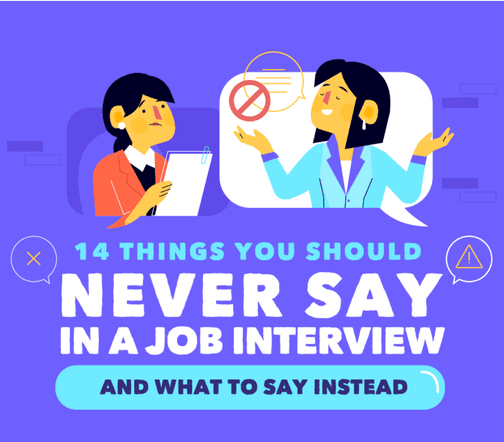
Interview phrases that backfire usually fall into a handful of categories: negative talk about a past employer, answers that reveal you skipped preparation, compensation questions raised too soon, and lines that sound either desperate or overconfident.
Each one gives the interviewer a reason to doubt you. Knowing what to say instead keeps the conversation pointed at your strengths.
What should you never say in a job interview?
The things you should never say in a job interview are the ones that make a hiring manager question your preparation, your attitude, or your professionalism.
The table below lists the most common mistakes, explains why each one lands poorly, and offers a stronger alternative you can use on the spot.
| What not to say | Why it gives an interviewer pause | What to say instead |
|---|---|---|
| "I don't really know much about the company." | Shows you did not prepare and are not genuinely interested. | "I read that you recently launched X, and I would love to hear how the team is building on it." |
| "It's on my resume." | Sounds dismissive and wastes your chance to add detail. | "Happy to walk you through that and add some context my resume does not capture." |
| "My last boss was a nightmare." | Reads as a preview of how you might describe this employer later. | "I was ready for a role with more room to grow, which is what drew me here." |
| "I'll do anything." / "I just need a job." | Sounds unfocused rather than invested in this role. | "This role fits what I do best, which is exactly why I applied for it." |
| "So, what's the salary and time off?" (early on) | Makes pay look like your only motivation before you have shown value. | "I would love to talk compensation once we both feel this is the right fit." |
| "My biggest weakness is that I'm a perfectionist." | An obvious cliché that dodges the question. | "I used to take on too much myself, so I have worked on delegating and asking for input earlier." |
| "No, I don't have any questions." | Reads as disengaged or uninterested. | "What does success look like in the first ninety days of this role?" |
None of these alternatives ask you to perform or pretend.
Each one shifts the focus from doubt to the value you bring, which is exactly what interview prep is for.
The sections below unpack the situations where these slips happen most often, so you walk in with a real answer ready instead of scrambling under pressure.
Think of them as the reasoning behind the table, with the context and nuance a single line cannot carry on its own.
What are trigger words in an interview?
Trigger words in an interview are specific words and phrases that make a hiring manager pause and reassess you, often without you noticing the shift.
Terms like "whatever," "honestly," and "desperate" tend to signal trouble underneath, and nearly all of them connect to one of three doubts an interviewer is quietly weighing throughout the conversation.
Behind almost every interview question is one of these three checks.
When a phrase raises a red flag, it is usually because it answered one of them the wrong way:
- Can you do the job? - This covers preparation and competence. Admitting you know little about the company, or leaning on "it's on my resume," suggests you have not done the work.
- Will you commit to this job? - This covers focus and motivation. "I'll do anything" and "I just need a job" tell the interviewer this role is interchangeable to you.
- Do we want to work with you? - This covers professionalism and fit. Criticizing a former manager, oversharing personal details, or padding answers with "honestly" and "obviously" all chip away at how you come across.
The goal is not to memorize a script word for word.
It is to recognize which doubt a phrase feeds, then steer toward the opposite.
A candidate who gives a concrete reason for wanting this exact role can settle all three doubts in one answer, which sits at the heart of the interview skills that help candidates get hired.
1. What not to say about a previous employer or boss
Do not criticize a previous employer or boss in a job interview, even when the criticism is entirely justified.
Speaking badly about a former manager is one of the fastest ways to lose an interviewer's trust, because they hear a preview of how you might one day describe them.
There is a version of this that catches well-intentioned candidates off guard.
Explaining that you left because you could not stand your manager, or because you were let go over attendance, can feel like plain honesty.
To a recruiter it reads as poor discretion, and it pulls the conversation toward problems instead of your strengths.
Honesty still matters, though it works best when you frame it around what you want next.
- Instead of: "My last boss micromanaged everything I did."
- Try: "I do my best work with a degree of autonomy, which is part of what drew me to this position."
The same principle applies to your reason for leaving.
Keep it brief, keep it forward-looking, and let the focus stay on the role in front of you rather than the one behind you.
2. What not to say about salary, benefits, or time off
Do not raise salary, benefits, or time off early in a job interview.
These are reasonable things to care about, but leading with them before the interviewer has seen your value makes the paycheck look like your only motivation.
Wait until compensation comes up naturally, or until an offer is on the table.
Picture an interview that is going well, and then the first thing you ask is how much vacation you would get.
The tone shifts immediately and the interviewer starts weighing how invested you actually are, rather than how well you fit the work.
Timing is the whole point here.
- Fine to hold until later: Pay, bonuses, vacation, remote days, and promotion timelines.
- Fine to ask anytime: Questions about the role, the team, and what success looks like.
When the interviewer does open the topic, you can speak to it directly and with confidence.
Preparing for salary and compensation questions in advance means you are ready to talk numbers the moment it is welcome, without having forced it too soon.
3. What not to say about your weaknesses
When asked about your weaknesses in an interview, never reach for a rehearsed cliché like "I am a perfectionist" or "I just work too hard."
Interviewers have heard these hundreds of times, and they land as an attempt to dodge the question rather than answer it with any self-awareness.
What the interviewer actually wants is evidence that you can see yourself clearly and act on it.
A real weakness, paired with the steps you have taken to manage it, is far more convincing than a polished non-answer.
Naming a genuine limitation also signals confidence, because it takes security to admit one openly.
The point is not the flaw itself but the growth around it, which is a quality every hiring manager values.
- Instead of: "My biggest weakness is that I care too much."
- Try: "I used to struggle to say no to extra work, so I started blocking my priorities first and flagging capacity early."
Working out your genuine strengths and weaknesses before the day turns one of the most dreaded questions into a chance to stand out for the right reasons.
4. What not to say when you are unsure or unprepared
When a question catches you off guard in an interview, never shut it down with a flat "I don't know."
That single phrase tells the interviewer they would have to guide you through the role, and it closes a door you could have used to show how you think.
A tough question is an opportunity, not a trap.
Interviewers rarely expect a flawless answer on the spot, so they watch how you handle the moment instead.
A composed pause reads far better than a shutdown, and it buys you room to give a real response without losing credibility.
- If you need a moment: "That is a good question. Give me a second to think it through."
- If you lack a detail: "I do not have that exact figure, but here is how I would approach finding it."
- If it is unfamiliar: "I have not faced that directly, though here is how I would handle it."
The same goes for deflections like "it's on my resume" or "what does the company do?", which send the same message of low effort.
Solid research and a few rehearsed stories remove most of these moments before they ever arrive.
5. What questions should you not ask the interviewer?
Never end a job interview by saying "no, I don't have any questions," and avoid questions that focus on what you gain before an offer exists.
Steer clear, too, of anything that invites the interviewer to speak negatively about the company or their colleagues, since that puts them in an awkward spot and reflects back on you.
Your questions are part of how the interviewer judges you, so they deserve as much preparation as your answers.
A weak or self-interested question can undo a strong hour of conversation, while a sharp one confirms you are already thinking like part of the team.
- Questions to avoid: "What does the company do?", "How soon can I get promoted?", and "What is the worst part of working here?"
- Questions that land well: "What does success look like in this role?", "How does the team measure a strong first year?", and "What are the biggest priorities for this position right now?"
Asking something thoughtful leaves the interviewer with a closing impression of curiosity and genuine interest, which is exactly the note you want to end on.
What to say instead to make a strong impression
The words interviewers want to hear are specific and forward-looking: what drew you to this role, clear proof that you prepared, and concrete examples of past results.
Leading with these turns everything you have learned about what to avoid into a genuinely positive conversation, and most of it is simple to prepare.
Open with a warm, brief greeting.
Skip the apology and the comment about your nerves, because how you introduce yourself in an interview sets the tone for everything that follows.
From there, the phrases that work share a pattern: they are concrete, positive, and centered on the value you bring to the team.
- Words that reassure an interviewer: "prepared," "for example," "results," and "collaborated."
- Themes that stand out: Real interest in this role, evidence over adjectives, and a focus on the team's goals.
The phrases that build momentum deserve as much rehearsal as the ones you avoid, so it is worth studying what to say during a job interview alongside this list.
Frequently asked questions
A few common questions come up about what not to say in a job interview.
What are three things you should never say at an interview?
Three of the most damaging are criticism of a former employer, "I just need a job," and "no, I don't have any questions."
Each one raises concern about your professionalism, focus, or engagement.
Replace them with concrete, positive answers that keep the attention on why you fit this role.
Is it okay to say you are nervous in an interview?
It is better not to. Announcing your nerves points the interviewer straight at them and can undercut your confidence in the moment.
A brief, warm greeting and a note about how glad you are to be there sends a stronger signal while helping settle you at the same time.
Should you ask about salary in the first interview?
Generally no. Raising pay before the interviewer has seen your value can make money look like your main motivation.
Wait until compensation comes up naturally or an offer is on the table, then discuss it directly and with confidence.
Tools & guides mentioned in this article
- AI Resume Builder
Build an ATS-ready resume with AI writing help and live preview.
- Resume Templates
Browse ATS-friendly layouts for every industry and career stage.
- Free ATS Checker
Upload your resume and get an instant ATS compatibility score.
- Career Advice Blog
More resume, ATS, and job-search guides from MakeResume.
Land 3x more interviews with AI.
Don't let your resume get stuck in an ATS. Build an optimized resume in minutes, then validate it with our free checker.