

Where do US and UK workers most enjoy working from home? In MakeResume's analysis of more than 600,000 geotagged Twitter posts, Delaware was the most positive U.S. state (46% of tweets supportive), El Paso, TX was the most positive U.S. city (45.4%), and Watford and Brent north of London led the UK (58.3% and 54.9% of tweets in the key findings below).
Remote work stopped being a niche perk in a few short years. Workplace tools, a global pandemic, and a shift in what people will accept from a job all collided. According to a Gallup study, 45% of full-time employees in America are now working partly or fully remotely, and 91% of these people support their ability to work in this way.
Most Americans judge the experiment a success. PwC's Remote Work Survey found that 83% of workers believe their company's shift to remote working has been a positive thing. Upwork's Future Workforce Report estimates that 40.7 million will be working fully remote in the next five years. Support is not universal. Not every job can be done from a spare room, and not every city sounds happy about it on social media. The maps below show where the mood is brightest and where it is not.
What We Did
To see how the public talked about working from home in 2023, MakeResume analyzed Twitter data in the UK and US and ranked places by how supportive or critical those posts were.
We analyzed more than 600,000 geotagged Twitter posts and used a sentiment-tracking AI called HuggingFace to determine whether posts about remote work were positive or negative. The full method sits at the end of this article. Rankings for your city or state are in the sections below.
Key Findings
- Residents of Delaware are most enthusiastic about remote work, with 46% of tweets supporting the policy.
- El Paso, TX, is America's most positive city about WFH — 45.4% of posts are happy with the idea of remote work.
- There is considerable negative sentiment against remote work in Baltimore, MD, where 26% of tweets were critical of it.
- In the UK, residents of Watford and Brent — both located north of London, were most supportive of remote work — 58.3% and 54.9% of tweets in the areas respectively contained positive sentiment.
Residents of Delaware Are Happiest About Remote Working
Delaware is the most optimistic U.S. state about remote working in this dataset, with 46% of tweets about it containing positive sentiment. Home working has spread nationwide, but the tone of those posts is not the same everywhere.
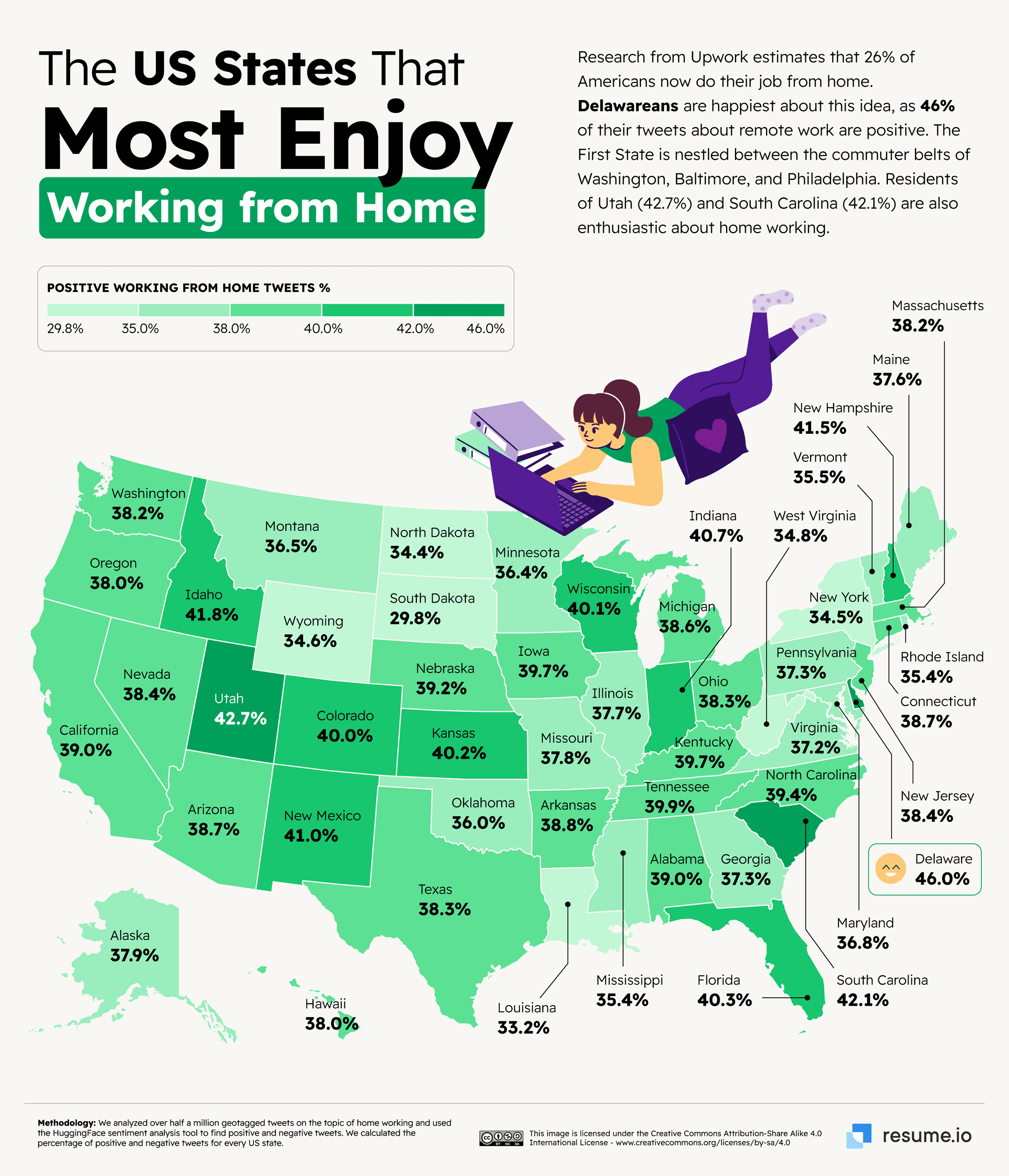
Delaware sits between Washington, Baltimore, Philadelphia, and New York City. More than 10,000 people in the state commute for 90 minutes or more each day. Hours recovered from that kind of travel help explain why Delawareans rank first on support.
The Dakotas are cooler on the idea. North Dakota (29.8%) and South Dakota (34.4%) show weaker support for home working. That pattern also shows up in commute-time savings for remote workers: places with brutal travel tend to sound happier about skipping it.
El Paso Locals Spared of Cross-Border Commute Support Home Working the Most
El Paso, TX is America's most positive city about working from home, with 45.4% of tweets supporting it. The commute context is extreme: the city sits on the Rio Grande and shares a border with Ciudad Juarez, and thousands of people cross daily for work and school.
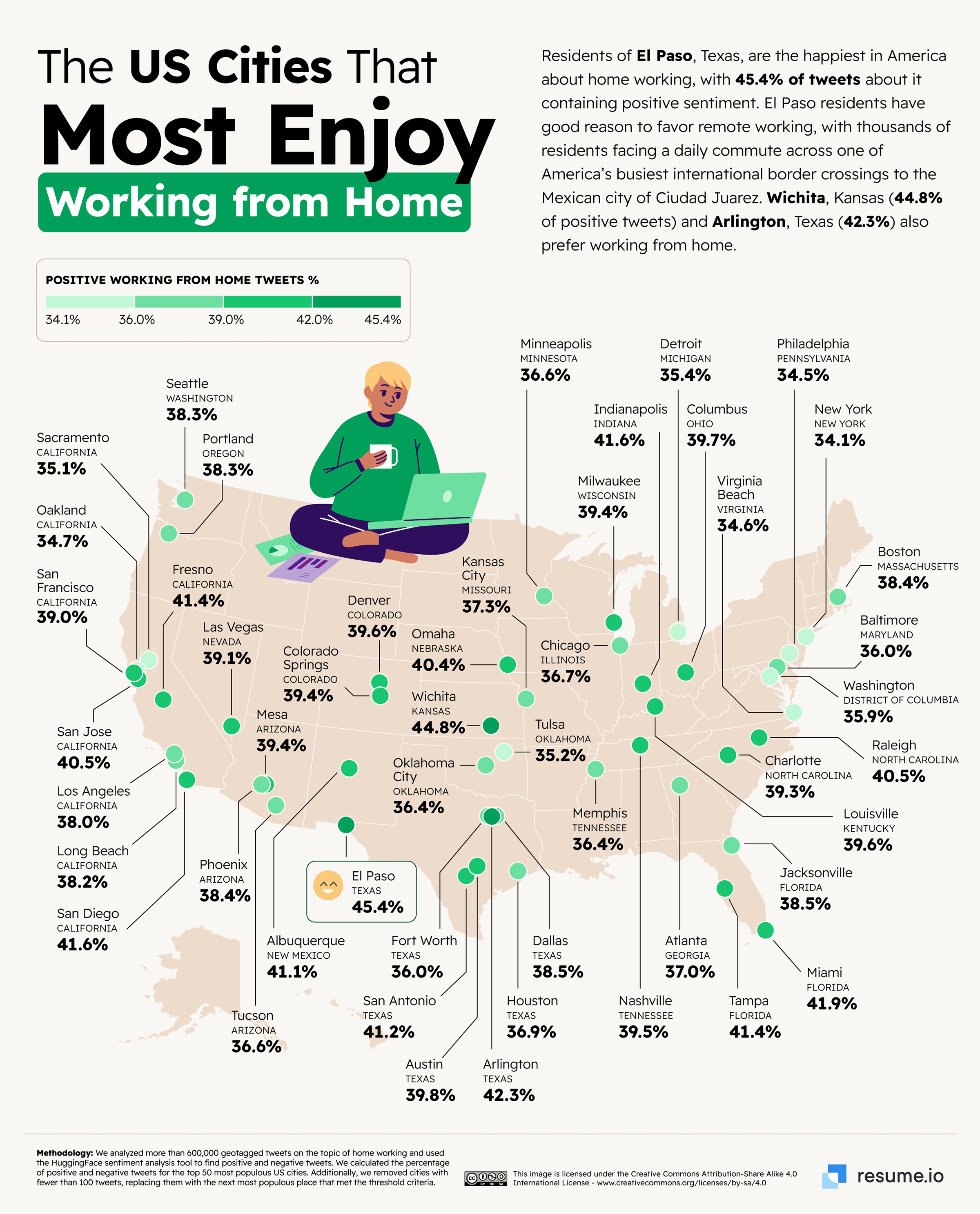
In 2017, 41 million people made the crossing. Tighter vehicle checks from Mexico into Texas have brought traffic to a standstill. Residents have described the wait as “inhumane.”
Against that backdrop, 45.4% support is unsurprising. El Paso narrowly beats Wichita, KS (45.4%) and Arlington, TX (42.3%) as the most supportive U.S. city in the set.
Almost 60% of Brent Tweeters Love Remote Working
In Brent, 58.3% of Twitter posts about remote working contain positive sentiment, slightly ahead of nearby Haringey (56%). London has been a focal point of the remote-work debate since the pandemic.
A study by King's College London found that 84% of people in the capital who work from home at least once a week say that it has positively impacted their quality of life. Brent, in North London, sits at the enthusiastic end of that mood.
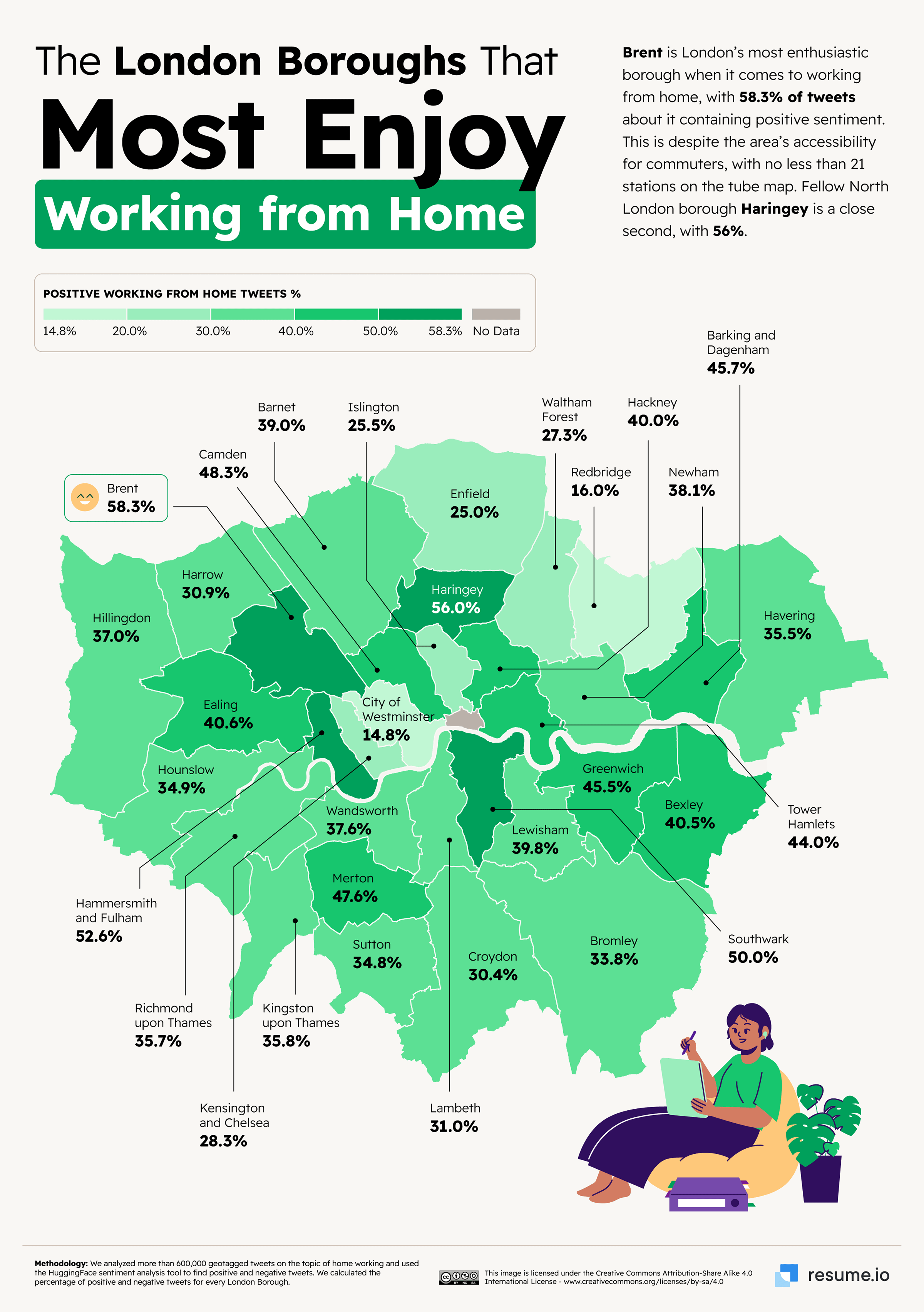
Workers largely want the flexibility. City leaders still worry about empty desks. Reports have warned that home working could make up to a fifth of office space in the capital redundant, with knock-on effects for the economy, especially retail and hospitality.
Watford Residents Love Remote Work More than Any Other UK City
Among the 50 largest cities in Britain in this study, Watford in Hertfordshire is the most positive: 54.9% of tweets about remote work in the area have positive sentiment.
In Spring 2022, an ONS survey revealed that 38% of UK working adults are still working from home at least once a week — up from 12% prior to the pandemic.
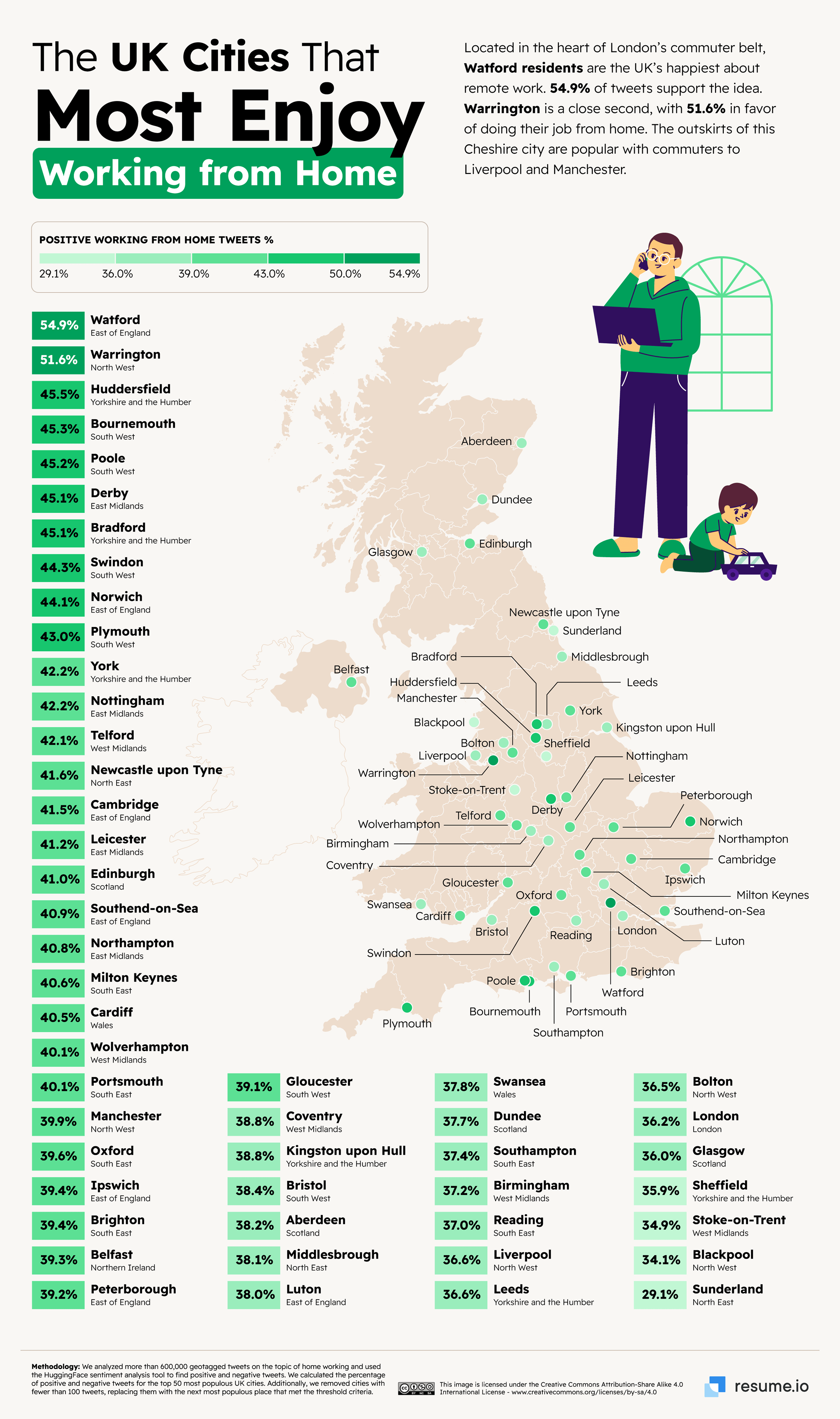
Watford is commuter-belt geography. It is 15 miles from central London, sits next to the M25, and is the 3rd busiest train station in the East of England region. Skipping even some of those trips is an obvious win.
Warrington in Cheshire is next, with 51.6% of tweets supporting remote working. It sits between Liverpool and Manchester. Huddersfield (45.5%) is third, similarly placed between Manchester and Leeds. Cities that feed larger job markets show up again and again in the supportive column.
Which US Cities Love and Hate Remote Working?
El Paso, TX is the most positive U.S. city (45.4% of posts in support); Baltimore is the most critical (26.7% negative), with Philadelphia close behind at 26.4%. A Pew Research Center survey found that 60% of Americans who can work remotely in their job said they would prefer to continue doing so once the Coronavirus pandemic was over. However, 60% of the workforce have jobs that cannot be done from home, and not everyone supports the shift.
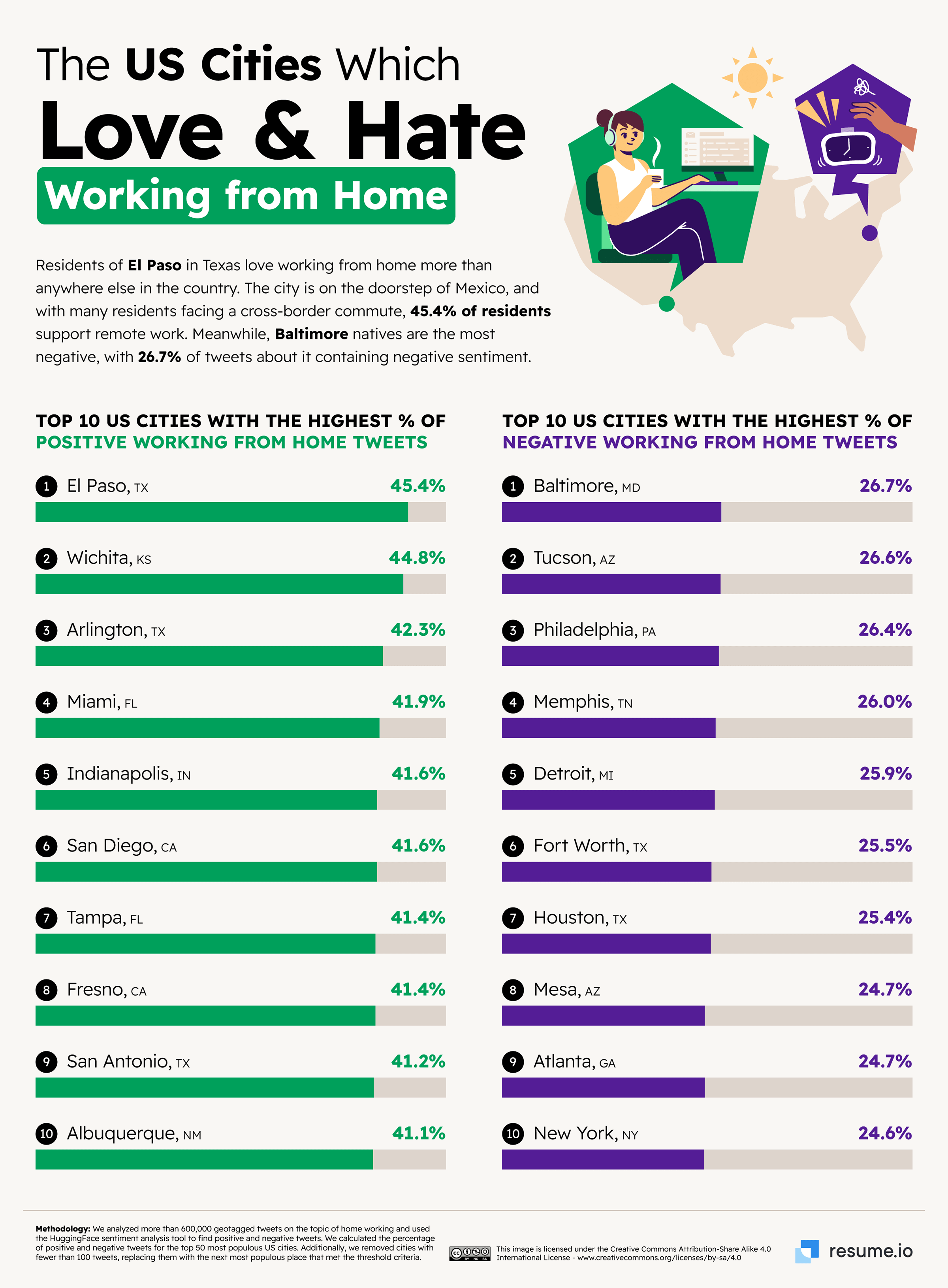
El Paso, TX sits at 45.4% of posts in support. Baltimore is more critical: 26.7% of tweets in Maryland's largest city contain negativity. Philadelphia is similar, with critical sentiment at 26.4%.
If you are negotiating location on a resume, pair this map with broader remote-work statistics rather than assuming your city's Twitter mood is a hiring policy.
Which UK Cities Love and Hate Remote Working?
Watford is the most supportive UK city in this ranking (54.9% positive tweets); Swansea is the most critical (29.2% negative). Fewer than 1 in 10 workers say they want to return to the office five days a week, even as ministers have urged people back to desks.
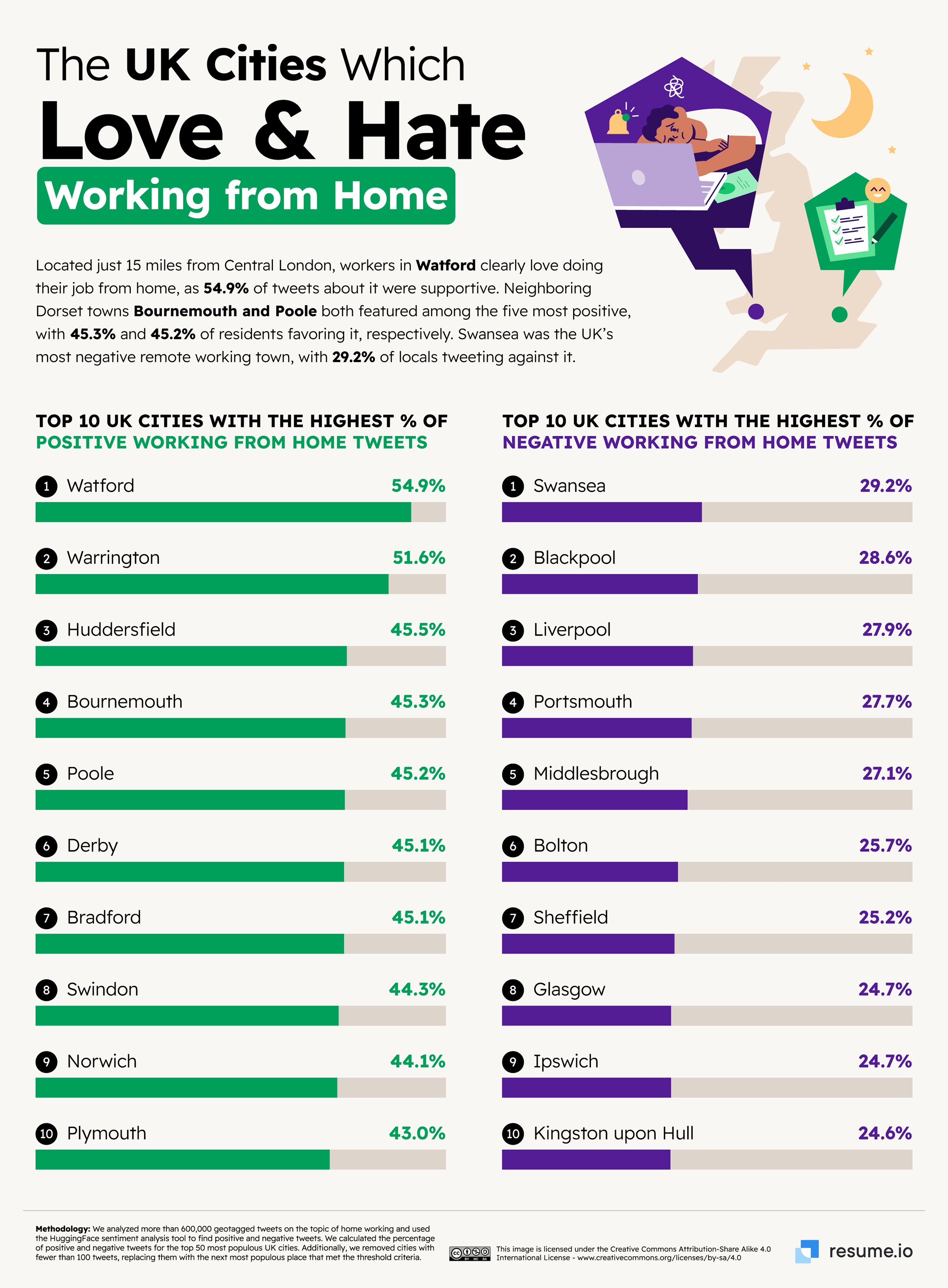
Watford shows 54.9% support among commuter-belt posts. Swansea is the other pole: 29.2% of tweets in the south Wales town contain negative sentiment — more than anywhere else in the UK in this ranking. Swansea's workforce has above-average shares of education, health, and retail staff, according to figures from the Welsh government. Those are jobs that are harder to do from a kitchen table, which helps explain the cooler tone.
Working From Home: Love It or Loathe It?
Remote work is staying, whether a given city cheers or complains. Five days a week, 9 to 5, in the same building is no longer the default for many office roles. That change has reached companies of every size.
The upsides are familiar: fewer stressful commutes, more time with family, and less hovering at the desk. The downsides are real too. Many employers have struggled to build team culture at a distance. 60% of respondents in the Pew Research Center survey said working from home made them feel less connected to their co-workers. Teamwork skills matter more, not less, when half the collaboration happens on a screen.
Whether you want full-time office, hybrid, or fully remote work, use the charts in this article to see how your city talked about the shift. If you are job hunting around location, say your preference clearly on the resume, then confirm it before you accept. The resume builder can hold a location line without crowding the rest of the page.
Methodology and Sources
We curated a list of keywords around the topic of home working and used a scraping tool to find 1,270,459 tweets containing those terms. We then removed any duplicate/spam tweets and those posted by users whose locations we couldn't identify from their profiles, leaving us with 610,661 located tweets.
We used the HuggingFace sentiment analysis tool to find positive and negative tweets. We then labeled the tweets as “negative” if the probability of “negative” is higher than 0.5 and “positive” if the probability of “positive” is higher than 0.5.
Finally, we calculated the percentage of positive and negative tweets for every US state, top US and UK cities, and London boroughs. At the city-level for both US and UK, we started with the top 50 most populous cities of a country but removed those with fewer than 100 tweets, replacing them with the next most populous cities that met the threshold criteria.
The data was collected in May 2022.
Sources used in this article:
- Saad, L., Wigert, B. (2021) Remote Working Persisting and Trending Permanent, gallup.com
- PwC. (2021) It's time to reimagine where and how work will get done, pwc.com
- Ozimek, A. (2021) Future Workforce Report 2021: How Remote Work is Changing Businesses Forever, upwork.com
- Baker, K. (2016) 90 minutes to work? Mega-commuting takes hold in Del., delawareonline.com
- Pskowski, M. (2022) Border agencies, truckers, leaders blast ‘unnecessary’ increased inspections stymying commerce, elpasotimes.com
- Hinojosa, H. (2022) Why the wait time to cross to Juarez is inhumane, theprospectordaily.com
- King's College London. (2022) The WFH revolution: how new ways of working are changing London, kcl.ac.uk
- Partridge, J. (2022) Home working could make up to a fifth of London office space redundant, theguardian.com
- Nelson, E. (2020) London Offices Aren't Refilling Fast Enough for Shops Relying on Them, nytimes.com
- Office for National Statistics (2022) Is hybrid working here to stay?, ons.gov.uk
- Office of Rail and Road (2022) Estimates of station usage, orr.gov.uk
- Parker, K., Menasce Horowitz, J., Minkin, R. (2022) COVID-19 Pandemic Continues To Reshape Work in America, pewresearchcenter.org
- Neate, R. (2022) Out of office? How working from home has divided Britain, theguardian.com
- Welsh Government (2021) Workplace employment by Welsh local areas and broad industry, statswales.gov.wales
Frequently asked questions
Which U.S. state is happiest about remote work in this study?
Delaware. 46% of tweets about remote work from the state were supportive, the highest state-level share in the dataset.
Which U.S. city is most positive about working from home?
El Paso, TX, with 45.4% of posts supporting home working, narrowly ahead of Wichita, KS (45.4%) and Arlington, TX (42.3%).
Which UK places are most supportive?
Key findings list Watford and Brent north of London at 58.3% and 54.9% positive tweets respectively. In the borough section, Brent is 58.3% and Haringey is 56%. In the city section, Watford is 54.9%.
How was sentiment measured?
1,270,459 tweets were scraped, then filtered to 610,661 located posts. HuggingFace's CardiffNLP twitter-roberta-base-sentiment model labeled a tweet negative or positive when that class probability exceeded 0.5. Data was collected in May 2022.
Does this mean my city will stay remote?
No. This is public Twitter mood, not a forecast of employer policy. Use it as context, then confirm the actual arrangement in the job posting and interviews.
Tools & guides mentioned in this article
- AI Resume Builder
Build an ATS-ready resume with AI writing help and live preview.
- Resume Templates
Browse ATS-friendly layouts for every industry and career stage.
- Free ATS Checker
Upload your resume and get an instant ATS compatibility score.
- Free Resume Checker
Grade your resume's overall quality, bullet impact, and clarity for free.
- Career Advice Blog
More resume, ATS, and job-search guides from MakeResume.
Land 3x more interviews with AI.
Don't let your resume get stuck in an ATS. Build an optimized resume in minutes, then validate it with our free checker.