

A resignation email is a short professional message that confirms you are leaving your job, states your notice period, and names your final working day — usually with a formal resignation letter attached as a PDF.
In most workplaces, speaking with your manager first and then sending a clear email plus letter creates a clean paper trail for HR without burning bridges. Keep the tone calm and factual even when the decision feels emotional.
This guide covers how to format and send a resignation email, what subject line to use, what to leave out, writing tips, common types of notice, and three copyable templates. For letter wording and notice-period examples, also see our formal resignation letter guide, two weeks' notice letter templates, and resignation letter templates. When you are ready for the next search, refresh your materials with MakeResume's resume builder or start from the MakeResume.pro homepage.
What is a resignation email and how do you send one?
A resignation email is a formal message that confirms you are leaving and states your notice period and last day of work.
Best practice in most offices is to email a short summary and attach a resignation letter as a PDF so managers and HR have a written record. If you can, tell your manager in person or on a call first, then send the email the same day so the date is documented.
Sending notice by email alone is common when remote work, time zones, or company policy make a meeting impractical — but a conversation first still reduces surprise and keeps the relationship more open. Pair the email with a formal letter attachment whenever your workplace expects one.
How should the resignation email format be?
Keep the resignation email format clear, professional, and concise: the body confirms resignation, notice, and last day, while a formal letter attachment usually handles the full business-letter record.
The email itself is shorter and more direct than a printed letter. Both documents should align on your intention to resign and the same final working date.
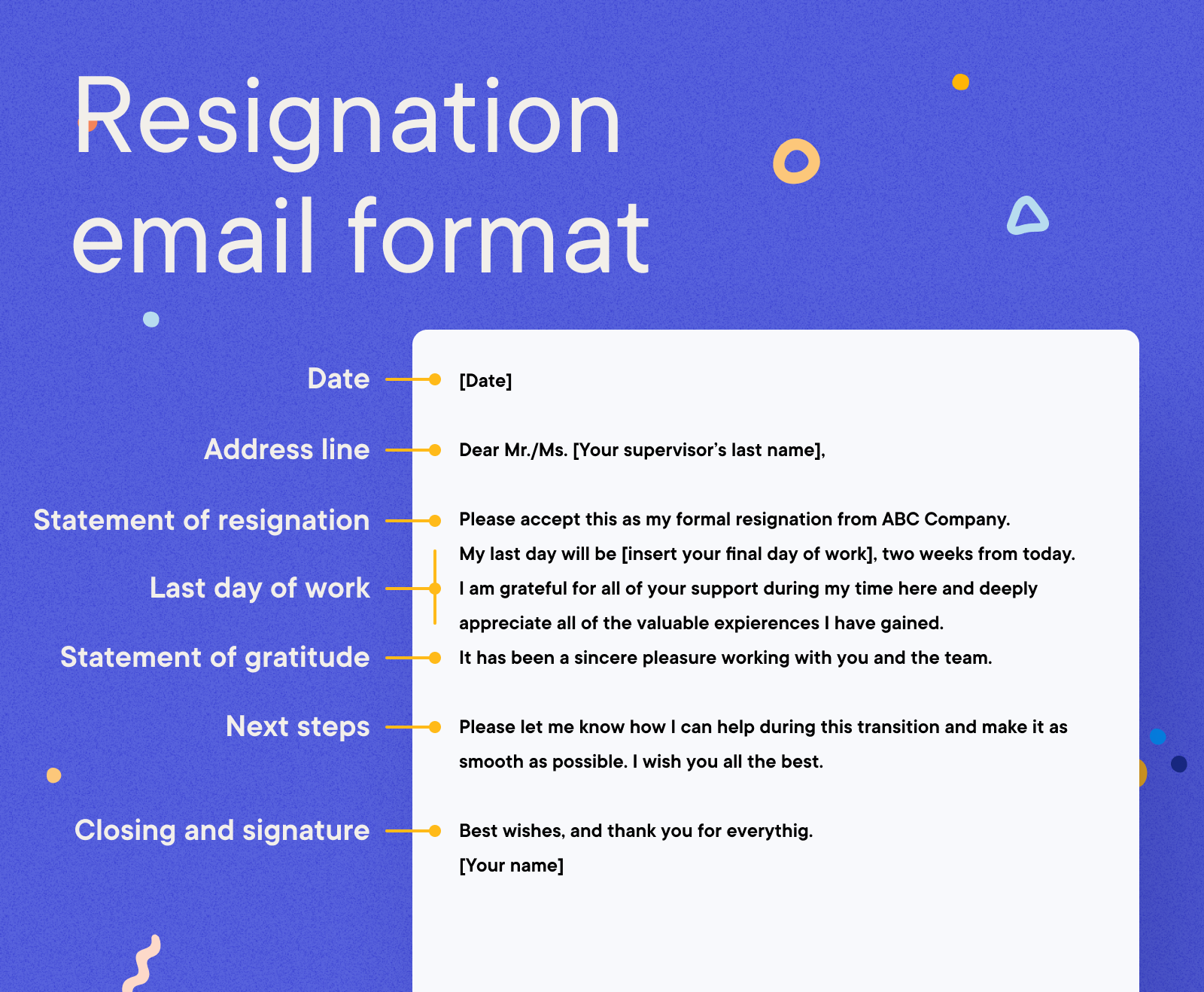
A standard resignation email format typically includes:
- A clear statement that you are resigning
- Your notice period
- Your final working day (a calendar date, not only “two weeks from today”)
- A brief expression of gratitude
- An offer to assist with the transition
If you are unsure what belongs in the attached letter, it should formally confirm your resignation, include your last day, and stay respectful. For structure details, use our formal resignation letter checklist.
What should the subject line of a resignation email be?
Use a clear, direct subject line such as “Resignation - Your Full Name.”
That wording helps your manager and HR find and file the message without guessing. Avoid vague, casual, or emotional subject lines — they are hard to search and look unprofessional in shared inboxes.
Examples of appropriate subject lines:
- Resignation - Jane Smith
- Notice of Resignation - Jane Smith
- Jane Smith - Resignation
How do you attach a resignation letter to an email?
Write a short email confirming your resignation, then attach your formal resignation letter as a PDF before you send.
That combination gives a clear summary in the inbox and a formal document for HR records. Follow these steps:
- Write and save your formal resignation letter as a PDF.
- Draft a brief, professional email summarizing your resignation and last day.
- Attach the resignation letter file to the email.
- Use a clear subject line such as “Resignation - Your Full Name.”
- Double-check the attachment, recipients, and dates before clicking send.
In most workplaces, a resignation email with an attached letter is considered best practice. Need letter wording? Start from our two weeks' notice or resignation letter generator examples, then personalize.
What should you not include in a resignation email?
Do not use a resignation email to air grievances, vent emotions, or explain every detail of your decision — keep it professional, clear, and focused on confirming your departure.
Your message often becomes part of your employment file. To protect your reputation, avoid:
- Complaints about management, colleagues, or company policies
- Emotional language or frustration
- Ultimatums or demands
- Detailed explanations about your new role or compensation
- Gossip or criticism of coworkers
- Promises of future support you cannot guarantee
Even under difficult circumstances, stay calm and factual. Angry “scorched earth” drafts belong unsent — our take on scorched-earth resignation letters explains why venting in writing usually backfires.
Tips for writing a resignation email
A carefully written resignation email makes your notice period less awkward and leaves a stronger final impression.
- Put your name and the word resignation in the subject line. Nothing else belongs there. Your manager will forward the message, and it needs to be easy to find.
- Be clear about your notice period. Whether it is two weeks or two months, state it early. Check your employment contract first so the timeline is accurate.
- Give the calendar date you are leaving. After confirming notice, name an unambiguous last day. Garden leave or a negotiated longer stay can change plans later, but start from a contractual baseline.
- Resist going into emotional detail. Regret, anger, joy, or hope are normal — but the email is not the place for them. Keep it formal; save nuance for a private conversation that does not burn bridges.
- Thank people for what you learned. Even imperfect experiences usually include skills or colleagues worth acknowledging briefly.
- Offer assistance during your notice period. Managers worry first about coverage. Say you will help with handoff, documentation, or training within reason.
- Put key questions in writing. Benefits, access, return of equipment, or reference timing often need a formal answer — list them in the email instead of relying on hallway chat.
- Include personal contact information. Work email access may end quickly. Add a personal email and phone so colleagues can reach you if needed.
If you are leaving without another job lined up or quitting a role you just started, the same clarity and professionalism still apply — only the notice length may change.
What are the different types of resignation email?
There is no single standard resignation email — tone and structure shift with notice length, workplace culture, and how you are leaving.
Most messages still follow the same core structure but fall into a few common categories:
- Standard two weeks' notice resignation email
- Professional resignation email
- Formal resignation email
- Short notice resignation email
- Immediate resignation email
- Resignation email when leaving under difficult circumstances
Each type differs mainly in tone, level of detail, and how much notice you can give. Immediate or short-notice exits deserve an honest conversation plus a brief written record — not a long justification. Never treat a scathing fantasy letter as something to send; keep those drafts private.
Resignation email examples and templates
Every resignation email is personal, but these three templates cover the essentials — replace the bracketed fields and keep the tone polite.
1. Standard resignation email sample
Keep a standard resignation email simple: state your last day, thank the company briefly, and attach your letter.
Standard resignation email
Subject: Resignation - [Your Full Name]

[Today's Date]

Dear [Supervisor's Name],

Please accept this email as notice that I am resigning from my role as [Job Title] at [Company Name]. My last day of work will be [Month Day, Year], which is two weeks from today.

I have valued my time at [Company Name] over the past [XX] years. I am leaving to [brief, neutral reason for departure].

Working here has been a genuine pleasure. I have learned a great deal and built relationships with colleagues that I will continue to appreciate.

I am happy to help train a replacement or document open work before my departure.

Thank you for the opportunity to work at [Company Name].

I have attached my formal resignation letter to this email.

Sincerely,
[Your Name]
[Personal email]
[Phone number]
2. Formal resignation email sample
Use a more formal register when your workplace expects traditional language — adjust word choice to match culture without adding complaints.
Formal resignation email
Subject: Resignation - [Your Full Name]

[Today's Date]

Dear [Supervisor's Name],

I am writing to inform you that I will be leaving my position as [Job Title] at [Company Name]. My final working day will be [Month Day, Year], in accordance with my notice period.

While I have greatly valued my time as an employee at [Company Name], I will be [brief, neutral reason for departure].

I have found professional and personal satisfaction in this role, and the lessons I have learned here will continue to shape my career. I have also appreciated working with an excellent team of colleagues.

Please let me know the next steps to ensure minimal disruption, including any handoff you need on systems or projects I currently manage.

I am happy to provide assistance to ensure a smooth transition, including preparing training materials for my replacement.

Thank you once again for the opportunity to work with you at [Company Name].

Please find attached my formal resignation letter.

Sincerely,
[Your Name]
[Personal email]
[Phone number]
3. Difficult circumstances resignation email sample
When the exit is awkward, keep the email short, civil, and factual — gratitude can stay brief without inventing false praise.
Difficult circumstances resignation email
Subject: Resignation - [Your Full Name]

[Today's Date]

Dear [Supervisor's Name],

Please accept this email and the attached resignation letter as formal notice that I am leaving my position as [Job Title] at [Company Name]. My final working day will be [Month Day, Year].

I have learned a great deal during my time at [Company Name]. Thank you for the opportunity to contribute to the team.

Please let me know the next steps from your side at your earliest convenience.

I remain available before my departure to help make the transition as smooth as possible.

Please find attached my resignation letter.

Sincerely,
[Your Name]
[Personal email]
[Phone number]
Personalize the brackets, proofread once, and send after you have spoken with your manager when possible. More letter options live in our resignation letter templates.
FAQs for a resignation email
Below are answers to common questions about writing and sending a resignation email so you can leave clearly and professionally.
How do you politely resign in an email?
To resign politely by email, state that you are resigning, confirm your final working day, thank your employer briefly, and offer transition help — keep the tone concise and free of emotional language.
What is a good resignation example?
A good resignation example is short, clear, and respectful: it confirms resignation, states notice and last day, expresses appreciation, and avoids unnecessary detail.
The templates above are a solid starting point; adapt them to your dates and workplace tone.
Is it okay to resign via email?
Yes — resigning via email is acceptable in most workplaces, especially where email is the standard channel.
Ideally, speak with your manager first, then follow up with a formal email (and letter attachment) for written confirmation of your last day.
Is it better to say I quit or I resign?
In professional communication, say “I resign” rather than “I quit.”
“Resign” is the formal workplace phrasing and helps preserve respect and reputation in the written record.
What is the difference between a resignation email and a resignation letter?
A resignation email is the message you send to notify your employer; a resignation letter is the formal document often attached for official records.
The email is usually shorter; the letter follows a traditional business format with fuller contact details. See our formal resignation letter guide for the letter side.
Can you give a resignation notice by email?
Yes — you can give resignation notice by email unless your contract requires a different method.
Stating your notice period and final working day clearly in the email is common practice, and many employees also attach a formal resignation letter for documentation.
Tools & guides mentioned in this article
- AI Resume Builder
Build an ATS-ready resume with AI writing help and live preview.
- Resume Templates
Browse ATS-friendly layouts for every industry and career stage.
- Free ATS Checker
Upload your resume and get an instant ATS compatibility score.
- Free Resume Checker
Grade your resume's overall quality, bullet impact, and clarity for free.
- Career Advice Blog
More resume, ATS, and job-search guides from MakeResume.
Land 3x more interviews with AI.
Don't let your resume get stuck in an ATS. Build an optimized resume in minutes, then validate it with our free checker.