
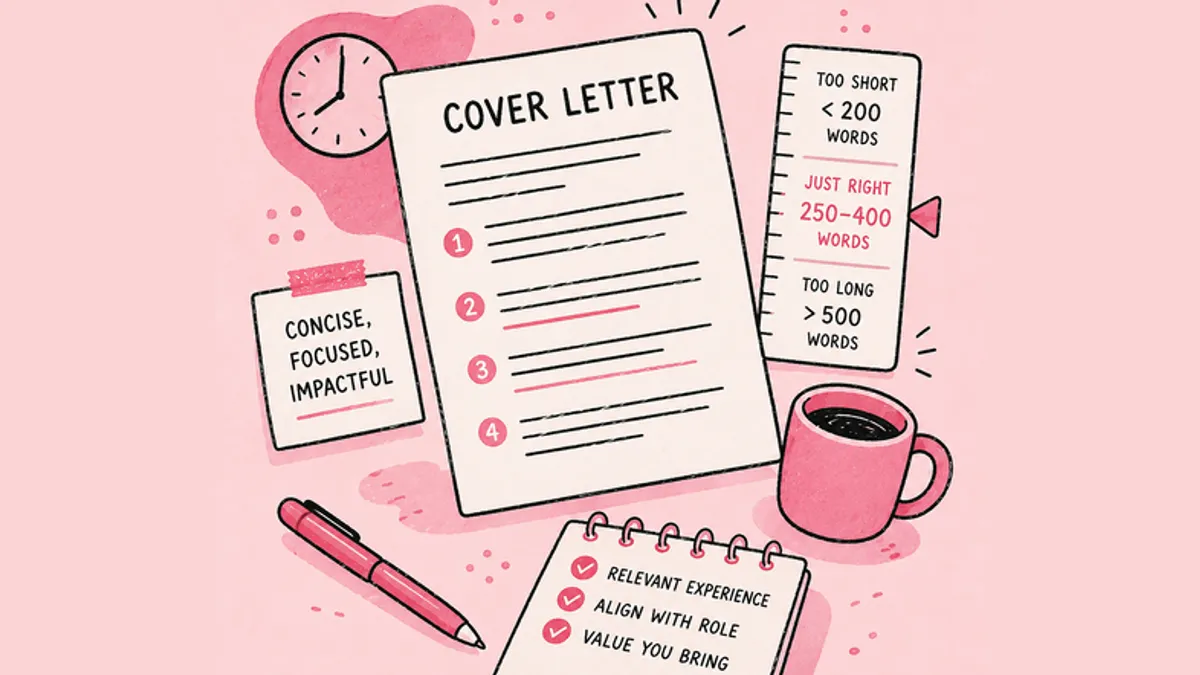
How long should a cover letter be? Keep it to one page — roughly 250 to 400 words — and you will hit the ideal cover letter length most hiring managers actually read. That is about three to five short paragraphs: enough room to make your case, not enough to lose someone who has thirty seconds and a stack of applications.
Cover letter word count matters because recruiters treat length as a signal. A tight letter suggests you know what is relevant; a two-page draft suggests you have not decided. The one page cover letter standard is not arbitrary etiquette — it reflects how little time decision-makers spend on each application before moving on.
This guide answers the length question in full: why cover letters still earn their place, how to structure each section without bloating the page, and practical cuts that protect your strongest points. Whether you are drafting from scratch or trimming a draft that ran long, start here.
Purpose of a cover letter — what's the point?
A cover letter explains the story your resume cannot tell on its own — your motivation, your voice, and the specific reasons you fit this role.
Your resume lists facts in a fixed format. A cover letter connects those facts into a narrative a hiring manager can follow in under a minute. It can earn attention before anyone reads your work history, and in competitive pools it sometimes determines whether your resume gets opened at all.
Understanding the purpose of a cover letter also clarifies why length rules exist: every sentence should do work the resume cannot. As a resume companion document, your cover letter serves these key purposes:
- Provides a personal introduction: You form a direct connection with the employer by addressing your cover letter recipient by name. Resumes are not addressed to anyone.
- Reveals the person behind the professional: The free-form writing style makes your cover letter a storytelling device. It adds narrative depth to your relatively impersonal resume, which is a factual synopsis in mostly list format.
- Bridges your past and future: A successful cover letter paints prospective employers into the picture of your next ideal career move, while resumes are background-oriented.
- Intrigues the reader: By saying just enough without giving away too much, cover letters motivate curious readers to dig deeper for the details in your resume.
But do you really need one?
Yes — in most cases you should submit a cover letter even when the listing marks it optional, because the data consistently shows it improves your odds.
Job applicants often wonder whether writing a cover letter is worth the effort when there is no guarantee it will be read. Skipping an optional cover letter is understandable — but it is rarely advisable. You have everything to gain and nothing to lose by treating cover letters as essential rather than optional. Our cover letter statistics roundup shows applicants who include one are nearly twice as likely to land an interview.
Why else?
Research has concluded that the cover letter is not “dead.” The opposite is true. Not submitting a cover letter with your resume could actually jeopardize your job-winning chances. Why risk it?
Even when a cover letter is not required, the only reason to skip one is if the application instructions explicitly say not to include it.
Statistical insight
According to one survey, 90 percent of hiring professionals consider a cover letter invaluable when making hiring decisions. Even if cover letters are optional, about three-quarters of recruiters still expect to receive them, prefer to receive them, always read them, and show a preference for applicants who include one.
HR professionals find cover letters important and useful to:
- Explain a job candidate's motivation to join the company — 63% of respondents
- Describe career objectives — 50%
- Explain the reasons for changing careers — 50%
- Explain employment gaps — 49%
- Highlight professional achievements — 47%
The do's of writing a spectacular cover letter
Write a strong cover letter by following a fixed five-part structure — header, greeting, introduction, body, and closing — and keeping each section focused on what this employer needs to hear.
Cover letter writing can feel daunting, even for experienced writers. The good news: the structure is simple, and once you know the framework, filling it in becomes much more manageable. A cover letter builder can enforce that structure while you concentrate on content.
Simply structured
Every effective cover letter uses the same five components, and knowing them upfront keeps your cover letter word count under control.
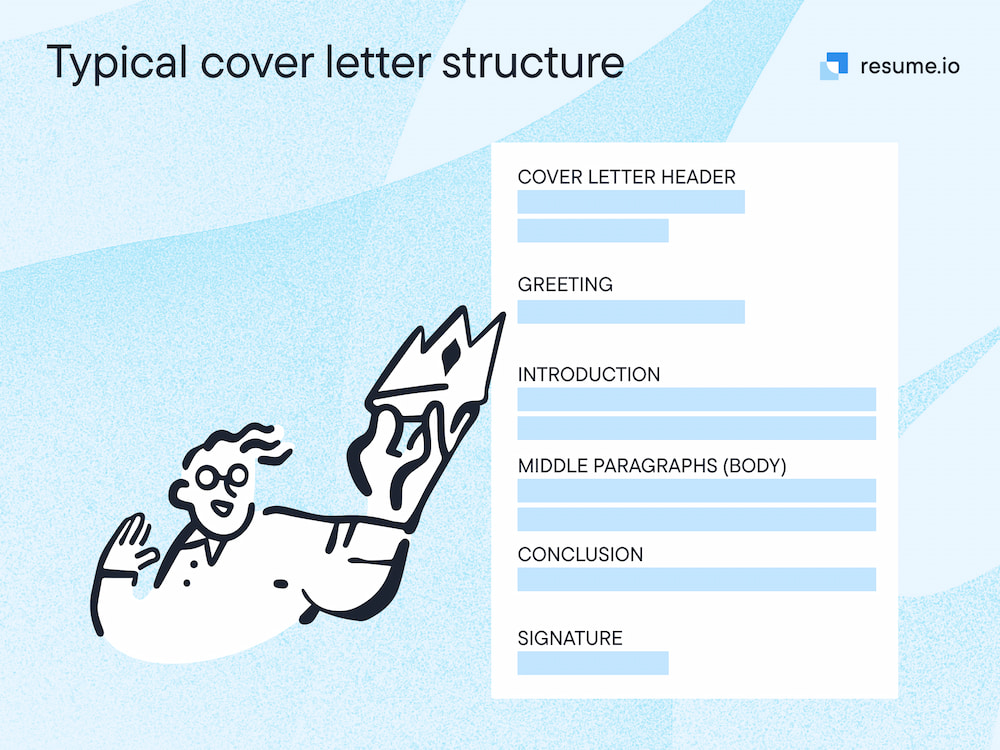
Take comfort in the simplicity of a cover letter's framework. Breaking it into separate parts makes the writing process less overwhelming. Every cover letter follows the same five components:
- Header
- Greeting / salutation
- Introduction
- Middle section (body)
- Closing (conclusion and sign-off)
The following sales representative example packs equal parts passion and professionalism into a compact 300 words — right in the sweet spot for ideal cover letter length.
Example: Sales Representative Cover Letter
Dear Ms. Underhill,

With a seasonal product such as garden furniture, you need a sales rep who can go into marketing mode for half a year and sales mode for the other half. Having been a rep for two gardening manufacturers previously, I understand the investment that this requires.

My career began with a sales management degree from Northwestern University and a graduate placement selling hot tubs. It was a perfect introduction to selling a high-value seasonal product and many conferences and events later, I had perfected my sales pitch. In my first two years as a sales rep, I skyrocketed my region's sales by 80%, attracted 55 more customers and won the national sales prize in my second year.

I have just left a role with your competitor due to a change of company ownership – they brought in their own sales team. This was disappointing, as I took great pleasure in eating away at your market share (the net gain for my previous employer was 6%), but after an acrimonious exit and on finishing my gardening leave, I am keen to stay in garden furniture and feel that my three years of direct experience will prove useful.

My accomplishments there are readily transferable:

- Developed a marketing brochure that increased ATV by 35% on tables and chairs.
- Cultivated a sophisticated sales pipeline, including social media in the sales funnel.
- Negotiated payment terms from 60 days to 51 days on average.
- Sourced new products at exhibitions and sourcing trips with the company buyer.

I know that we have met before, but as I was a rival rather than a potential hire, I hope that the current circumstances may be a little more interesting. I would love the opportunity of an interview to discuss the market and how I might contribute to your sales team.

Sincerely,
Tyler Bellinger
While “sales representative” is one of the broadest job titles in existence, this cover letter example fully illustrates how to target each specific position and employer. Let's look at how to optimize the impact of each cover letter part without adding unnecessary length.
Cover letter greeting
Open with a professional greeting addressed to a named recipient whenever you can find one.
Start your cover letter on a professional, yet approachable, note in the greeting. Science has proven that positive responses are triggered by people hearing or reading their own name. That is why all cover letters should be addressed to someone by name if possible. Our guide to how to address a cover letter walks through what to do when a name is not listed.
Cover letter introduction
Your introduction should hook the reader in two or three sentences with your strongest relevant credential and why it matters to this employer.
In the few seconds it would take in person to shake hands and be seated for an interview, your cover letter introduction facilitates the same connection in writing. Recruiters will expect you to jump in right away with your relevant strengths and experience. And so you should. But the “why you need me” hook is what they will find irresistible.
Our sales representative sample letter leads with this masterful introduction.
Example: Sales Representative Cover Letter Intro
With a seasonal product such as garden furniture, you need a sales rep who can go into marketing mode for half a year and sales mode for the other half. Having been a rep for two gardening manufacturers previously, I understand the investment that this requires.
Cover letter body
Use the body to prove your fit with one or two specific achievements — not a recap of everything on your resume.
This is the place to show, not just tell, what makes you an ideal job match. Elaborate on a few carefully selected achievements and the transferable skills brought to bear. Cite relatable facts and figures that the employer would relish seeing you replicate if hired. And let your motivation shine through in a pertinent anecdote or two. For a deeper breakdown of what belongs here, see what to include in a cover letter.
The cover letter body sample below demonstrates the reader-friendly use of bullet points for both showcasing and word-trimming.
Example: Sales Representative Cover Letter Body
My career began with a sales management degree from Northwestern University and a graduate placement selling hot tubs. It was a perfect introduction to selling a high-value seasonal product and many conferences and events later, I had perfected my sales pitch. In my first two years as a sales rep, I skyrocketed my region's sales by 80%, attracted 55 more customers and won the national sales prize in my second year.

I have just left a role with your competitor due to a change of company ownership – they brought in their own sales team. This was disappointing, as I took great pleasure in eating away at your market share (the net gain for my previous employer was 6%), but after an acrimonious exit and on finishing my gardening leave, I am keen to stay in garden furniture and feel that my three years of direct experience will prove useful.

My accomplishments there are readily transferable:

- Developed a marketing brochure that increased ATV by 35% on tables and chairs.
- Cultivated a sophisticated sales pipeline, including social media in the sales funnel.
- Negotiated payment terms from 60 days to 51 days on average.
- Sourced new products at exhibitions and sourcing trips with the company buyer.
Cover letter closing
Close with a brief thank-you, a reminder of your fit, and a clear call to action — three sentences is usually enough.
Close off in a manner that is concise but not entirely conclusive. Thank recruiters for their time and interest in your application, adding a reminder of why you are an ideal job fit. Then, include a call to action that puts some onus on the employer to respond, not cast your application aside.
The call to action in this sample cover letter closing is unusual but potentially effective.
Example: Sales Representative Cover Letter Closing
I know that we have met before, but as I was a rival rather than a potential hire, I hope that the current circumstances may be a little more interesting. I would love the opportunity of an interview to discuss the market and how I might contribute to your sales team.
Expert tip
Searching for more detail? Our guide to cover letter format covers the broader aspects of writing a well-rounded cover letter — layout, spacing, and file type included.
How to keep your cover letter to one page
Stay within one page by cutting anything that repeats your resume, trimming filler phrases, and choosing fewer, stronger examples over a comprehensive list.
Here are practical ways to keep your cover letter short and focused without selling yourself short:
- Purposeful is persuasive. An engaging cover letter focuses solely on your most relevant and relatable qualifications. It should be obvious to recruiters that you have done your homework, to the extent they can picture what you would look like in the position and hiring organization. A tailored cover letter does this naturally because every sentence targets this role.
- Leave readers wanting more. As an elevator pitch hitting just the high notes, your cover letter should never rehash your resume information, but rather reframe it as a preview. Seamlessly bridge from past to future accomplishments, giving a sense of:
- Who you are and what you have done
- How you will contribute if hired
- Why you want to work for this employer more than any other
- Write lean, not lazy. Think of concise and precise as synonymous in writing that is clear, descriptive, dynamic, and solid. Consult a thesaurus often for help pinpointing exactly the right words. Fewer words are always better, with sparing reliance on adjectives and adverbs.
Expert tip
Action verbs in the active present or past tense are your best friend in a cover letter or resume. They automatically make your writing tighter and more results-driven. Tell the reader what you do or did, not what you are responsible for doing.
- Say it for the first time, your way. Meaningless clichés and other superfluous fluff waste valuable cover letter page space and the reader's precious time. Nothing in your cover letter should sound like what recruiters have seen from other job applicants — especially a thousand times before. That includes this opening line: “I am applying for the position of …” Readers already know that.
- Do not be a drag on the reader's time and energy. Taking too long to make your point is as bad as repeating yourself. Do not be afraid of short sentences. The pauses pack more punch and command staying power, while also sustaining reader momentum. The same goes for shorter paragraphs and bullet points.
- Self-edit scrupulously. Every time you review each cover letter redraft, a crisper, cleaner, and more efficiently polished new version should emerge. Then, when you think it is perfect, ask someone else to give it a look. Revise accordingly. Shorter word counts virtually guarantee a higher recruiter's score. And make sure to use a cover letter builder with a good built-in spell check.
- Proofread for perfection. No one should need reminding of the obvious reason to scrutinize your final cover letter draft for integrity-compromising mistakes. But proofreading can sometimes reveal word-tightening opportunities too, including inadvertent editing errors.
Expert tip
“If I had more time, I would have written a shorter letter.”
That these famous words are frequently misquoted or misattributed takes nothing away from their meaning. Do not be surprised or discouraged by this oft-misunderstood reality when composing your cover letter: the shorter it is, the longer you might take writing it well.
Put another way: cover letters are a classic case of “less is more.” And getting to “less” typically takes more time and effort.
* The earliest recorded version of this quote dates back to 1657, when French mathematician and philosopher Blaise Pascal published “Lettres Provinciales.” Later variations are attributed to philosopher John Locke; inventor Benjamin Franklin; authors Henry David Thoreau and Mark Twain; and U.S. President Woodrow Wilson.
Short and sweet — looking as good as it sounds
Once your cover letter word count is right, polish the layout so the page looks as clean as the writing reads.
Do not tinker with margins or font size as a way to squeeze in too many lines of cover letter text. If word bloat is the real problem, further edits are the only slimming solution.
But if your cover letter is well within the 400-word count limit and fits on a single page, it might still benefit from eye-pleasing improvements. Every aspect of the document's layout, design, and formatting should help make it:
- Inviting to read at first glance — neat, clean, and streamlined, with ample white space.
- Easy to read all the way through — reflecting suitable choices of fonts and sparing graphic touches.
Start from a cover letter template matched to your industry so spacing and margins are handled before you write a word.
Expert tip
How to prevent widows and orphans
Knowing how to manage straggler text snippets in your cover letter is useful to ensure the document fits on one page without compromising the layout's look.
“Widows” are paragraph-ending lines of text that stray onto the top of the next page, while “orphan” lines start a new paragraph at the bottom of a page. Neither is desirable in a multi-page document, but can be prevented with certain line or page break adjustments.
Even within a single-page document, “widow” lines of text can cause problems with page fit and layout imbalance. One of the following solutions can make a difference:
- Break a long paragraph into two paragraphs
- Combine two short paragraphs into one
- Revise the wording to remove “widow” lines
Expert tip
For more inspiration, check out our free cover letter templates and build your own cover letter.
FAQs: Cover letter length
These are the length questions we hear most often — with direct answers you can apply before you hit submit.
What is the ideal cover letter word count?
Aim for 250 to 400 words on a single page — that is the ideal cover letter length for most roles. The range gives you enough space for a strong introduction, one or two body paragraphs, and a confident close without asking the recruiter to read a second page.
Can a cover letter be two pages?
No — a cover letter should always fit on one page and never exceed 400 words. If your draft runs longer, cut content rather than shrinking margins or font size to force a one page cover letter layout.
How many paragraphs should a cover letter have?
Most effective cover letters use three to five short paragraphs: an introduction, one or two body paragraphs, and a closing. Each section should earn its place — if a paragraph does not add new information, remove it.
MakeResume offers cover letter templates, occupation-specific examples, and formatting guides to help you write a letter that is the right length and the right fit for every application.
Tools & guides mentioned in this article
- AI Resume Builder
Build an ATS-ready resume with AI writing help and live preview.
- Resume Templates
Browse ATS-friendly layouts for every industry and career stage.
- Free ATS Checker
Upload your resume and get an instant ATS compatibility score.
- Career Advice Blog
More resume, ATS, and job-search guides from MakeResume.
Land 3x more interviews with AI.
Don't let your resume get stuck in an ATS. Build an optimized resume in minutes, then validate it with our free checker.