

What is a cover letter? It is a short, one-page document you send with your resume when applying for a job — a written pitch that introduces you to the hiring manager, explains why you want the role, and connects your experience to what the employer needs.
The purpose of a cover letter is not to repeat your resume. Where a resume lists facts in a fixed format, a cover letter supplies the context, motivation, and personality behind those facts. Think of it as your case for why this employer should read the rest of your application.
Whether you are applying for your first role or your fifteenth, understanding what a cover letter is — and what it is not — is the first step toward writing one that actually gets read. This guide covers the cover letter vs resume distinction, the types of cover letters you might need, and what each section should contain.
What is a cover letter for a job application?
A cover letter for a job application is a personalized letter that accompanies your resume and explains why you are the right fit for a specific opening.
Your resume lists the facts of your career — titles, dates, skills, and achievements in a scannable format. A cover letter explains the thinking, motivation, and context those facts alone cannot show. It answers questions a resume leaves open: why this role, why now, and why you.
That distinction is the core of the cover letter vs resume relationship. The resume proves you can do the work; the cover letter argues you are the person they want doing it.
Cover letters are especially useful when you are changing careers, returning to work after a break, or applying for a role where your background is not an exact match. Hiring managers who are seriously interested in a candidate will almost always read it carefully, so it is worth getting right. For data on how much weight recruiters give it, see our cover letter statistics roundup.
What are the different types of cover letters?
The types of cover letters you might write depend on how and why you are applying — not every letter follows the same template.
Most job seekers need one of these four formats:
- Application cover letter: The most common type. You are responding to a specific job posting and explaining why you are the right fit. This is what most people mean when they talk about a cover letter.
- Letter of interest: Sent speculatively to a company that has not advertised a vacancy. You are expressing interest in working there and inviting a conversation.
- Referral cover letter: Similar to an application cover letter, but you mention the name of someone who referred you to the role. A referral early in the letter can help you stand out from a large applicant pool. This is different from adding references to your cover letter.
- Email cover letter: A shorter version of the standard cover letter written directly in the body of an email rather than as an attachment.
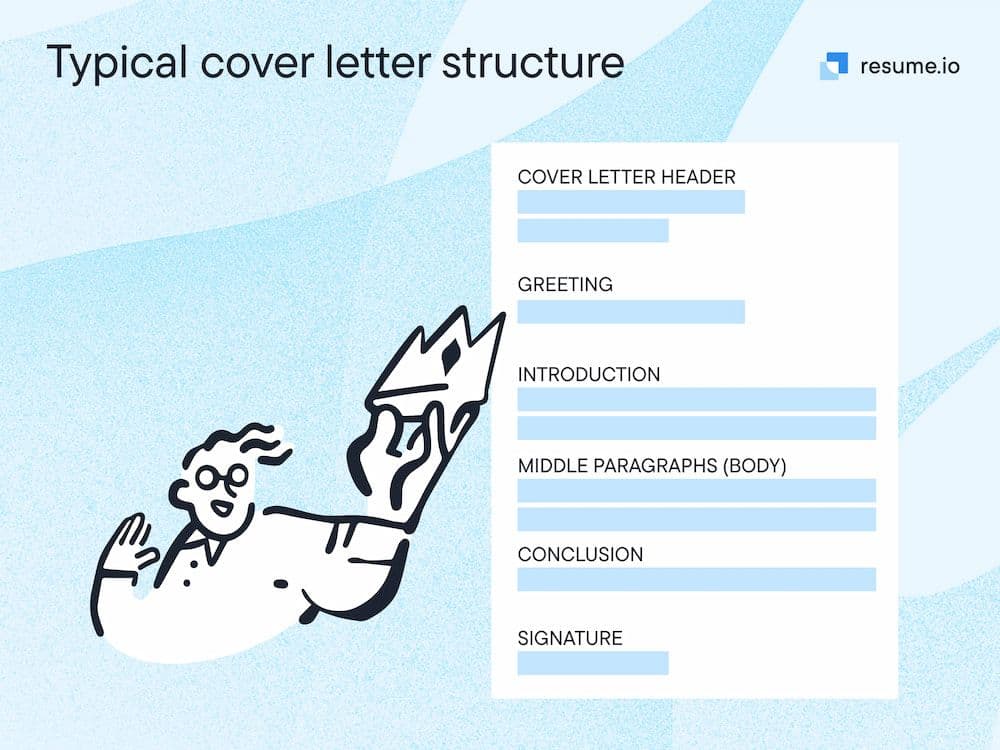
Regardless of type, every cover letter should follow the same cover letter format — header, greeting, body paragraphs, and sign-off on a single page.
What does a cover letter include?
A standard cover letter includes a header, a personalized greeting, an opening paragraph, one or two body paragraphs, a closing paragraph, and a professional sign-off.
Most letters run three to five paragraphs and follow this structure:
- Header: Your contact details, the employer's details, and the date.
- Opening paragraph: State the role you are applying for and give the reader a reason to keep going.
- Body paragraph(s): One or two relevant achievements, explained in your own words, focused on what they mean for this specific employer.
- Closing paragraph: Restate your interest and invite a conversation.
- Sign-off: A professional closing greeting such as “Sincerely,” followed by your name.
For a section-by-section breakdown with examples, see what to include in a cover letter.
What does a cover letter look like?
A cover letter looks like a formal business letter: your contact details at the top, a greeting, three to four short paragraphs of content, and a sign-off — all on one page.
Here is a short example of how the structure comes together in practice:
Cover letter template
Dear Ms. Johnson,

I am applying for the Marketing Coordinator role at Brightfield Agency. With three years of experience managing social content and paid campaigns at a mid-size retailer, I am confident I can contribute to your team from day one.

In my current position, I reduced cost-per-click by 30% over six months by restructuring our audience targeting strategy. I am drawn to Brightfield specifically because of your focus on data-led creative work, and I would welcome the chance to bring that same approach to your clients.

Thank you for your time. I would love to discuss the role further at your convenience.

Sincerely,
Jordan Lee
This is three short paragraphs: an opener that states the role and your relevance, a body paragraph with a specific achievement tied to the employer's needs, and a brief, confident close. Keep yours to this kind of length unless the job description asks for more — our guide on how long a cover letter should be explains the word-count targets.
Why does a cover letter matter?
A cover letter matters because it does things a resume simply cannot — show genuine interest, explain an unconventional path, and give the hiring manager a sense of who you are before you ever speak.
It shows you chose this employer deliberately, not at random. It gives context to a career path that might look unconventional on paper. And it gives the hiring manager a sense of who you are before you ever speak to them.
Our cover letter research shows that applicants are nearly twice as likely to land an interview when they include one, even when the listing says it is optional (cover letter research, 2025).
What makes a cover letter worth reading?
The cover letters that get noticed are tailored to the role, focused on what the candidate brings to the employer, and written in a voice that sounds like a real person.
Generic letters are easy to spot — and easy to skip. The ones that earn a full read are written specifically for the role, not adapted from a previous application. They focus on what the candidate brings to the employer, not just what the candidate wants. And they sound like a real person, not a template.
Showing genuine enthusiasm for the role is more powerful than most people realize. Hiring managers want to feel that you actually want to be there. Letting that come through, while staying professional, gives your application a different quality to the ones that play it safe. A tailored cover letter makes that difference deliberate rather than accidental.
Cover letter examples and resources
Start with a template matched to your industry, then customize using occupation-specific examples and the guides below.
Ready to write your own? Start with a cover letter template matched to your industry, then browse occupation-specific cover letter examples for roles like entry-level, teacher, nursing, and graphic design. Use our cover letter generator to handle structure while you focus on content.
For deeper guidance, explore these related articles:
- How to format a cover letter — layout, spacing, and structure
- What to include in a cover letter — section-by-section breakdown
- How to tailor a cover letter — customizing for each application
- ATS-friendly cover letters — passing applicant tracking systems
- How long a cover letter should be — word count and page limits
Frequently asked questions about cover letters
These are the questions we hear most often about cover letters — from whether you need one to how much customization is enough.
Do I need a cover letter if the job listing says it's optional?
Yes, in most cases — optional does not mean unwanted. Most hiring managers still read cover letters, and submitting one signals genuine effort and interest in the role. It is one of the simplest ways to separate yourself from candidates who do not bother.
How long should a cover letter be?
A cover letter should be one page long, made up of three to five short paragraphs. Aim for around 250 to 400 words. Longer does not mean more impressive; a concise, focused letter is far more likely to be read in full than one that rambles.
Should I use the same cover letter for every application?
No — a reused cover letter is usually easy for a hiring manager to spot, and it signals that you are not particularly invested in their specific role. You do not need to start from scratch each time, but you should tailor the key details — your opening, the achievement you lead with, and any mention of the company — to match each job you apply for.
Can you use ChatGPT to write a cover letter?
Yes, but with caution — AI can help you structure and draft, but it cannot supply the specific details that make a letter work. AI tools can help you structure your letter, overcome a blank page, or tighten up your wording. Where they fall short is in the details that make a cover letter actually work: your specific achievements, your real reasons for wanting the role, and the personal voice that makes a hiring manager feel like they are hearing from a person rather than a template.
Using AI as a starting point is fine. Submitting whatever it produces without editing it is not. Hiring managers are increasingly familiar with AI-generated writing, and a letter that sounds generic will not help your application.
MakeResume offers cover letter templates, occupation-specific examples, and formatting guides to support every step of your application.
Tools & guides mentioned in this article
- AI Resume Builder
Build an ATS-ready resume with AI writing help and live preview.
- Resume Templates
Browse ATS-friendly layouts for every industry and career stage.
- Free ATS Checker
Upload your resume and get an instant ATS compatibility score.
- Career Advice Blog
More resume, ATS, and job-search guides from MakeResume.
Land 3x more interviews with AI.
Don't let your resume get stuck in an ATS. Build an optimized resume in minutes, then validate it with our free checker.