

A strong cover letter gives recruiters a reason to open your resume — it is not a repeat of your work history, but a focused argument for why you belong in this specific role. Knowing what to include in a cover letter takes the guesswork out of getting started and keeps you from filling the page with information a hiring manager does not need.
Every cover letter section has a distinct job to do, from the header that handles formalities to the closing that prompts a response. This guide walks through each part in order, with examples, a section-by-section table, and answers to the questions that come up most when you are drafting from scratch.
Whether you are writing your first letter or tightening an existing draft, use the cover letter outline below to make sure nothing important is missing — and to cut anything that does not earn its place on the page.
What should you include in a cover letter?
A cover letter should include six core elements: a header with your contact details, a personalized greeting, a focused opening, one or two body paragraphs connecting your experience to the role, a brief note on why you want to work for this employer, and a confident closing with a call to action.
Together, these cover letter sections fit onto one page and give the reader everything needed to want to open your resume. According to cover letter research, 83% of hiring managers say a well-written cover letter can help a candidate overcome a weaker resume — but only when each section does real work rather than repeating what is already on the page.
| Section | What it contains | What it does |
|---|---|---|
| Header | Your name, phone number, email address, and the date | Handles the formalities and makes it easy to follow up |
| Greeting | A direct address to the recruiter, by name where possible | Sets a personalized, professional tone from the first line |
| Opening paragraph | The role you are applying for and why it caught your attention | Earns attention and gives the recruiter a reason to keep reading |
| Body paragraphs | One or two relevant accomplishments tied directly to the role | Makes your case with evidence rather than claims |
| Company interest | A genuine reason why you want to work for this employer | Shows you chose this role deliberately, not at random |
| Closing | A call to action and a professional sign-off | Prompts a response and ends on a confident note |
Make this process easier with our Cover Letter Generator — it handles structure so you can focus on what to include in each section. The subsections below expand on every row in the table.
What should your cover letter header include?
Your cover letter header should include your full name, phone number, professional email address, and the date, followed by the recruiter's name and title, the company name, and the company address. Keep the header consistent with your resume in font and layout — a matching design across both documents signals care before a word of content is read.
What to include at the top of the page:
- Your full name
- Phone number and professional email address
- Your city (address) and LinkedIn URL (optional but recommended)
- The date
- The recruiter's name, title, company name, and company address
Place your details first, then the recipient's. For online applications that route through an applicant tracking system, keep contact information in the document body rather than a Word header region — our ATS-friendly resume guide covers the same principle for both documents.
How should you open a cover letter?
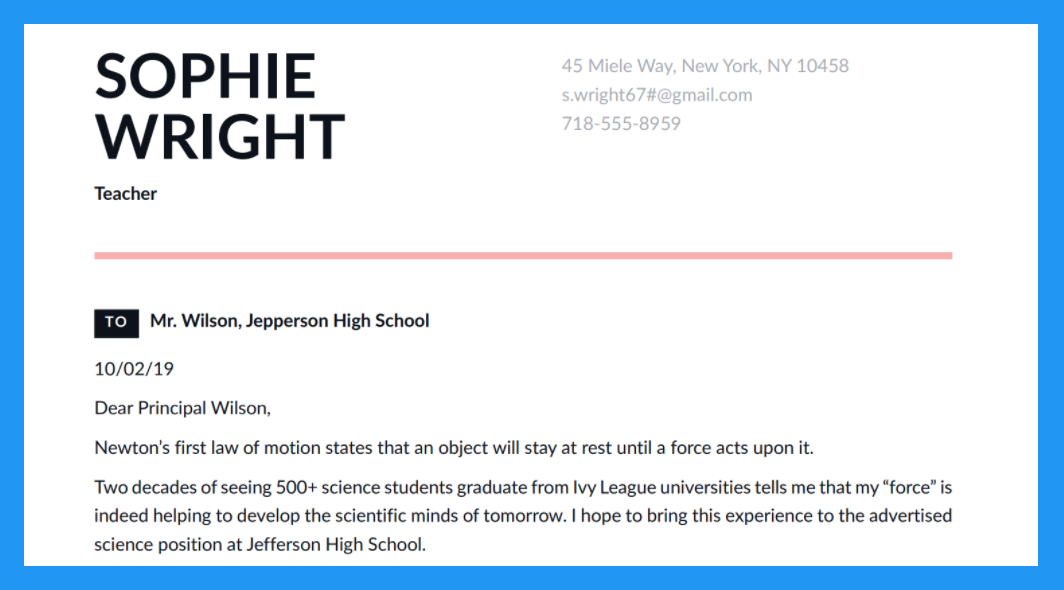
Your opening paragraph should name the role you are applying for, signal genuine interest, and give the recruiter a reason to keep reading — in two to three sentences. Avoid starting with “I am writing to apply for,” the opener recruiters see most often and immediately dismiss as generic.
A stronger opening leads with something real — relevant experience, a specific detail about the company, or a result that connects directly to what the role requires:
- Weak: “I am writing to apply for the Customer Experience Manager role and believe I would be a strong candidate.”
- Strong: “After five years leading customer success teams in fast-growth software companies, the Customer Experience Manager role at [Company] stood out — your proactive support model mirrors the approach I used to reduce churn by 22% at my current employer.”
The second version names the role, connects relevant experience, references something real about the company, and lands a result. That is the level of opening paragraph that earns a recruiter's attention. If someone at the company referred you to the role, name them early — a referral in your cover letter gives your application immediate context and credibility.
What should the body of your cover letter say?
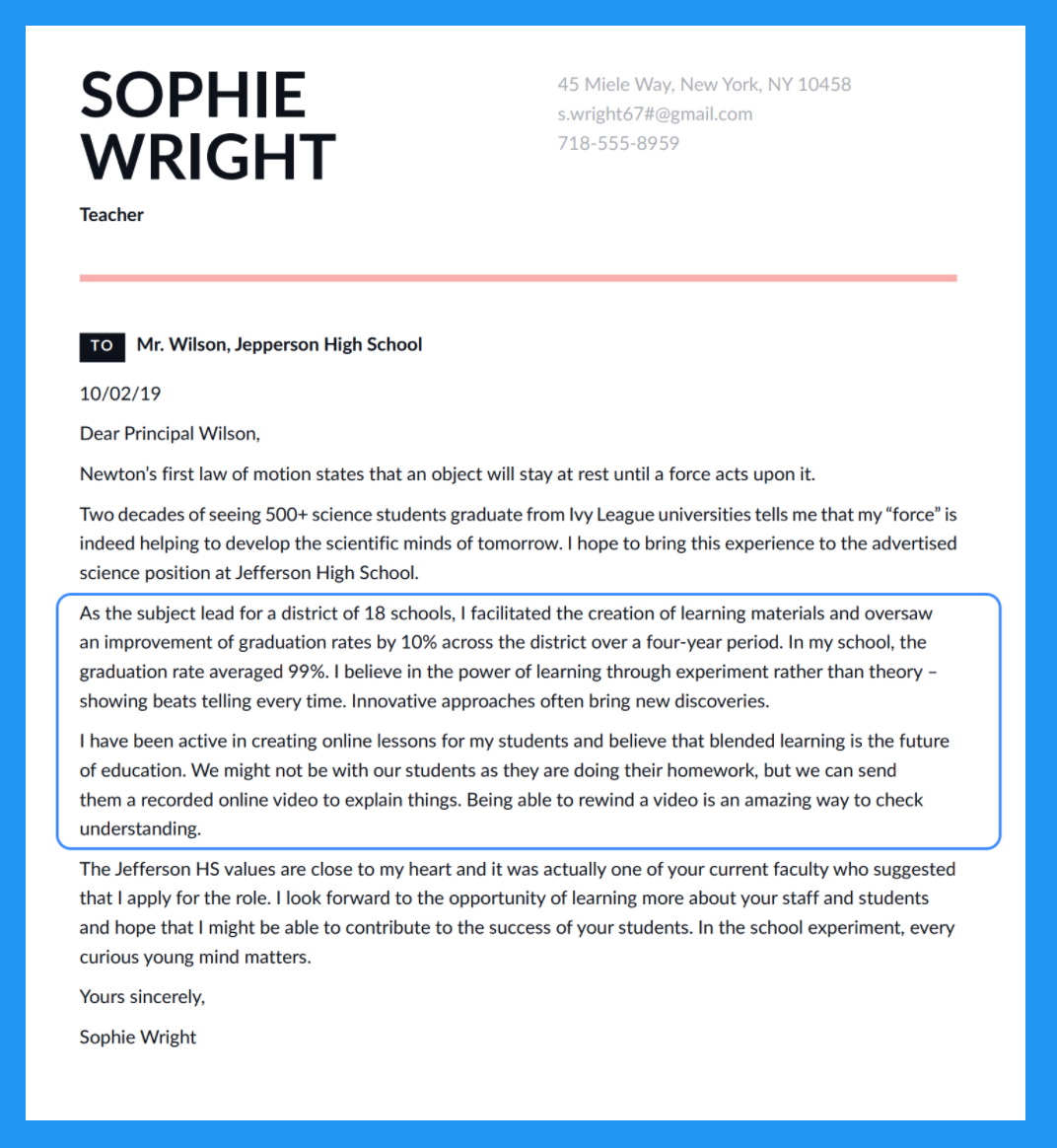
The body of your cover letter — one or two paragraphs — is where you connect your strongest experience to what the employer needs. This is not a repeat of your resume; it is where you explain the reasoning and results behind your most relevant work, with one or two accomplishments rather than a list of duties.
Compare these two approaches:
- Vague: “I have experience managing cross-functional teams and delivering projects on time.”
- Specific: “I led a cross-functional team of nine across three time zones, delivering a product migration six weeks ahead of schedule and under budget by 12%.”
Let the job description guide what you include. If the role emphasizes stakeholder communication and delivery, those areas should lead your body paragraphs. Aligning your language with the listing also helps your letter perform well in applicant tracking system screening — matching the keywords employers use is part of writing a letter that reaches a human reader.
Each body paragraph should add something your resume cannot carry on its own: context, motivation, and the reasoning behind a result. That is what this section is for, and it is where a tailored cover letter earns its advantage over a generic one.
Should you include why you want to work for the company?
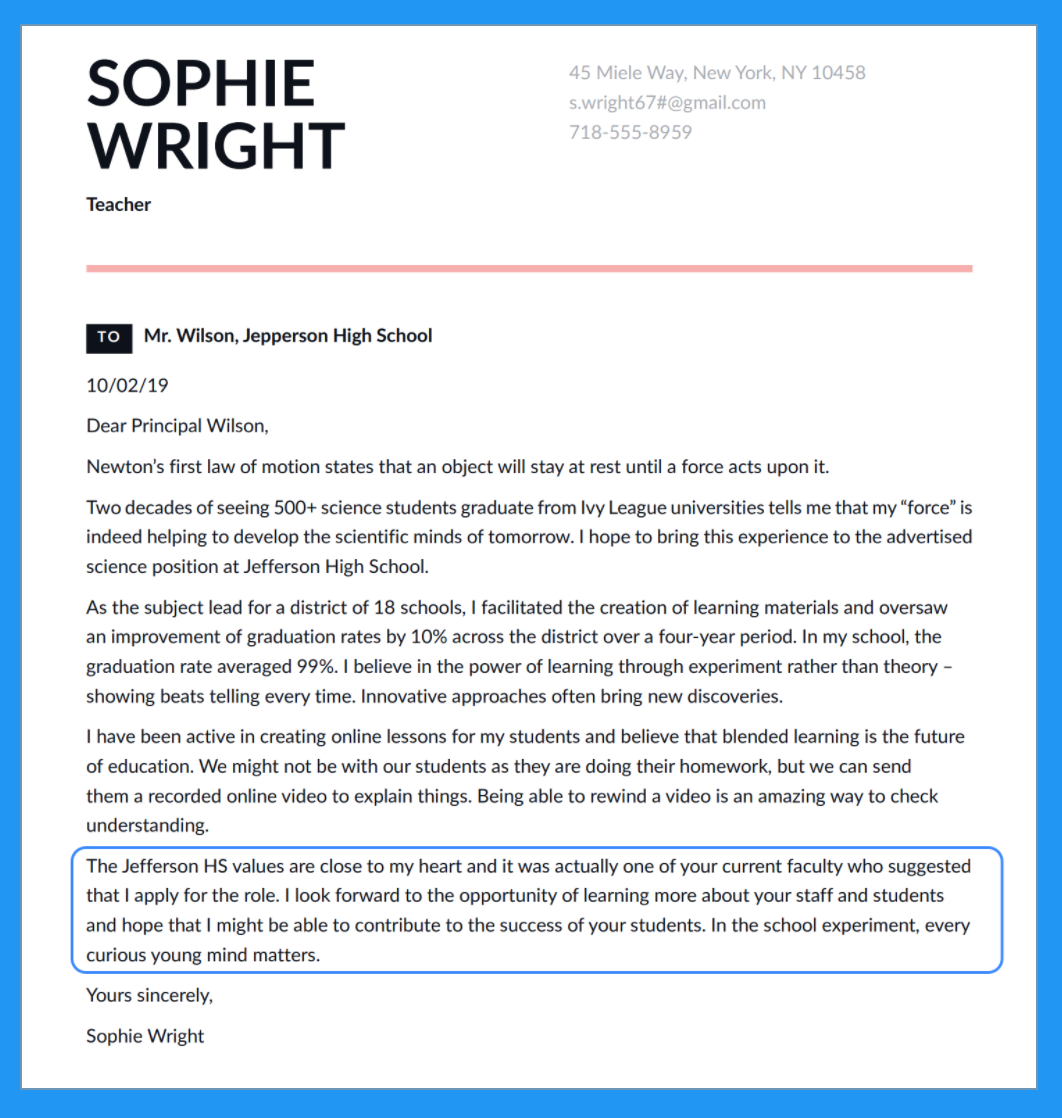
Yes — two to four sentences on why you want to work for this organization is one of the most persuasive parts of a cover letter and one of the most commonly skipped. Recruiters can tell the difference between a tailored letter and one sent to twenty employers; reference something real such as a product you use, a project they recently announced, their mission, or their way of working.
Vague enthusiasm reads as low effort. A concrete detail reads as genuine interest and answers a question every recruiter has but rarely asks directly: did this person choose us, or are they just looking for any job? Answering it well separates a good letter from a forgettable one.
How should you close a cover letter?
Your closing paragraph should restate your interest, express confidence in what you would bring, and include a clear call to action — two to three sentences is enough. Avoid hedging phrases like “I hope I might be considered” or “I look forward to hearing from you at your earliest convenience,” which undercut the confidence the rest of the letter has built.
A strong close reinforces the impression you have spent the letter creating. End with a professional sign-off:
- Use “Sincerely” or “Best regards”
- Follow with your full name
- Add your phone number and email beneath your name so the recruiter does not have to return to the header
For formal or physical applications, a signed cover letter above your typed name is worth including. See our cover letter dates guide if you are unsure how to format the date in the header above your closing.
What should you not include in a cover letter?
A cover letter should not include salary expectations, personal information unrelated to the role, or content taken word for word from your resume. Generic phrases that could apply to any role at any company are equally worth cutting before you submit.
Leave these out:
- Salary expectations: Unless the employer asks, this belongs later in the process.
- Unrelated personal detail: Age, marital status, religion, and family situation are not relevant.
- Resume duplication: If a line could have been lifted from your resume, rewrite or cut it.
- Vague claims: “Hard worker” and “team player” add nothing without a real example behind them.
- Negative comments about past employers: Keep the focus on where you are going, not what you are leaving.
A letter beyond one page is almost always including content the employer does not need at this stage — three to four tight paragraphs is the standard. How you lay those paragraphs out matters too; our cover letter formatting guide covers spacing, font, and structure in full.
How long should a cover letter be?
A cover letter should be one page, made up of three to four short paragraphs. For most applications, 250 to 400 words is the right range — enough to make a clear case without losing the reader's attention.
If your letter is running long, the most common cause is repeating resume content or including background the employer does not need at this stage. A short cover letter done well is always stronger than a longer one with filler, though the right length can shift slightly depending on the role and seniority level.
Frequently asked questions
Still have questions? Here are the ones job seekers ask most about cover letter sections and structure.
Does a cover letter need to follow a specific structure?
Yes. A cover letter should follow a clear order: header, greeting, opening, body, company interest, and a closing with a call to action. This works because it mirrors how a reader processes information naturally — from who you are, to what you bring, to why you want the role. A cover letter outline is a practical way to map this before you start writing, and our what is a cover letter guide explains why the format exists in the first place.
Should every cover letter be different?
Yes. Each cover letter should be tailored to the specific role and employer — a generic letter is easy for a recruiter to identify and signals low engagement with the opportunity. Keep a strong base template and adjust the opening, the company interest section, and your key examples for each application. That saves time without losing the relevance that makes a letter worth reading.
Can a cover letter be shorter than three paragraphs?
Yes, in some cases. A two-paragraph letter works for straightforward roles or where brevity is valued. What matters is that the essentials are covered: who you are, what you bring, and why you want the position. If you can do that clearly in two paragraphs, a third is not needed.
Tools & guides mentioned in this article
- AI Resume Builder
Build an ATS-ready resume with AI writing help and live preview.
- Resume Templates
Browse ATS-friendly layouts for every industry and career stage.
- Free ATS Checker
Upload your resume and get an instant ATS compatibility score.
- Career Advice Blog
More resume, ATS, and job-search guides from MakeResume.
Land 3x more interviews with AI.
Don't let your resume get stuck in an ATS. Build an optimized resume in minutes, then validate it with our free checker.