
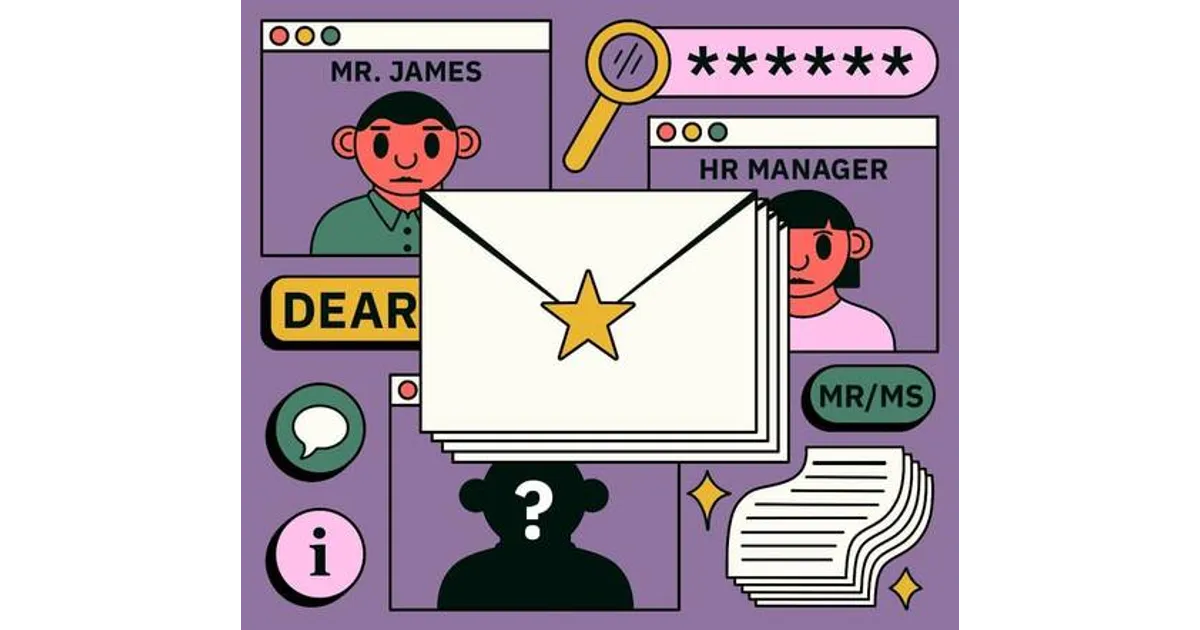
The cover letter greeting is the first line a hiring manager reads — and a generic or misaddressed salutation can undermine an otherwise strong application before the second sentence.
Knowing how to address a cover letter correctly signals that you researched the role and take the process seriously. A personalized cover letter salutation creates an immediate connection; a careless one reads as a mass application.
This guide walks through every scenario: finding the hiring manager's name, choosing the right cover letter greeting when you cannot, and building a complete header that leads naturally into your opening paragraph.
How to address a cover letter
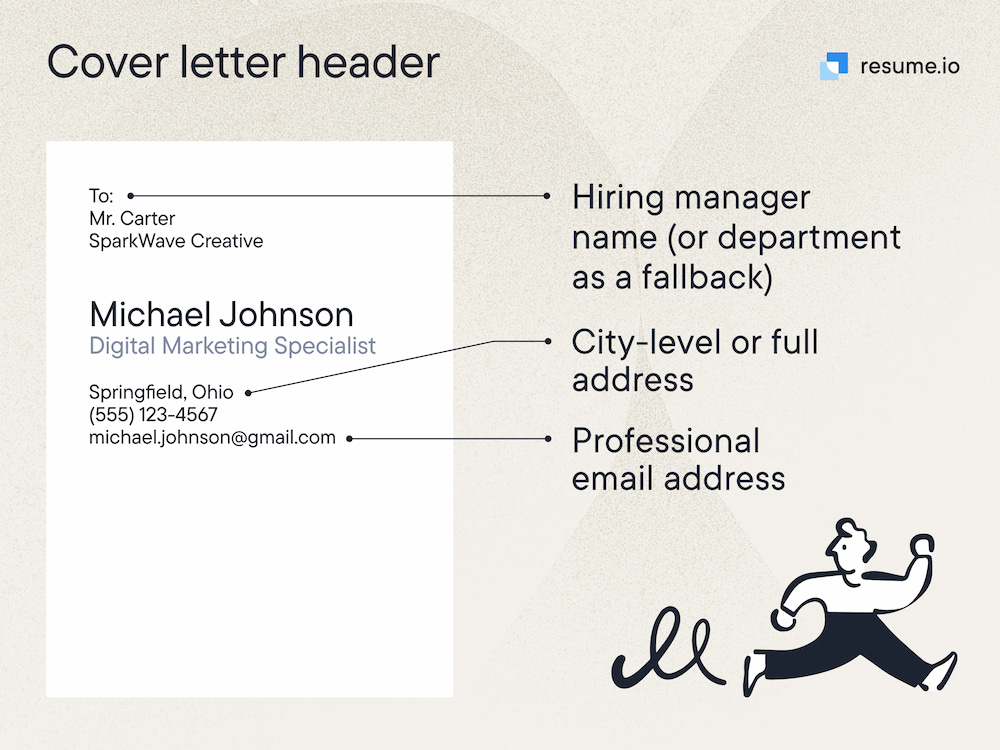
Address a cover letter with a formal greeting followed by the recipient's name — “Dear [First Name Last Name],” when you know it, or a specific department or role title when you do not. Place the greeting below your contact details and the employer block in standard business letter order.

It is only a few words, but the salutation sets the tone for your entire cover letter. When you address it correctly, you show an employer you have done your homework — a small detail that separates a tailored application from a generic one.
A well-addressed cover letter typically includes these elements, in order from top to bottom:
- A greeting and salutation
- The recipient's name
- The company address (optional)
- The date (optional)
- Your contact information
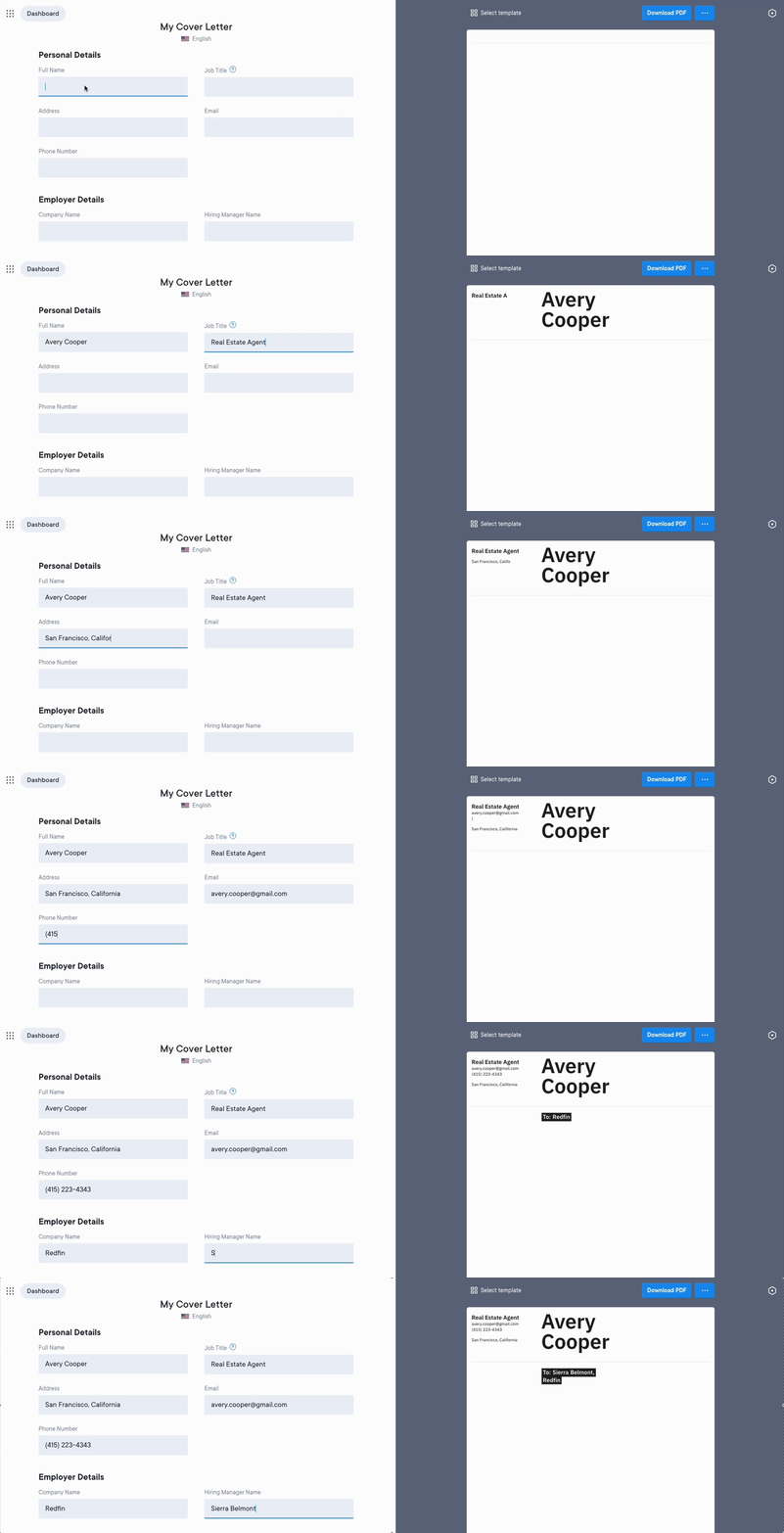
Our cover letter generator handles this structure automatically — you focus on finding the right name and writing the content that follows.
Step 1: Open with a cover letter greeting & salutation
Start with “Dear [Hiring Manager's Name],” — the most widely accepted cover letter greeting — and keep the tone formal throughout. Avoid informal openers like “Hey” or “Hi there,” which read as unprofessional in a job application.
“To [Hiring Manager's Name],” is an acceptable alternative, though “Dear” remains the safer default across industries. Whatever you choose, the salutation should feel deliberate, not casual.
Never assume a hiring manager's gender or preferred pronouns. If you are unsure, use their full first and last name without a title — “Dear Jordan Ellis” is respectful and neutral. When you know their gender and pronouns, “Mr.” or “Ms.” followed by the last name works well.
Avoid “Miss” or “Mrs.” unless you are certain it is their preferred title. A quick search on LinkedIn or the company website usually settles the question before you write a single word of the letter body.
Cover letter greeting examples
Dear John Smith
Dear Mr. Smith
Dear Louise Fox
Dear Ms. Fox
Step 2: Find the right cover letter name
Check the job posting first — many listings name the hiring manager or recruiter directly. If the name is not there, spend ten to fifteen minutes researching before you settle on a generic greeting.
Addressing someone by name is one of the fastest ways to signal a tailored cover letter. Recruiters notice when an applicant took the time to find out who will read their application.
Here are the most reliable ways to find out who to address a cover letter to:
- Visit the company's website: Many organizations list department leaders on “About” or “Team” pages. Look for the head of the department you would be joining.
- Check LinkedIn: Search for the job title plus the company name. You can often find the hiring manager, an HR contact, or someone in the department who can point you in the right direction. See our guide on building a strong LinkedIn profile if you want to use the platform more effectively in your search.
- Do a Google search: Try “[Company name] + [Department] + hiring manager” or “[Job title] + [Company name] + recruiter.” Press releases, conference bios, and industry articles sometimes name the right contact.
- Ask your network: A contact or referral at the company may know the hiring manager's name — and mentioning that connection in your letter adds credibility.
- Call the company: When other options are exhausted, call the main line and ask who handles applications for the role. Most receptionists will share a name or direct you to HR without hesitation.
Should you include their title?
Use a professional title in your salutation when the hiring manager holds one — “Dr.” for a doctorate, for example, instead of “Mr.” or “Ms.” The title belongs in both the employer block of your cover letter header and the greeting line that follows.
If the hiring manager has a PhD, address them as “Dr. [Last Name].” Other titles you may encounter include:
- Professor (Prof.)
- Reverend (Rev.)
- Sergeant (Sgt.)
- Colonel (Col.)
- Captain (Capt.)
- Honorable (Hon.)
Cover letter greetings with titles
Dear Dr. Jones
Dear Prof. Atkins
To Rev. Allsworth
How to address a cover letter without a name
When you cannot find a specific person, address the letter to the department, team, or role title from the job description — not to a generic placeholder like “To Whom It May Concern.”
Refer to the posting or company website to identify which department owns the role or who the position reports to. A targeted fallback like “Dear Product Management Team” still shows you read the listing carefully.
If every research avenue comes up empty, “Dear Hiring Manager” is the accepted last resort. It is professional, current, and widely understood. Avoid outdated salutations such as To Whom It May Concern, Dear Sir/Madam, or Dear Sir or Madam — all read as impersonal and out of touch.
Addressing a cover letter without a name
Dear Accounting Department
Dear Product Management Team
Dear Head of Civil Engineering
Dear Sales Hiring Manager
Addressing a cover letter for multiple recipients
When more than one person will review your application, address the cover letter to all of them — by name if you know each one, or to the team or committee if the group is larger.
Some companies use hiring committees rather than a single decision-maker. In that case, greeting the whole group — “Dear Marketing Team” or “Dear Hiring Committee” — is cleaner than listing five individual names.
Addressing a cover letter to multiple recipients
Dear Anna Johnson and Lee Thomas
Dear Mr. Allen and Ms. Adams
Dear Marketing Team
Dear Hiring Committee
Step 3: Add the company address (Optional)
Include the company's physical address in your header for formal or executive-level applications; skip it for email submissions, which is now the default for most roles.
A polished cover letter header leads directly into your greeting. The employer block should carry the recipient's name and title regardless of whether you add a street address below it.
For high-level positions — C-suite, board, or senior leadership — a full address signals the formality the role demands. For standard email applications, the company name alone is sufficient.
When you do include an address, follow standard cover letter format: company name on the first line, street address on the second, city, state, and zip code on the third.
Company address in a cover letter header
Innovexa Solutions
1234 Market Street, Suite 500
San Francisco, CA 94103
Step 4: Include the date (Optional)
Add the date you send the letter below your contact information — full month, day, and year — though this is optional for most modern email applications.
Industries that still expect a dated header include legal, healthcare, and finance, where formal business correspondence conventions carry more weight.
When you include a date, place it between your contact block and the employer block, using the same spacing as the rest of the letter. See our guide on cover letter dates for formatting details and when to omit the field entirely.
Date in a cover letter
Jane Ryan
New York, NY
(492) 394-1739
j.ryan@email.com
September 30, 2024
Step 5: Provide your details
Place your name, location, phone number, and email at the top of the cover letter, matching the contact block on your resume exactly.
Consistent headers across both documents help a hiring manager connect your application materials at a glance. Mismatched fonts, layouts, or contact details create friction before anyone reads a word of content.
When you email a cover letter, you can omit the contact block from the message body — your email signature or the attached PDF carries that information instead. If you include details in the email itself, place them below your sign-off rather than at the top.
Our cover letter templates apply consistent header formatting automatically, so your letter and resume stay aligned without manual adjustment.
Contact information for a cover letter
Eliza Williams
Frankfort, KY
(374) 301-4730
elizaw@email.com
Examples of well-addressed cover letters
These four scenarios cover the most common addressing situations — use them as starting points and adapt the greeting to your specific application.
When you know the hiring manager's name
Lead with “Dear [First Name Last Name],” and open the first sentence with a direct statement of interest in the role — no preamble needed.
Opening when you know the hiring manager's name
Dear Robert Owens,

I am writing to express my interest in joining the marketing team at...
For a full letter built around a personalized greeting like this, see our digital marketing cover letter example.
When you do not know the hiring manager's name
Use “Dear Hiring Manager,” and compensate for the generic greeting with a specific, role-focused opening line that shows you read the posting carefully.
Opening when the hiring manager's name is unknown
Dear Hiring Manager,

I am thrilled to submit my application for the software development position...
See how this approach works in a complete application in our software developer cover letter example.
When the hiring manager holds a formal title
Address them by their professional title — “Dear Dr. [Last Name],” for example — and maintain that level of formality throughout the letter.
Opening when the hiring manager has a formal title
Dear Dr. Gregory,

With four years of experience working in laboratory settings, I am applying for...
Our scientist cover letter example shows how to carry a formal salutation through the rest of the letter.
When you are emailing a cover letter
Keep the same formal greeting as a printed letter, but pay equal attention to the subject line — it is the first thing the recipient sees in their inbox.
Opening for an emailed cover letter
Dear Ms. Patel,

Attached please find my cover letter for the account executive role...
For a polished email application with a clear subject line and greeting, review our account executive cover letter example.
For more inspiration on keeping the rest of the letter concise, see our guide on how long a cover letter should be and these short cover letter samples.
FAQs about how to address a cover letter
These are the addressing questions job seekers ask most often.
How do you address an email cover letter?
Use the same formal greeting as a printed letter — “Dear [Name],” or “Dear Hiring Manager,” if the name is unavailable — and craft a subject line that includes your full name and the position title.
The subject line is easy to overlook, but it determines whether your email gets opened promptly or buried in an inbox. Keep it short and scannable so a hiring manager can find your application later if needed.
Email cover letter subject lines
Subject: Emily Davis: Sales Director Application
Subject: Noah Garcia - Application for Operations Manager
Subject: Liam Thomson, UX Designer Role
Should I include titles like PhD or MBA in my salutation?
Use “Dr.” when the hiring manager holds a doctorate — it is a formal title they earned and expect in professional correspondence. Do not include degrees like MBA or MS in the salutation; those are credentials, not address titles.
When in doubt, use the person's full name without a title. That is always respectful and avoids guessing wrong.
What are common mistakes to avoid in cover letter addresses?
The three mistakes that most often undermine an otherwise strong cover letter greeting are an informal tone, a misspelled name, and an unnecessarily long salutation.
When writing a cover letter, watch for these specific errors:
- Informal tone: A cover letter salutation should read as professional correspondence, not a message to a friend. “Hey,” “Hi there,” and first-name-only greetings without “Dear” all fall below the expected standard.
- Spelling errors: Finding the right name is only half the job — spell it correctly. A typo in the greeting tells a hiring manager you did not proofread, which raises doubts about the rest of the letter.
- Too lengthy: The greeting is one line. Keep it short and move into your opening paragraph. The full letter should stay within 200 to 400 words, and the salutation is not the place to use any of that budget.
For a complete checklist of what belongs in the rest of the letter, see our guide on what to include in a cover letter.
Tools & guides mentioned in this article
- AI Resume Builder
Build an ATS-ready resume with AI writing help and live preview.
- Resume Templates
Browse ATS-friendly layouts for every industry and career stage.
- Free ATS Checker
Upload your resume and get an instant ATS compatibility score.
- Career Advice Blog
More resume, ATS, and job-search guides from MakeResume.
Land 3x more interviews with AI.
Don't let your resume get stuck in an ATS. Build an optimized resume in minutes, then validate it with our free checker.