
![The US Cities with the Most Unhappy Workers [2025 Study]](/_next/image?url=%2Fblog%2Fthe-us-cities-with-the-most-unhappy-workers.webp&w=1920&q=75)
Job dissatisfaction used to stay inside the break room. Today it lives on TikTok — hashtagged, geotagged, and visible to anyone scrolling past.
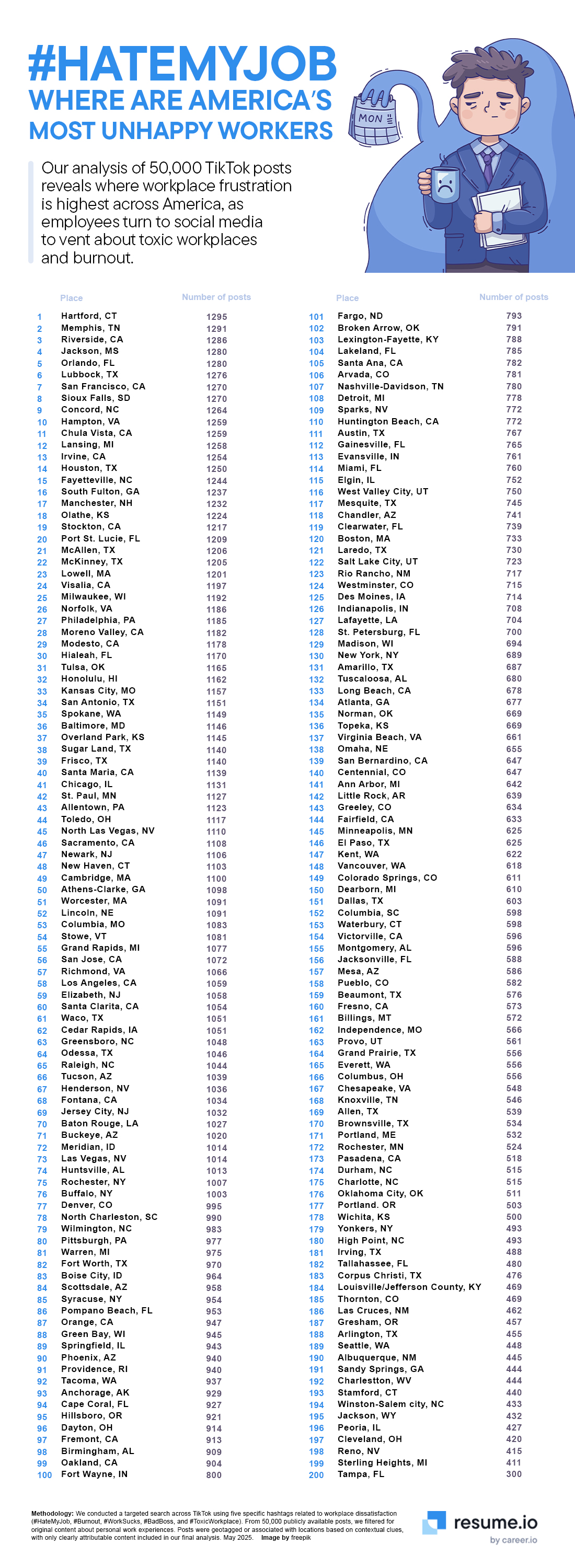
We analyzed 50,000 TikTok posts tagged with workplace frustration — #HateMyJob, #Burnout, #WorkSucks, #BadBoss, and #ToxicWorkplace — to identify which U.S. cities show the highest concentration of unhappy workers.
The map reveals patterns tied to industry stress, cost of living, limited mobility in smaller markets, and toxic management cultures called out online. Here is what the data shows and what it suggests about where dissatisfaction is loudest.
Which industries drive the most workplace dissatisfaction?
Long hours and high stress can quickly result in high levels of workplace dissatisfaction, and many of the cities highlighted in our study are home to industries that are notorious for both, such as healthcare (Memphis, TN), hospitality (Orlando, FL), and tech (San Francisco, CA).
To make matters worse, as well as these sectors being highly demanding, opportunities for advancement within them are often limited, which can then make workers feel stuck and as if there are no alternatives.
How does cost of living affect worker unhappiness?
The higher the cost of living in a city, particularly Hartford, CT, and San Francisco, CA, the higher the level of dissatisfaction.
If you are not being paid that much in the first place, or your income does not go far enough to cover even the basics, even a moderately stressful job can feel unbearable.
The issue here is not just about the work — it is about how pressurized and thankless it can be to try and survive in an expensive environment.
Why are workers unhappy in smaller cities too?
You would think that working in a smaller city, like Lubbock, TX, and Jackson, MS would make things easier: less commute time, cheaper cost of living, your money going a little bit further. But workers in these kinds of places are also unhappy.
With a smaller population comes fewer job opportunities, meaning that workers can often feel trapped in their roles, and cannot find better options that match their skills and ambitions.
How much do bad bosses and toxic culture show up?
Some of the most dominant hashtags include “Bad Boss” and “Toxic Workplace.”
When the rot starts from the top, it trickles down to every single level, and workers are starting to call out poor leadership and negative work cultures.
A micromanaging or toxic workplace has an effect on all parts of its workforce, draining energy, eroding morale and creativity, and making it almost impossible for workers to stay engaged or care about their job.
Can social media help unhappy workers?
Social media has, at least, served to unite dissatisfied workers, who are discovering they are far from alone in their struggles and what they are having to put up with.
It could work as a powerful tool for collective power, meaning that online unity and shared grievances could be the spark needed to push for real change, and even shape the future of workplace reform.
What should employers and workers take from this data?
The list of workplace complaints is, in many ways, the same as it has been over the past few decades: long hours, poor management, limited opportunities, and in some cases, high costs of living.
But the difference is that now, dissatisfied workers have a real voice. The outcome of all this outcry need not be negative: it can be a wake-up call for employers who are, finally, being forced to listen to their workforce.
To retain talent, you need to treat them properly, and bosses need to take action by addressing toxic cultures, offering better work-life balance, and providing career advancement opportunities. If you are ready to move, start with an updated resume and read how to leave a role without burning bridges.
This increase in transparency about life in the workplace may well encourage companies to evolve, if only because having the general public know about their faults and defects should shame them into doing so. As ever, workers with a collective voice can achieve real results, and in this instance, they are more than ready for change.
Study methodology
A targeted search was conducted across TikTok using five specific hashtags directly related to workplace dissatisfaction: #HateMyJob, #Burnout, #WorkSucks, #BadBoss, and #ToxicWorkplace.
A dataset of 50,000 publicly available TikTok posts was compiled. Posts were filtered to ensure relevance, focusing on original content where users described their own work experiences rather than reposts or purely meme content.
Posts were geotagged or, when geotagging was unavailable, associated with a location based on contextual clues within the content or user profile information. Only posts with clear geographic attribution were included in the final analysis.
Frequently asked questions
How was worker unhappiness measured in this study?
Researchers compiled 50,000 TikTok posts using five workplace-dissatisfaction hashtags, then geotagged posts to map which U.S. cities generated the highest volume of frustrated content.
Which factors correlate with unhappy workers?
High-stress industries (healthcare, hospitality, tech), expensive cities where wages do not stretch, smaller markets with limited job mobility, and cultures with toxic management all appeared frequently in the analysis.
What can I do if I am unhappy at work in one of these cities?
Document whether the issue is pay, management, or fit; explore internal options if safe; and prepare an external search with a refreshed resume. Our Sunday Scaries survey shows many workers eventually act on persistent dread.
Tools & guides mentioned in this article
- AI Resume Builder
Build an ATS-ready resume with AI writing help and live preview.
- Resume Templates
Browse ATS-friendly layouts for every industry and career stage.
- Free ATS Checker
Upload your resume and get an instant ATS compatibility score.
- Free Resume Checker
Grade your resume's overall quality, bullet impact, and clarity for free.
- Career Advice Blog
More resume, ATS, and job-search guides from MakeResume.
Land 3x more interviews with AI.
Don't let your resume get stuck in an ATS. Build an optimized resume in minutes, then validate it with our free checker.